Categories
interesting titbits

The Victorian Kindle: Schloss’s Bijou Almanac

‪In the mid nineteenth-century no handbag was complete without a Schloss Bijou Almanac. Anticipating the portability of kindles and tablets, the almanac was half the size of a postage stamp. One would store their almanac alongside a miniature magnifying glass in a small silk lined case.‬

The little book would contain ‘many tasteful vignettes’ (characteristic of the different months) and miniature portraits. (Such as the Princess Royal of England or the infant Charles Dickens.)

The almanac was principally put together by female contributors and marketed ‘for the ladies’. But later editions proclaimed to be – ‘suitable for [both the] purse pocket-book or [the] waistcoat pocket’.


Categories
interesting titbits

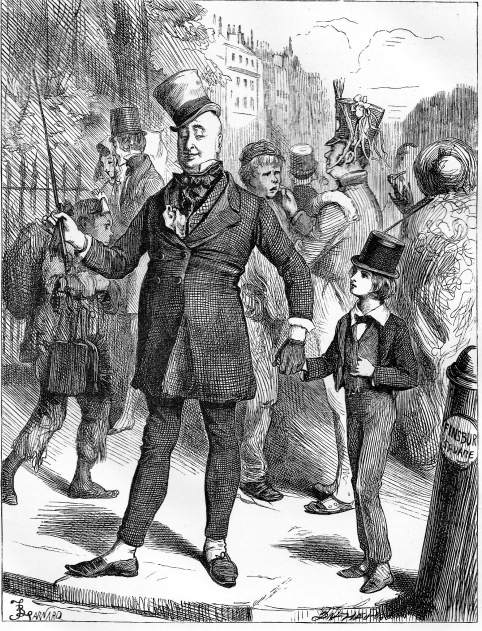
Mr Micawber the Hermit Crab

Welcome poverty!..Welcome misery, welcome houselessness, welcome hunger, rags, tempest, and beggary! Mutual confidence will sustain us to the end! – Mr. Micawber 

Wilkins Micawber from Charles Dickens’ David Copperfield (1854) is known for his resourcefullness, optimism and adaptability.

“His clothes were shabby but he had an imposing shirt-collar on . . . And a quizzing-glass hung outside his coat – for ornament, I afterwards found, as he very seldom looked through it and couldn’t see anything when he did.

Welcome poverty!..Welcome misery, welcome houselessness, welcome hunger, rags, tempest, and beggary! Mutual confidence will sustain us to the end! – Mr. Micawber 

Wilkins Micawber from Charles Dickens’ David Copperfield (1854) is known for his resourcefullness, optimism and adaptability.

“His clothes were shabby but he had an imposing shirt-collar on . . . And a quizzing-glass hung outside his coat – for ornament, I afterwards found, as he very seldom looked through it and couldn’t see anything when he did.

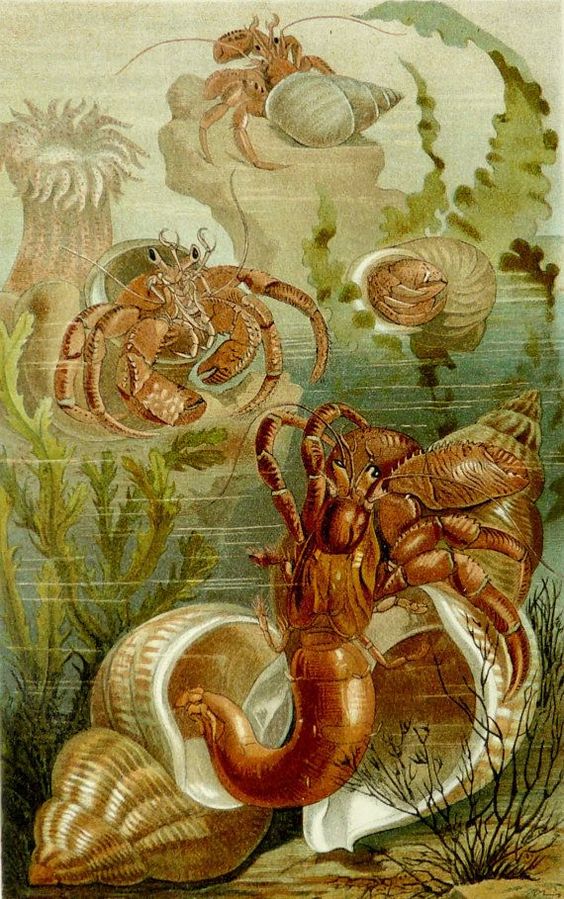
The noted naturalist, and populariser of the aquarium,  Philip Henry Gosse extended Micawber’s sense of reckless buoyancy to the character of the hermit crab in his domestic aquarium.

The Bernhard crab or hermit crab, much like Mr Micawber is in the habit of frequently changing his residence. As the hermit crab grows it finds a new shell to live in. they often make use of the discarded shells of other animals.

Here is Gosse’s amusing anecdote: hermit crab parasitic anemone
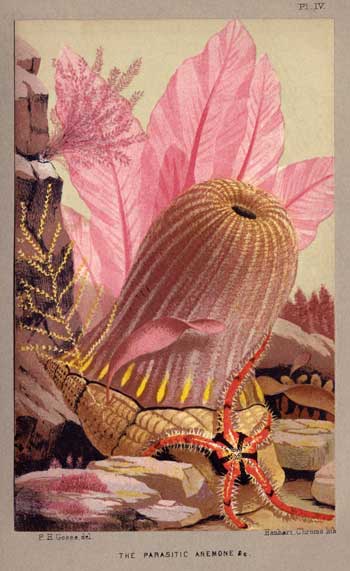
This Bernhard Crab in the front, so leisurely pushing away the sand before him with his broad, flat claws, quietly enjoys the meal he finds, undisturbed by fears of a failing supply. There is less of enterprise than complacency in his character, and I call him Micawber, for he is always expecting “something to turn up.” 

Twice since March has he changed his coat, and thrown off his tight boots and gloves for new ones. The disrobing seemed to give him little trouble, though he sat dozing at the door of his cell some hours after, as though fatigued by the unusual effort. 

Dickens himself makes metaphorical use of the hermit crab in Our Mutual Friend (1864) in reference to John Rokesmith, a character who sheds his old life and takes on a new identity.

‘The natural curiosity which forms the sole ornament of my professional museum,’ he resumes, ‘hereupon desires his Secretary–an individual of the hermit-crab or oyster species, and whose name, I think, is Chokesmith–but it doesn’t in the least matter–say Artichoke–to put himself in communication with Lizzie Hexam.’

___

See Philip Henry Gosse, The Aquarium: an unveiling of the wonders of the deep sea (1854).

Categories
interesting titbits

The Little King of Serpents: A Basilisk in the Archives

I stumbled upon these plates from a gorgeous book entitled An Essay Towards a Natural History of Serpents (1742) and had to share them on the blog. I love it when the boundaries of science and folklore begin to blur. The book is available via the Biodiversity Heritage Library.

Fellow muggleborns should pay close attention to pages 78 and 79 which may be of use should a certain chamber be opened once more. The pages bear more than a passing resemblance to a passage found by one Hermione Granger on a fateful day in 1993.

An abridged excerpt is as follows …

The Basilisk or Cockatrice, is a Serpent of the Draconick Line: in shape [it] resembles a Cock, the Tail excepted. Authors differ about its Extraction; the Egyptians say, it springs  from the Egg of the Bird Ibis; and others, from the Eggs of a Cock: other conjectures about its descent, being as ridiculous, I forbear to mention them. It is gross in Body, of fiery Eyes, and sharp Head, on which it wears a Creft, like a Cock’s Comb. It has the Honour to be known by the latins as the Little King of Serpents. … Tradition adds, that its eyes and breath are killing.


Several dreadful things are attributed to its venomous qualities. The Venom of the Basilisk is said to be so exalted, that … it will kill the person that makes use of it.


The reason why this Serpent is dubbed King is not because it is larger in bulk, or because it wears a Crown, … But ’tis most probable, that the royal title is given to this Serpent, because of its majestic pace, which seems to be attended with an Air of Grandeur and Authority. It does not, like other Serpents, creep on the Earth … but moving about, in a sort of an erect Posture, it looks like a Creature of another Species, therefore [other serpents] conclude ’tis an Enemy.

C12F308B-3F4C-47B3-A691-6A789581CC1E

Categories
interesting titbits

Weekly Roundup of Curiosities #3