In 2021 I co-wrote Pre-Raphaelites in the Spirit World alongside Professor Barrie Bullen and Lenore Beaky. This fascinating project entailed transcribing, contextualising and providing explanatory notes for William Michael Rossetti’s Séance Diary – a remarkable document in both the history of Pre-Raphaelitism and nineteenth-century spiritualism.
In this previously unpublished manuscript, Rossetti meticulously recorded twenty séances between 1865 and 1868. The original motive was the death, in 1862, of Dante Gabriel Rossetti’s wife, Elizabeth Siddal. He felt a profound sense of guilt about her and began these séances to reassure himself that she was happy in the afterlife. Messages came from many spirits within the Pre-Raphaelite circle and provide an unprecedented record of spiritualist activity in the late nineteenth century. Questions and answers fill the pages of the diary, many of them communicating uncannily accurate information or details that could be known only to the participants.
This book also includes another unpublished document showing spiritualism in action. It comprises a long letter to Dante Gabriel Rossetti written in 1856 from the artist and spiritualist medium Anna Mary Howitt recounting her interactions with the spirit world and her (sometimes violent) experiences as she became aware of the extent of her psychic powers. Both sections of this book provide an original insight into the cult of spiritualism and throw considerable light on the interactions between members of the Pre-Raphaelite circle and beyond.
You can currently use code WMR22 for 30% off 💫 or its available on Amazon!
Happy to share that I’m taking on the role of editor for the CLiC Fiction Blog (as Research Fellow at the University of Birmingham) If you are a teacher, historian or literary scholar interested in delving into the CLiC corpora, need any guidance navigating the CLiC app, or are interested in submitting an article let me know! 📚🔎
CLiC (Corpus Linguistics in Context) lets users search for particular words and phrases, study them in context, see how they are distributed across 19thC texts, and compare different texts with one another.
We’re looking for articles that focus on particular details or overarching patterns within our corpora. 📖 Scholars of all career stages welcome, so share widely! More details are available here.
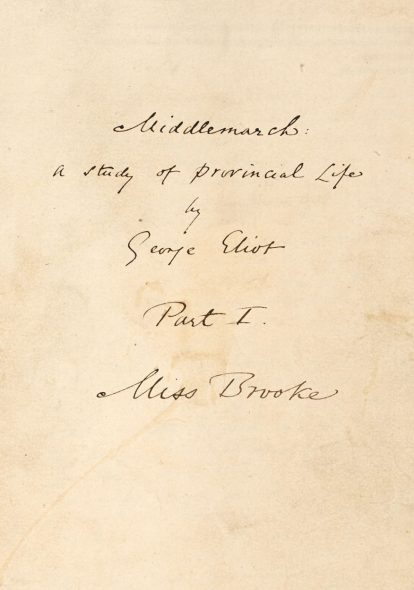
In this blog post, for CLiC Fiction I explore how corpus linguistic tools can be used to illuminate the semantic texture of George Eliot’s writing.
I make use of the CLiC Web App (Mahlberg et al. 2020). From the outset, George Eliot frames Middlemarch: A Study of Provincial Life (1871) as a pseudo-scientific sample of the complex human dynamics that can be found in a provincial town. Using the metaphor of an optical microscope, the narrator vows to concentrate ‘all the light [they] can command’ on ‘unravelling certain human lots and seeing how they [are] woven and interwoven’ (102).
Even with a microscope directed on a water-drop we find ourselves making interpretations which turn out to be rather coarse; for whereas under a weak lens you may seem to see a creature exhibiting an active voracity […] a stronger lens reveals to you certain tiniest hairlets which make vortices for these victims while the swallower waits passively at his receipt of custom.
A ‘strong lens applied to Mrs Cadwallader’s match-making’, Eliot suggests, will show a parallel ‘play of minute causes’ (41). This metaphorical microscope reappears throughout the narrative. Ineffectual intellectual Edward Casaubon — who ‘dreams in footnotes’ — is so single-minded that Mrs Cadwallader suspects a drop of his blood under a slide, would reveal ‘all semicolons and parentheses’ (49). Ego, Eliot infers, can act as a ‘tiny speck very close to our vision’ that ‘blot[s] out the glory of the world and leave[s] only a margin by which we see the blot’, for there is ‘no speck so troublesome as self’ (589).
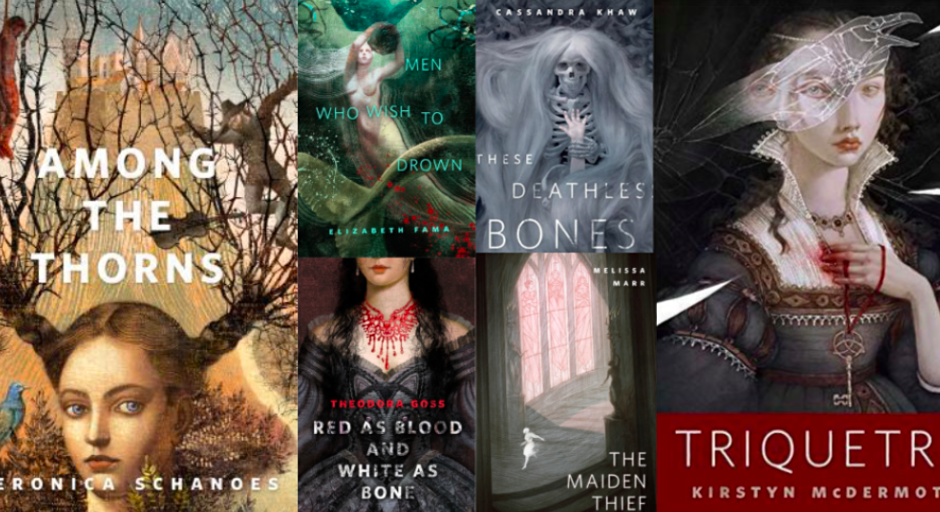
A dark fantasy about a kitchen girl obsessed with fairy tales, who, upon discovering a ragged woman outside the castle during a storm, takes her in–certain she’s a princess in disguise.
A dark fantasy novelette about a teenager whose town is plagued by the annual disappearances of girls and young women. Her father blames her when one of her sisters is one of the taken.
A dark fantasy taking place in seventeenth century Germany, about a young woman who is intent on avenging the brutal murder of her peddler father many years earlier, by a vagabond with a magic fiddle.
A dark fantasy novelette about the fraught relationship between Snow White and her stepmother after Snow White marries the prince and has her own child.
Follow me on Goodreads, for more fantasy recommendations.
How do we approach an age that, increasingly, feels unanchored from our emotional present? Why do the outsized passions and curious habits of the past, often evade faithful restoration? As we take what has been termed a ‘material turn’[1] in Victorian studies, appraising an object’s function has become secondary to uncovering an object’s emotional afterlife. We are still interested, for example, in a fossil’s paleontological value, but are perhaps more eager to learn that they were routinely licked by enthusiastic geologists tongue-testing for mineralisation. Our concern with the affective capacity of an object has led to an intersection between the study of materiality and the burgeoning field known as the ‘history of emotions.’
Do check out my article in the latest issue of theJournal of Pre-Raphaelite Studies – “What of Her Glass Without Her?” Prismatic Desire and Autoerotic Anxiety in the Art and Poetry of Dante Rossetti. / Vol. 28, 2019, p. 16-35.
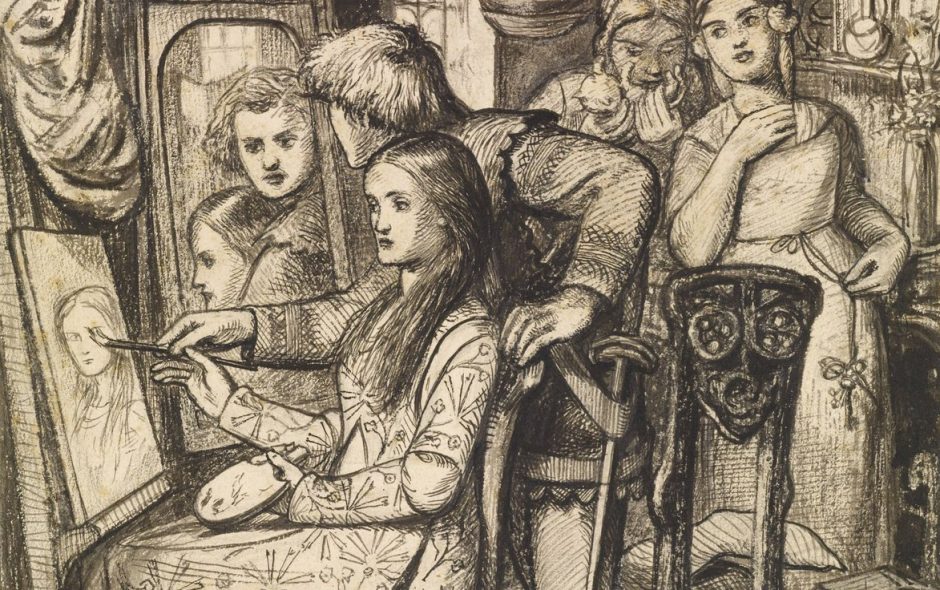
Journeying through the looking glass, this paper examines autoerotic anxiety in the works of Pre-Raphaelite artist and poet Dante Gabriel Rossetti. The Pre-Raphaelite muse, enshrined within the metaphor of the mirror, became a prism through which the artist sought to refract his own desires. In this hermeneutic hall of mirrors feminine identity habitually recedes into the distance. At times, however, the female muse becomes a defiant mirror image that holds the artist in her reflexive thrall. Incorporating phenomena such as “the Venus effect”, Lacanian mirror theory, psychiatric photography, and the Contagious Diseases Act of 1864: I will examine how the looking glass, as a reflective, translucent medium, became inextricably intertwined with femininity. This paper draws on Isobel Armstrong’s Victorian Glassworlds and the work of pre-Raphaelite scholars J. B Bullen and J. H. Miller who first identified Rossetti’s love of crafting “mirrors of masculine desire”.
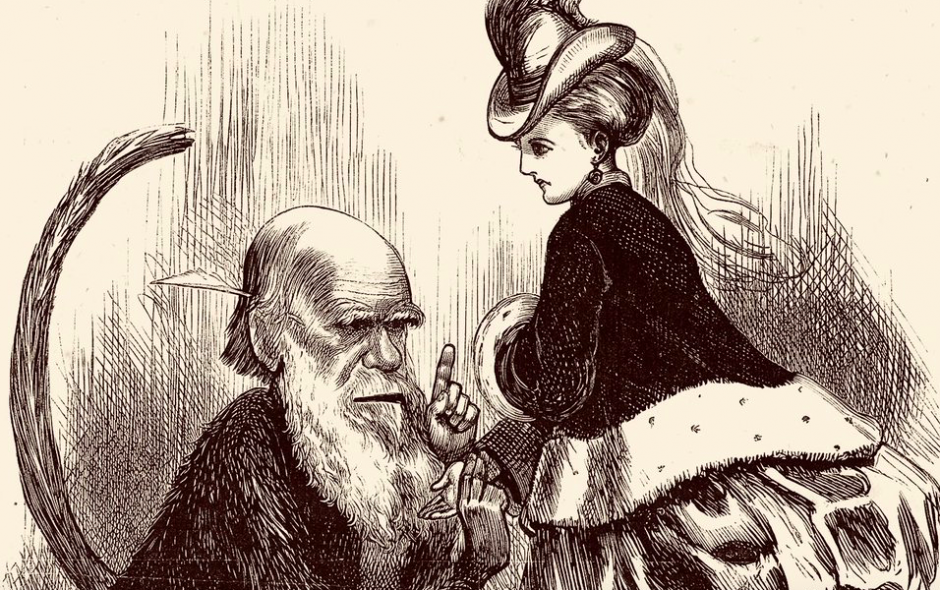
The latest publication from the Darwin Correspondence Project, Darwin and Women, begins with its own taxonomic quandary. From the outset Samantha Evans, entrusted with the tricky task of uncovering Darwin’s intellectual interdependence with women through the fractured prism of his private correspondence, wisely chooses to forgo chronology for a thematic arrangement. This classification system, in which letters are sorted into 14 clusters, means that correspondents frequently reappear under different taxons. The book includes sections on botanical correspondence, observing humans, religion (a chapter edited by Paul White), companion animals, and a section on insects, “small, apparently insignificant creatures”, though, as Evans notes, no mention is made of outliers such as John Lubbock’s pet wasp. My favourite chapter, “Scientific wives and allies”, best illustrates the inextricable way in which the contributions of women interwove with Darwin’s vision of an entangled bank.
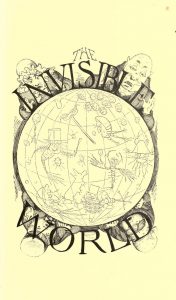
“The Invisible World,” a frontispiece for a chapter on microscopy in The Fairy Tales of Science (1859)
Fitz-James O’Brien (1828-1862) was an Irish-American Civil War soldier and one of the forerunners of the Science-Fiction genre. His primary literary connection was with Harper’s Magazine – a periodical that he contributed to – in prose and verse- over sixty times. He likewise wrote for the New York Saturday Press, Putnam’s Magazine, Vanity Fair, and The Atlantic Monthly. To the latter he sent “The Diamond Lens” in 1858.
“The Diamond Lens” tells the tale of Mr. Linley, a man who has had an obsession with microscopy from childhood. He forges a new microscope lens with a diamond of one hundred and forty carats that has been submitted to electro-magnetic currents to rearrange its atoms. Beneath his new microscope he sees an enchanted realm of minuscule beauty. Common mildew becomes “enchanted gardens, filled with dells and avenues of the densest foliage and most astonishing erdure, while from the fantastic boughs of these microscopic forests hung strange fruits glittering with green, silver, and gold”. Such a descriptive passage would have been familiar to the Victorian reader by 1858.
Common Objects of the Microscope, by Rev. J Wood. (1880 edition.)
Charles Kingsley, for example in 1846 saw “in the tiniest piece of mould on a decayed fruit,’ a tiny animalcule amid a fairy-land of inexhaustible wonders”. Such fervour frequently elicited ridicule, the Quarterly Journal of Science, Literature, and Art, for example, explains to us that a man who observes ‘a drop of stinking ditch-water or the amorous passions of worms and ants’ is likely to be regarded as ‘a puny, pitiful, pedant, whose passions and amusements were of a childish and even degrading complexion’. Unsurprisingly, children’s books of the era habitually married science or natural history with such a fairyland. Works like John Cargill Brough’s The Fairy Tales of Science: A Book for Youth (1859), or Arabella Buckley’s The Fairy-Land of Science (1878).
‘Monster Soup’ a droplet of water from the River Thames.
Fitz-James O’Brien’s tale takes this convention a step further – into the genre of romance. His microscopist witnesses a ‘form’ moving slowly through the glades of a prismatic forest; ‘at last the violet pennons that trailed nearest to me vibrated; they were gently pushed aside, and the form floated out into the broad light.’ In this forest he sees what appears to be a ‘female human shape.’ Linley clarifies that when he say human, he ‘mean it possessed the outlines of humanity; but there the analogy ends.’
I can not, I dare not, attempt to inventory the charms of this divine revelation of perfect beauty. Those eyes of mystic violet, dewy and serene, evade my words. Her long, lustrous hair following her glorious head in a golden wake, like the track sown in heaven by a falling star, seems to quench my most burning phrases with its splendors. If all the bees of Hybla nestled upon my lips, they would still sing but hoarsely the wondrous harmonies of outline that inclosed her form.
Breathless with gazing on this lovely wonder, Linley withdraws his eye from the microscope: gazing with disbelief at ‘the colorless drop of water’ which imprisoned ‘this beautiful being.’ He bestows her with the name Animula. (A name derived from the word animalcule – a generic term for a microscopic animal.) Presumably Animula -with her ‘enchanting curves’, ‘earnest gaze’ and ‘delicate hands’- quite transcends the alien animalcules traditionally observed under the microscope. She has no tentacular protuberances, and does not wear a ring beating cilia around her person. Though her golden glow does suggest she may be bioluminescent.
Animalcule. A Microscopic View of the different Animalcules. Lower Center: London, Published as the Act directs, 12th Novr. 1796, by J. Wilkes
By the time Animula disappears amid the opaline forest Linley’s ‘daylight had vanished’. Tempering the paranoia that he has ‘suddenly gone blind’ he frets that Animula had ‘obeyed the summons’ ‘of a lover or husband’ and wishes he could ‘pierce the mystical walls that so inexorably rose to separate’ them.
With a bitter cry of anguish I fled from the room, and flinging myself on my bed, sobbed myself to sleep like a child.
After having a good cry Linley returns to his study at daybreak. Subsequently, in a passage bizarrely charged with voyertistic desire, the microscopist looks upon Animula as though she is a water nymph attempting to seduce a grecian hero.
I found the sylph bathing, as it were, with an expression of pleasure animating her features, in the brilliant light which surrounded her. She tossed her lustrous golden hair over her shoulders with innocent coquetry. She lay at full length in the transparent medium, in which she supported herself with ease, and gamboled with the enchanting grace that the nymph Salmacis might have exhibited when she sought to conquer the modest Hermaphroditus.
“Join me in my water droplet, you colossus peeping Tom!” Waterhouse Hylas and the Nymphs Manchester Art Gallery 1896
As the hours go by Animulas grows ‘thin and haggard’ – ‘her features contracted, and she writhed, as if with some internal agony.’ After racking his brain ‘for the solution of this mystery’ Linley looks ‘down on the stage of the microscope.’ Only to find that ‘the water droplet had vanished.’
The awful truth burst upon me; it had evaporated, until it had become so minute as to be invisible to the naked eye; I had been gazing on its last atom, the one that contained Animula — and she was dying!
Like Ayesha, the immortal sorceress of H. Rider Haggard’s gothic fantasy She (1887), Animula’s limbs ‘shrivel up into nothings’: her eyes are ‘quenched into black dust’ her lustrous golden hair discolored’.
The slide work of James Neville (1840-1900)
Coming to terms with the fact that his unquenchable curiosity has killed his beloved, the microscopist promptly faints.
Fitz-James O’Brien ends his tale by informing us that his protagonist becomes known as ‘Linley, the mad microscopist’. He lives on the charity of young men who for ‘love of a joke’ invite him to lecture on optics – their laughter competing in his head with his ‘ghastly memories’, ‘the shapes of death’ which gripped his ‘lost Animula’.
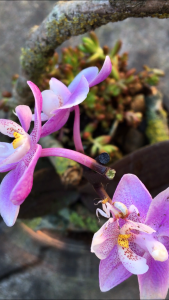
The orchid mantis, (Hymenopus coronatus) is renowned for its visual resemblance to an orchid in bloom. Its pink heart-shaped mid-and hind-legs are semi-opalescent and resemble delicate petals. Naturalists have puzzled over the orchid mantis since the early 19th century. Mr S. E, Peal of Assam (in correspondence with Dr Anderson) describes the deceptive resemblance: “I have just captured a little rose-pink Mantis that simulates a blossom beautifully”. Six months later he observed a second “beautifully white (wax-white) and larger than the previous pink one.” The travel writer James Hingston (in his 1879 account of wanderings in the Orient) also encountered the ambush predator:
Ophelia ready to ambush.
Ophelia the perfect model in her fairy dell.
I am taken by my kind host around his garden, and shown, among other things, a flower, an orchid, that catches and feeds upon live flies. It seized upon a butterfly while I was present, and enclosed it in its pretty but deadly leaves, as a spider would have enveloped it in network.
Alfred Russell Wallace first suggested that the orchid mantis’s ‘aggressive mimicry’ was a predatory strategy in 1877 when he recounted a story by British politician Sir Charles Dilk. In 1868 Dilk, while travelling through Indonesia, was shown a praying mantis that resembled a pink orchid flower. Wallace (1889) suggested that the appearance of an orchid with four petals and a broad labellum could be mimicked by the mantis’ four legs and broad abdomen, whereas the head and thorax of the mantis resembled the column of an orchid flower. In his 1889 book Darwinism Wallace describes the orchid mantis:
A beautiful drawing of this rare insect, Hymenopus bicornis (in the nymph or active pupa state), was kindly sent me by Mr. Wood-Mason, Curator of the Indian Museum at Calcutta. A species, very similar to it, inhabits Java, where it is said to resemble a pink orchid. Other Mantidae, of the genus Gongylus, have the anterior part of the thorax dilated and coloured either white, pink, or purple; and they so closely resemble flowers that, according to Mr. Wood-Mason, one of them, having a bright violet-blue prothoracic shield, was found in Pegu by a botanist, and was for a moment mistaken by him for a flower.
Alfred Russell Wallace and drawing of nymph of “Hymenopus bicornis in active pupa stage” by James Wood-Mason.
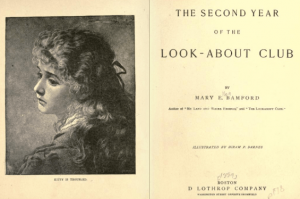
The orchid mantis was later featured in a number of books and articles on animal coloration (Wallace 1877; Wood-Mason 1878; Wallace 1889; Poulton 1890). America author Mary Ellen Bamford (1857-1946) featured the orchid mantis in the sequel to her children’s book The Look-About Club (1887.) Bamford’s series documented “the curious live things” found by a precocious group of young girls smitten with natural history.
The Look-About Club (1887.)
Papa told me some funny things about the mantis. He said that in Java there is a kind of pink mantis that, when it sits still, looks just like a pink orchid-flower. Papa said that this mantis likes to eat butterflies, and the butterflies suppose that the mantis is really a flower, and so they come near it and are caught.
According to the Papa of The Look-About Club the mantis is “of so divine a nature that to a child who asks it its way, it points it out by stretching out one of its legs, and rarely or never makes a mistake.” Chatterbox (a weekly British paper containing stories for children, published in the 19th and 20th centuries) likewise supposes in 1894 ‘that the unwary insects take the Mantis for an orchid and walk into a living grave.’
By the end of the century Wallace’s theory was taken as indisputable fact. L N Badenoch, for example, pays homage to the orchid mantis in True Tales of the Insects under the subtitle ‘alluring colouration and aggressive mimicry’ :
Colour, form, and attitude all conspire, in an inimitable manner, to produce the resemblance. Of the meaning of the resemblance there can be no doubt. Insects seem attracted to the mantis, as insects to flowers ; they settle upon it, and are instantly captured.
Alfred Russell Wallace’s initial theory has only recently (Hanlon & Rashid: 2013) been further investigated. The assumption that the orchid mantis’ morphology functions as a form of mimicry implies that the orchid mantis is cognitively misclassified as an orchid. However researchers recently concluded that the shape and color features of the orchid mantis’ body does not converge upon a specific flower. Using spectrometry to measure their overall coloration geometric morphometric techniques, researcher’s concluded that the mantis was seen by its prey as an approximation of various flowers. They have also been proven to attract more pollinators (per hour) than a number of control stimulus flowers. ( Hanlon et al: 2014) This predatory strategy ensures that the mantis does not discriminate its prey – attracting all manner of pollinators – into its waiting jaws.
Bamford, M. E., & D. Lothrop & Company. (1887). The Look-About Club, and the curious live things they found. Boston: D. Lothrop Co.
L. N. Badenoch, True Tales of the Insects, Dutton, 1899.
‘Coloration and morphology of the orchid mantis Hymenopus coronatus (Mantodea: Hymenopodidae)’, J.C. O’Hanlon, D. Li and Y. Norma-Rashid, Journal of Orthoptera Research, Vol. 22, No. 1 (2013), pp. 35-44.
J.C. O’Hanlon, G. I. Holwell, M.E. Herberstein; Predatory pollinator deception: Does the orchid mantis resemble a model species?, Current Zoology, Volume 60, Issue 1, 1 February 2014, Pages 90–103.
In the mid nineteenth-century no handbag was complete without a Schloss Bijou Almanac. Anticipating the portability of kindles and tablets, the almanac was half the size of a postage stamp. One would store their almanac alongside a miniature magnifying glass in a small silk lined case.
The little book would contain ‘many tasteful vignettes’ (characteristic of the different months) and miniature portraits. (Such as the Princess Royal of England or the infant Charles Dickens.)
The almanac was principally put together by female contributors and marketed ‘for the ladies’. But later editions proclaimed to be – ‘suitable for [both the] purse pocket-book or [the] waistcoat pocket’.




 The latest publication from the Darwin Correspondence Project, Darwin and Women, begins with its own taxonomic quandary. From the outset Samantha Evans, entrusted with the tricky task of uncovering Darwin’s intellectual interdependence with women through the fractured prism of his private correspondence, wisely chooses to forgo chronology for a thematic arrangement. This classification system, in which letters are sorted into 14 clusters, means that correspondents frequently reappear under different taxons. The book includes sections on botanical correspondence, observing humans, religion (a chapter edited by Paul White), companion animals, and a section on insects, “small, apparently insignificant creatures”, though, as Evans notes, no mention is made of outliers such as John Lubbock’s pet wasp. My favourite chapter, “Scientific wives and allies”, best illustrates the inextricable way in which the contributions of women interwove with Darwin’s vision of an entangled bank.