The latest publication from the Darwin Correspondence Project, Darwin and Women, begins with its own taxonomic quandary. From the outset Samantha Evans, entrusted with the tricky task of uncovering Darwin’s intellectual interdependence with women through the fractured prism of his private correspondence, wisely chooses to forgo chronology for a thematic arrangement. This classification system, in which letters are sorted into 14 clusters, means that correspondents frequently reappear under different taxons. The book includes sections on botanical correspondence, observing humans, religion (a chapter edited by Paul White), companion animals, and a section on insects, “small, apparently insignificant creatures”, though, as Evans notes, no mention is made of outliers such as John Lubbock’s pet wasp. My favourite chapter, “Scientific wives and allies”, best illustrates the inextricable way in which the contributions of women interwove with Darwin’s vision of an entangled bank.
In 1842, Charles Darwin relocated to the English countryside where he would spend the next seventeen years working on his magnum opus, The Origin of Species.
There he adopted a surprisingly relaxed routine. The following schedule, provided by Francis Darwin, summarises a typical day in his father’s life.
7 a.m. Rose and took a short walk, followed by breakfast.
8a.m. Worked in his study; he considered this his best working time.
9:30 a.m. Went to drawing-room and read his letters, followed by reading aloud of family letters.
10:30 a.m Return to study, the end of his working day.
12 noon Walk, starting with visit to greenhouse, then round the sandwalk, the number of times depending on his health, usually alone or with a dog.
12:45 p.m. Lunch with whole family, which was his main meal of the day.
3 p.m. Rested in his bedroom on the sofa and smoked a cigarette, listened to a novel or other light literature read by ED [Emma Darwin, his wife].
4 p.m. Walk around sandwalk followed by clearing up matters of the day
6 p.m. Rested again in bedroom with ED reading aloud.
7.30 p.m. Light high tea while the family dined. In late years never stayed in the dining room with the men, but retired to the drawing-room with the ladies.
10 p.m. Left the drawing-room and usually in bed by 10:30, but slept badly.
Darwin’s strategy is one of crafted self-possession. He prioritises domestic comfort, time with the family, rambles in the country, and immersing oneself in the sensory world over hard-lined intellectual endurance. His emotional discipline is built on positive rather than negative reinforcement.
Moreover, it likely that this approach was adopted in an effort to maintain both his mental and physical health. As Scott Stossel notes in My Age of Anxiety: Fear, Hope, Dread, and the Search for Peace of Mind Darwin’s wellbeing was psychosomatically wed to his work.
Observers going back to Aristotle have noted that nervous dyspepsia and intellectual accomplishment often go hand in hand. Sigmund Freud’s trip to the United States in 1909, which introduced psychoanalysis to this country, was marred (as he would later frequently complain) by his nervous stomach and bouts of diarrhea. Many of the letters between William and Henry James, first-class neurotics both, consist mainly of the exchange of various remedies for their stomach trouble.
But for debilitating nervous stomach complaints, nothing compares to that which afflicted poor Charles Darwin, who spent decades of his life prostrated by his upset stomach.
However this modus operandi not only safeguarded Darwin’s health but also fostered a deep emotional connection with his research.
The personal intimacy intertwined with Darwin’s ‘entangled bank’ resonates within the lucid flow and appreciative tone of his argument.
It is interesting to contemplate an entangled bank, clothed with many plants of many kinds, with birds singing on the bushes, with various insects flitting about, and with worms crawling through the damp earth, and to reflect that these elaborately constructed forms, so different from each other, and dependent on each other in so complex a manner.
There is grandeur in this view of life, with its several powers, having been originally breathed into a few forms or into one; and that, whilst this planet has gone cycling on according to the fixed law of gravity, from so simple a beginning endless forms most beautiful and most wonderful have been, and are being, evolved.
Darwin resists an algorythmic, automatic, or breakneck approach; the symbiotic pleasurehe takes in both his writing and research is tied with his ability to take a moment, breathe, and witness the world in a wider dimension.
This consciousness of place, evolving from a sharpening of vision, and a slowing down of time is a method that can be applied to both natural history and to writing.
If your writing is made up of non-stop, frantic, action with no breathing space at all, then – instead of accelerating your work – you can just create a confusing muddle of disparate ideas.
In a letter to H.W Bates in 1861 Darwin provides a plan for dredging your thoughts out of this primordial soup. Lamenting the sting of labouring ‘very hard and slowly at every sentence’, he admits he sometimes finds style ‘a great difficulty’. His advice to fellow floundering writers is as follows:
I find it a very good plan, when I cannot get a difficult discussion to please me, to fancy that some one comes into the room, & asks me what I am doing; & then try at once & explain to the imaginary person what it is all about.— I have done this for one paragraph to myself several times; & sometimes to Mrs. Darwin, till I see how the subject ought to go.— It is, I think, good to read one’s manuscript aloud.
He also suggests that a writer should power through their piece briskly in order to construct a kind of skeleton argument; noting ‘it is good I think to dash “in medias res”, and work in later any descriptions of country or any historical details which may be necessary.’
Darwin, unsurprisingly, encourages writers to work with (rather than against) the natural selection process. Adam Gopnik in Angels and Ages: A Short Book about Darwin, Lincoln, and Modern Life explores Darwin’s strategy for adapting his argument to different environments. Short of growing gills, or developing the ability to camouflage, Gopnik describes Darwin’s power to create ‘a book that is one long provocation in the guise of being none.’ Gopnik notes that the habit of “sympathetic summary,” what philosophers now call the “principle of charity,” is essential to all the sciences and traces the the heart of Darwin’s rhetorical power with his ability to preemptively defend his ideas.
A counterargument to your own should first be summarized in its strongest form, with holes caulked as they appear, and minor inconsistencies or infelicities of phrasing looked past. Then, and only then, should a critique begin. This is charitable by name, selfishly constructive in intent: only by putting the best case forward can the refutation be definitive. The idea is to leave the least possible escape space for the “but you didn’t understand…” move. Wiggle room is reduced to a minimum.
All of what remain today as the chief objections to his theory are introduced by Darwin himself, fairly and accurately, and in a spirit of almost panicked anxiety — and then rejected not by bullying insistence but by specific example, drawn from the reservoir of his minute experience of life. This is where we get it all wrong if we think that Wallace might have made evolution as well as Darwin; he could have written the words, but he could not have answered the objections. He might have offered a theory of natural selection, but he could never (as he knew) have written On the Origin of Species. For The Origin is not only a statement of a thesis; it is a book of answers to questions that no one had yet asked, and of examples answering those still faceless opponents.
Darwin rhetoric not only predicates an opposing argument but inhabits it with all the fidelity and spirit of one who truly holds such an intellectual position. The survival of his thesis is won on the field of intellectual empathy, within the privacy of his own work, rather than through an indelicate fight to the death played out in the public arena.
Thus, Darwin teaches us that, in an effort to make sure that your work does not go the way of the dodo – and become usurped by an argument better suited to the wider intellectual climate – it is worthwhile to adapt your methodology and anticipate arguments in order to survive.
In the spirit of this philosophy, I think it is important to remember that such advice is worthless if you do not possess the tenacity to actually write the damn thing – intellectual stagnation, masquerading as perfectionism, is an all too common affliction of writers and researcher’s alike – Darwin himself after all did take over two decades to produce Origin, in equal parts due to academic ambivalence and an eight year sojourn to study barnacles.
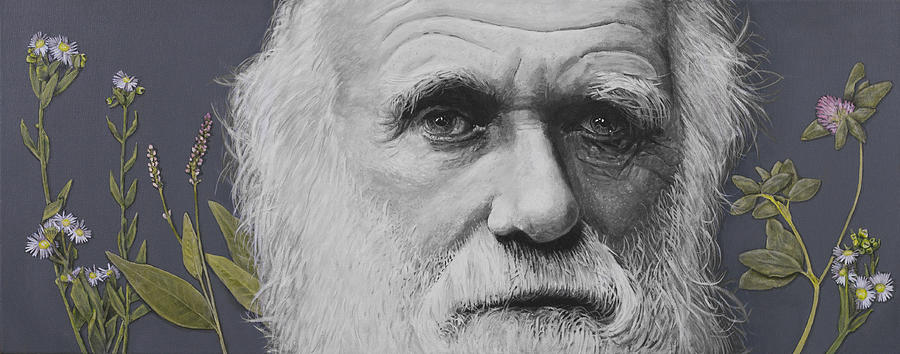
Sandlewalk Wood by Simon Kregar (2012)
Scott Stossel, My Age of Anxiety: Fear, Hope, Dread, and the Search for Peace of Mind (London William Heinemann, 2014)
Charles Darwin On the Origin of Species, (Oxford Classics, 2008)
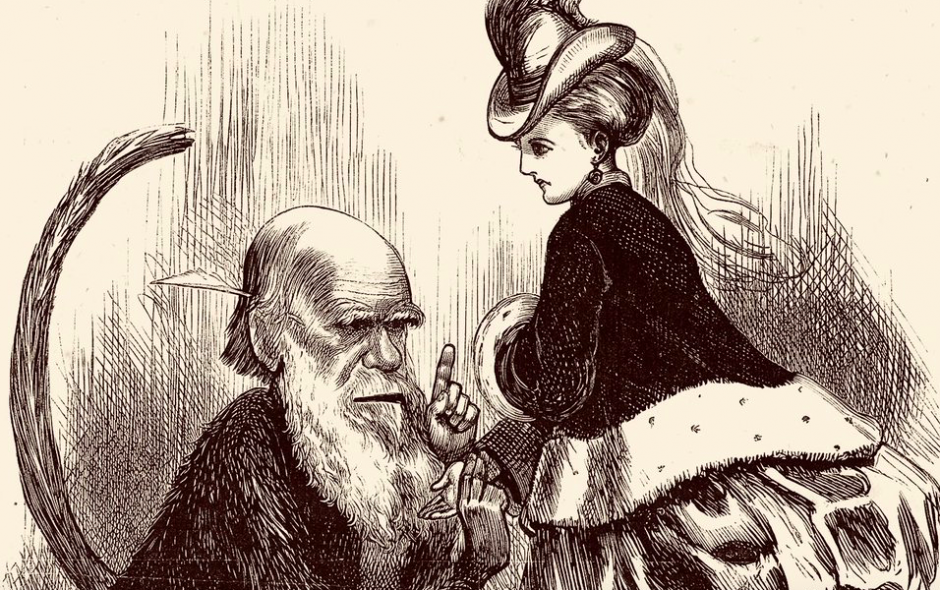
Linley Sambourne’s cartoon ‘Man is but a Worm’, appearing in Punch in 1882 in depicts the evolution of man; from worm, to ape, to an archetypal top-hatted Victorian gentleman, concluding with an image that had fast become an emblem for evolutionary theory – the bearded Darwin himself. The cartoon ridicules the idea of a relation between the two species, using grotesque caricature to depict Darwin’s theory as nothing more than comical absurdity.
Like Linley Sambourne’s cartoon, Charles Kingsley’s The Water Babies parodies much of the discourse surrounding the origins debate. However, Kingsley does not choose to satirise the theory of natural selection itself, instead Kingsley parodies the reaction Darwin’s ideas provoked. The novel ‘argues against purely physical definitions of humanity’. [2] Kingsley takes a bone of contention in the origins debate, The Great Hippocampus Question (which debated upon the similarities between the anatomy of apes and men) and lampoons the debate as ‘the great hippopotamus debate’, using humour to emphasis the absurdity of reducing humanity to anatomy.
‘You may think that there are other more important differences between you and an ape, such as being able to speak… and knowing right from wrong and saying your prayers; but that is a child’s fancy my dear…if a hippopotamus major is ever discovered in one single ape’s brain nothing will save your great-great-great-great-great-greater-greatest-grandmother from having been an ape too.’
Rather than ridicule the idea of natural selection Kingsley takes the essence of the theory and transforms it into what he terms ‘Fairy Science’. As Anne Chassagnol notes:
‘Darwin’s theory is quite a fairy-like concept concerning as it does metamorphosis…[and] focusing frequently upon fantastical, often miniature animals including, larvae, beetles and butterflies’. [3]
Kingsley adopts these characteristics of science and re-imagines them as tenets of fairy-tale. Tom’s odyssey begins with his metamorphosis: like a butterfly he leaves his old husk behind and devolves into an eft in preparation for his moral evolution.
In On the Origin of Species (1859) Darwin emphasises that the natural world is characterised by a struggle for survival. He urges us to remember that ‘birds which are idly singing around us mostly live on insects and are thus constantly destroying life’ . [4] This struggle for survival is depicted in The Water Babies. The trout ‘gobble the beetles and leeches… [and swim] about with great worms hanging out of their mouths, tugging and kicking to get away’ . The otter despairs how men speared her ‘poor dead husband’ . Even Tom is described as being at the bottom of the food chain; the otter first decreeing that Tom ‘is not worth eating after all’ and then threatening that the salmon will eat him and then they will eat the salmon. This struggle is imperative to Tom’s passage into adulthood. Gradually he moves up the evolutionary ladder no longer fraternising with the gnats, the dragonflies and the sea snails, and instead talking to Ellie and other water babies.
The logical inversion of Darwin’s theory, devolution, is made a concrete possibility in The Water Babies. As Mrs Bedonebyasyoudid asserts ‘if I can turn beasts into men, I can by the same law of circumstance and selection and competition, turn men into beasts’. Tom observes many examples of this throughout his journey: some of the salmon become ill adapted through their atrophy and as a result ‘grow ugly and brown and spotted;’ the Tomtoddies turn into radishes, as their brains are so filled with water due to their preoccupation with ‘The Examiner;’ the Doasyoulikes, a race of idle humans, ‘grow so stupid … [that] they have almost forgotten how to talk… [and] will all be apes very soon’.
Tom himself is described at the beginning of the tale as a ‘little black ape’ , which immediately emphasises his risk of degeneracy. Furthermore, he is described to be quite at home in a chimney; ‘a mole underground’ he is adapting to his uncivilized surroundings, and therefore is presented as being on the wrong evolutionary tract. Kingsley uses Tom as a symbol for Victorian anxieties about the degeneration of the poor, who: unclean; uneducated and faithless seemed symptomatic of social degeneration on a national level. This connection between moral decay and evolutionary decline was unequivocally assumed, as although by the 1830s the term ‘evolution’ was used in its modern sense, prior to this it was ‘a term for individual growth’, which ‘only further helped to forge and explicit connection between the two processes’. [2]
Kingsley responds to the anxiety of degeneration with the concept of recapitulation, an idea which suggested that ‘the development of the individual repeats the development of the human race’. Just as ‘the human foetus passes in the womb through the evolutionary stages of life on earth … the growing child passes through physical and psychological stages of savagery and barbarism’. [5]
In The Water Babies the fairies spirit Tom away from London, where he is at risk of evolving into a double of Mr Grimes; he imagines that when he himself is a master ‘he would bully [his apprentices] and knock them about, just as his master did to him’ . They reduce him to an embryonic size and submerge him in a womb-like water-world, where Tom must ‘re-inhabit nature to achieve his own humanity, [in order to] transcend his origins.’ [2] Mrs Bedonebyasyoudid embodies nature’s absolute justice; she ‘cannot help punishing people when they do wrong … [she] work[s] by machinery … wound up carefully [so that she] cannot help keep going’. She does not interfere, allowing the water babies to learn from their mistakes, and adapt accordingly.
However, her code of conduct does differ from Darwinian selection. The natural education Tom is subject to is not reliant on qualities that nurture survival, but on qualities that nurture Christian virtue. It is not survival of the fittest but survival of the moral. For example, Tom grows prickles not because he has done something contrary to his survival but because he has done something contrary to Christian morality; ‘when his soul grew all prickly with naughty tempers, his body could not help growing prickly too’. The use of the word ‘punish’ throughout the novel (the tommodites are ‘punished’ for worshipping the ‘idol’ examination, the salmon ‘properly punished’ for their slothful nature) magnifies the sense that God uses the seemingly autonomous model of natural selection to enact divine punishment. Kingsley only reconciles religion with science, by making the two entities one and the same; faith in the universal laws of science becomes synonymous with faith in divine presence.
This is made irrefutably clear at the end of the novel when Tom and Ellie learn that all the fairies who have throughout Tom’s journey governed nature’s law are one and the same. This epiphany is met with ‘a clear, white, blazing light’ emblematic of divine presence. To Kingsley ‘evolution must have meaning and purpose, two attributes that Darwin had tried to eliminate from his own theory’. [6] Kingsley separates the evolution of man from the evolution of all other organisms, upholding modern man as a superior being because of his moral choices. The notion of Mrs Bedonebyasyoudid’s ‘downhill as well as uphill road’ is made clear; Tom learns Christian principles, and therefore is no longer at risk of remaining a degenerate ‘little black ape,’ nor a ‘poor little heathen’, instead he journeys upon the ‘uphill road’ becoming a ‘great man of science’.
The Water Babies functions simultaneously as a tale of evolutionary recapitulation and as a religious pilgrimage. Tom’s return to a pre-human morphology allows him to spiritually as well as physically adapt to achieve a redemptive end. Parallel to this, physical evolution and moral evolution are inextricably intertwined, as Kingsley hypothesises ‘your soul makes your body just as a snail makes his shell.’ Kingsley takes the idea of evolution as a grotesque struggle and moralises it, likening each transitional stage of physical advancement with moral improvement, and moral decline with physical deterioration. Faith in the indefinite, a tenet of religious belief becomes a prerequisite for scientific practice –
‘You must not say that this cannot be, or that is contrary to nature. You do not know what nature is or what she can do’.
Overall, the Darwinian subtext present in The Water Babies is paramount to the novel’s moral sentiment, that although ‘some people say that [bad behaviour] … is nature, and only proof that we are all originally descended from beasts of prey’, ‘little boys can help it and must help it’ otherwise ‘by doing only what they liked’ they are at risk of degeneracy and ‘will all be apes very soon’.
References
[1] Kingsley, Charles, The Water Babies, (Oxford: Oxford University Press, 1995).
[2] Straley, Jessica, Of Beasts and Boys: Kingsley, Spencer and the Theory of Recapitulation’, Victorian Studies, Vol. 49, No. 4, (2007) pp. 587-609.
[3] Anne Chassangnol, ‘Darwin in Wonderland: Evolution, Involution and Natural Selection in The Water Babies’, University of Toulouse, France, (2010) p. 1.
[4] Charles Darwin, On the Origin of Species, (Oxford University, 1859) p. 62.
[5] Moore, K.L. and Persaud, T.V.N., The Developing Human; Clinically Oriented Embryology, Fifth Edition, (Philadelphia: 1993), p. 608.
[6] Joseph Green, ‘“THE GREAT FAIRY SCIENCE”: THE MARRIAGE OF NATURAL HISTORY AND FANTASY IN VICTORIAN CHILDREN’S LITERATURE’, (University of Missouri-Columbia, 2009) p. 161.
 The latest publication from the Darwin Correspondence Project, Darwin and Women, begins with its own taxonomic quandary. From the outset Samantha Evans, entrusted with the tricky task of uncovering Darwin’s intellectual interdependence with women through the fractured prism of his private correspondence, wisely chooses to forgo chronology for a thematic arrangement. This classification system, in which letters are sorted into 14 clusters, means that correspondents frequently reappear under different taxons. The book includes sections on botanical correspondence, observing humans, religion (a chapter edited by Paul White), companion animals, and a section on insects, “small, apparently insignificant creatures”, though, as Evans notes, no mention is made of outliers such as John Lubbock’s pet wasp. My favourite chapter, “Scientific wives and allies”, best illustrates the inextricable way in which the contributions of women interwove with Darwin’s vision of an entangled bank.


 he takes in both his writing and research is tied with his ability to take a moment, breathe, and witness the world in a wider dimension.