Categories
interesting titbits

Mr Micawber the Hermit Crab

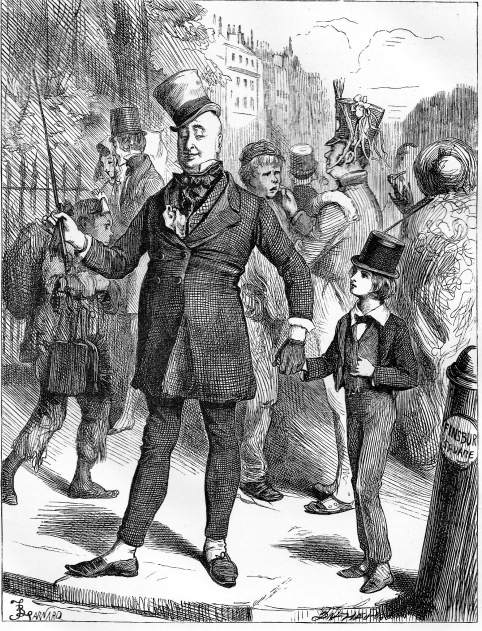
Welcome poverty!..Welcome misery, welcome houselessness, welcome hunger, rags, tempest, and beggary! Mutual confidence will sustain us to the end! – Mr. Micawber 

Wilkins Micawber from Charles Dickens’ David Copperfield (1854) is known for his resourcefullness, optimism and adaptability.

“His clothes were shabby but he had an imposing shirt-collar on . . . And a quizzing-glass hung outside his coat – for ornament, I afterwards found, as he very seldom looked through it and couldn’t see anything when he did.
Welcome poverty!..Welcome misery, welcome houselessness, welcome hunger, rags, tempest, and beggary! Mutual confidence will sustain us to the end! – Mr. Micawber 

Wilkins Micawber from Charles Dickens’ David Copperfield (1854) is known for his resourcefullness, optimism and adaptability.

“His clothes were shabby but he had an imposing shirt-collar on . . . And a quizzing-glass hung outside his coat – for ornament, I afterwards found, as he very seldom looked through it and couldn’t see anything when he did.

The noted naturalist, and populariser of the aquarium,  Philip Henry Gosse extended Micawber’s sense of reckless buoyancy to the character of the hermit crab in his domestic aquarium.

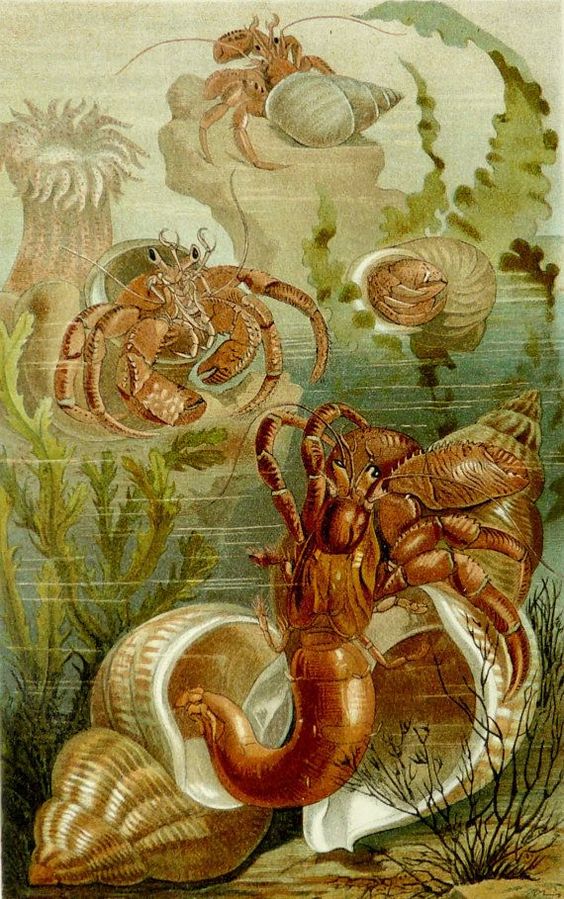
The Bernhard crab or hermit crab, much like Mr Micawber is in the habit of frequently changing his residence. As the hermit crab grows it finds a new shell to live in. they often make use of the discarded shells of other animals.

Here is Gosse’s amusing anecdote: hermit crab parasitic anemone
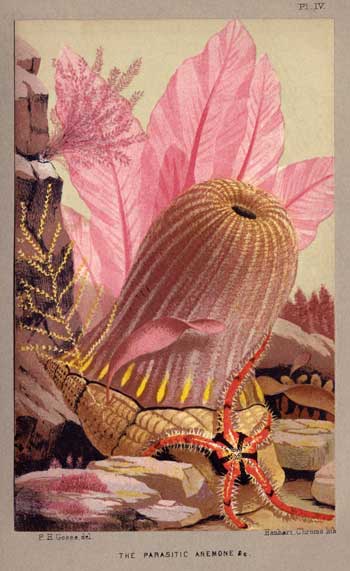
This Bernhard Crab in the front, so leisurely pushing away the sand before him with his broad, flat claws, quietly enjoys the meal he finds, undisturbed by fears of a failing supply. There is less of enterprise than complacency in his character, and I call him Micawber, for he is always expecting “something to turn up.” 

Twice since March has he changed his coat, and thrown off his tight boots and gloves for new ones. The disrobing seemed to give him little trouble, though he sat dozing at the door of his cell some hours after, as though fatigued by the unusual effort. 

Dickens himself makes metaphorical use of the hermit crab in Our Mutual Friend (1864) in reference to John Rokesmith, a character who sheds his old life and takes on a new identity.

‘The natural curiosity which forms the sole ornament of my professional museum,’ he resumes, ‘hereupon desires his Secretary–an individual of the hermit-crab or oyster species, and whose name, I think, is Chokesmith–but it doesn’t in the least matter–say Artichoke–to put himself in communication with Lizzie Hexam.’

___

See Philip Henry Gosse, The Aquarium: an unveiling of the wonders of the deep sea (1854).

Categories
longer blog posts

How the Victorian Craze for Conchology became a Billion-dollar Business

Throughout the nineteenth-century the mania for seashells steadily swelled; they featured on Christmas cards, and adorned countless keepsakes, jewellery, and furniture. The Gradgrind nursery in Charles Dickens’ Hard Times is equipped with a “little conchological cabinet, a little metallurgical cabinet, and a little mineralogical cabinet”, whilst, inspired by works of natural history, men and women scoured the seashore for conchological specimens. Conchology, unlike other branches of natural history such as zoology or mineralogy was easily accessible to everyone, and did not require specialist equipment. It also had the added bonus of including inanimate specimens that were not subject to disease or decay.

IMG_5518

The Conchologist / G. Spratt del. ; Printed by G. E. Madeley ; Pubd by C. Tilt, Fleet Street. 

George Spratt’s composite caricature of ‘The Conchologist’ offers a personification of the craze – a woman, fashioned from shells of marine life, is depicted scanning the sea-side for her kin: her basket is filled with sprigs of seaweed and various tide pool treasures. Her rather ineffectual sun-bonnet looks to be crafted from the soft-bodied bell of a jellyfish, while a quasi-vulval cowry shell, disturbingly enlarged, makes up the lower half of her body.

The Shell Grotto in Margate, is perhaps the most impressive example of conchological worship. In 1835 an architectural love letter to the humble shell was uncovered by a man and his son attempting to dig a duck pond. The son, falling from a hole in the ground, recovered from his tumble to find a chamber ‘papered’ with an exquisite tapestry of shells. The chamber was connected to a labyrinthian passage similarly shrouded with cockles, whelks, mussels and oyster shells forming intricate mosaics. We still do not know how, or why the grotto came to be nor who is responsible for its creation.

Victorian women made use of their collection in various handicraft projects. Many put together imitation bouquets: using various miniature shells to create the desired flower.

Soon enough collectors, having exhausted the beaches of Britain, took to harvesting more impressive shells from overseas. An army of merchants, catering for the increasing demand, set up shop in London.

The name of the global oil company  “Shell” is, oddly enough, a reminder of the victorian love of conchology.

In 1833 one Marcus Samuel opened such a shop selling shells, curios, and other trinkets to natural history enthusiasts. By 1851 Marcus was described in the census as a ‘shell merchant’ and was listed as proprietor of ‘The Shell Shop’ in Houndsditch. He later formed the ‘Shell Transport and Trading Company.’ In 1882 his son (Marcus Junior) while travelling in the Caspian Sea, saw a potential for exporting oil from the region. He commissioned the world’s first purpose-built oil tanker and named the tanker the Murex, Latin for a type of snail shell, as  a nod to the company’s beginnings. The first logo (1901) was a mussel shell, but by 1904 it was replaced with a scallop shell.

And so it has remained ever since.

Categories
longer blog posts

This particular web: a week with George Eliot at Dickens Universe 2017

I at least have so much to do in unravelling certain human lots, and seeing how they were woven and interwoven, that all the light I can command must be concentrated on this particular web, and not dispersed over that tempting range of relevancies called the universe. (2.15.1)

In an academic world where we are accustomed to reading multiple works in tandem, where we have to juggle disparate eras, genres, and styles, the opportunity to spend an entire week alone with a single novel is as rare as it is rewarding. This year, for the first time in 36 years, the organisers of Dickens Universe chose to illuminate a single work outside of Dickens’ oeuvre. The spotlight was torn from Charles Dickens and refocused onto his contemporary, George Eliot: zooming in on her meticulous study of provincial life, the once infamous Middlemarch. The chosen text provided us with a sample frame teeming with microscopic particulars and idiosyncratic details –  revealing a work that through its focused myopia became known for its expansive influence.


The keynote papers each morning provided us with a centre of illumination with which to interpret Middlemarch: our thoughts and discussions arranging themselves, like the scratches of Eliot’s pier glass, in a series of concentric circles around each speaker’s provocative thesis. The cumulative effect of this was that each of us emerged at the conference’s close with a Venn diagram of overlapping interpretations of the novel that orbited around a constellation of different arguments.

My own thoughts centred around the concept of Middlemarch as text that, as Ruth Livesey put it, ‘flickers between particularity and universalism.’ Alongside Ruth’s talk on the middleness of Middlemarch, Summer Star’s examination of the significance of multitasking in Middlemarch as well as Helen Michie’s paper detailing the value of mid-page lexical forays helped me to foster new ways of thinking about my own work. Helen Michie’s paper, alighting on words such as ‘pilulous’ and ‘privacies,’ demonstrated how to refocus a text through the prism of a single word. – A methodology that yields surprisingly nuanced results and which, I hope, will inform my own research practice.

[Courtesy of Marissa Bolin – whose Deer watching skills surpass mine]

As Eliot Universe progressed it began to feel as though we had developed our own Middlemarch-esque microcosm, within the web-like redwood forest of Santa Cruz. As cohorts dining and dorming together we embraced a curious pseudo-provinciality. We adopted the same preoccupations: from how to pronounce various character’s names, to the oft heard question – is George Eliot funny (yes!). We shared a sense of collective disorientation, (‘are you lost too?’), and embarked on countless mutual quests (whether to find the Wi-Fi signal, bus stop, or a way to get into the cafeteria early.) Daily afternoon teas, ‘Post-Prandial Potations’, and graduate parties soon resembled Middlemarch’s whispering gallery, so a-buzz was the Eliot Universe hive-mind. Each of these informal events afforded us with the opportunity for countless fruitful discussions, as well as a healthy dose of gossip.  Whilst the various workshops encouraged us to pool our collective tips, resources and teaching horror stories.

At times, Dickens Universe feels rather like an exercise in placing academia under the microscope. The occupation can be observed in all its sprawling intensity – as the week progresses, and stories of past and present ‘universes’ are shared between meals, there is a sense that any barriers between the professor and the student have been broken down. It is hard to articulate the nature with which Dickens Universe manages to dispel the hierarchal nature of academia – where other conferences have not. So, I will do as Eliot might, and provide a small anecdote, from which the whole can be expanded. – A quote from renowned Victorianist George Levine, spoken on the last day of Eliot Universe – ‘If you want to get the Ladislaw backstory straight, I recommend Schmoop.”

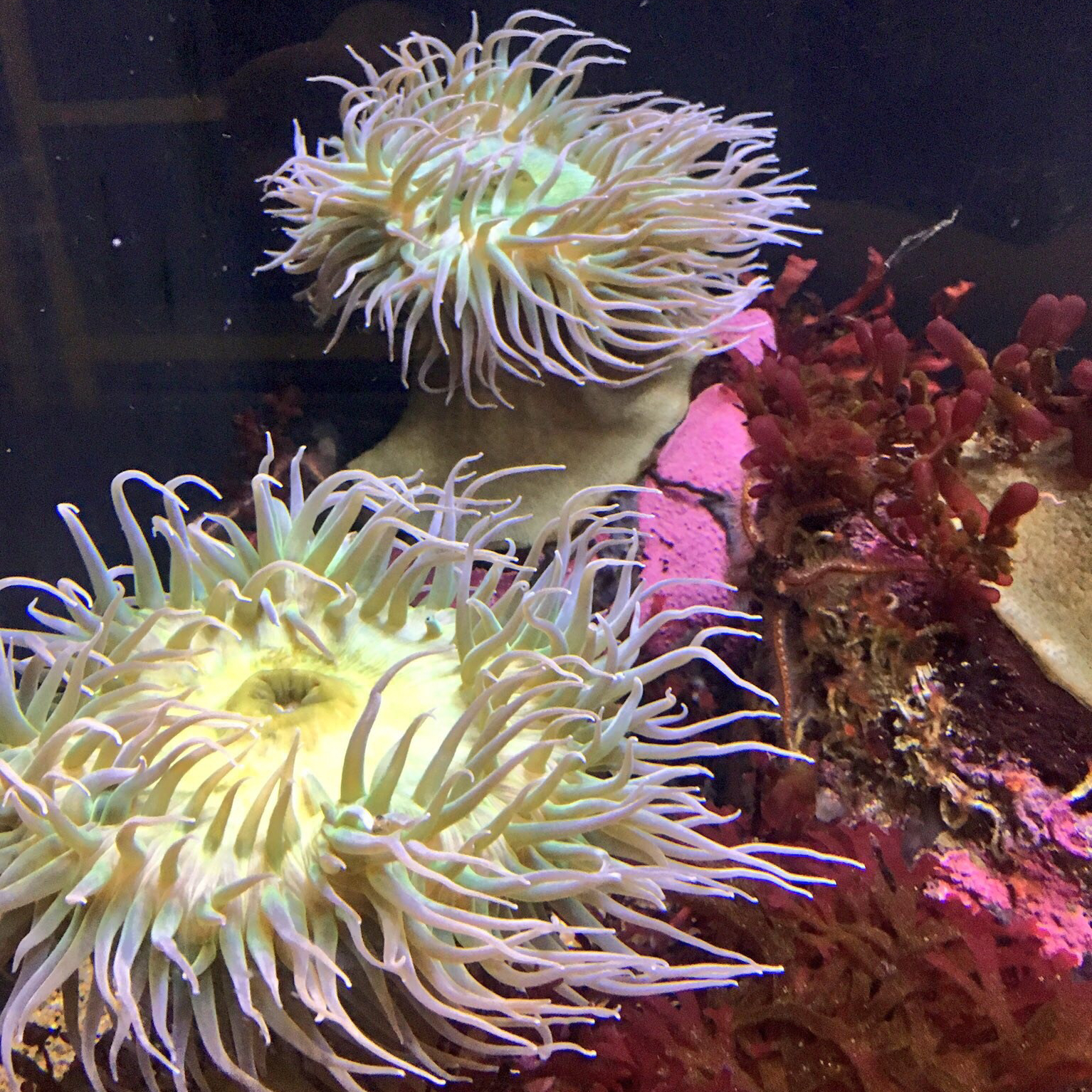
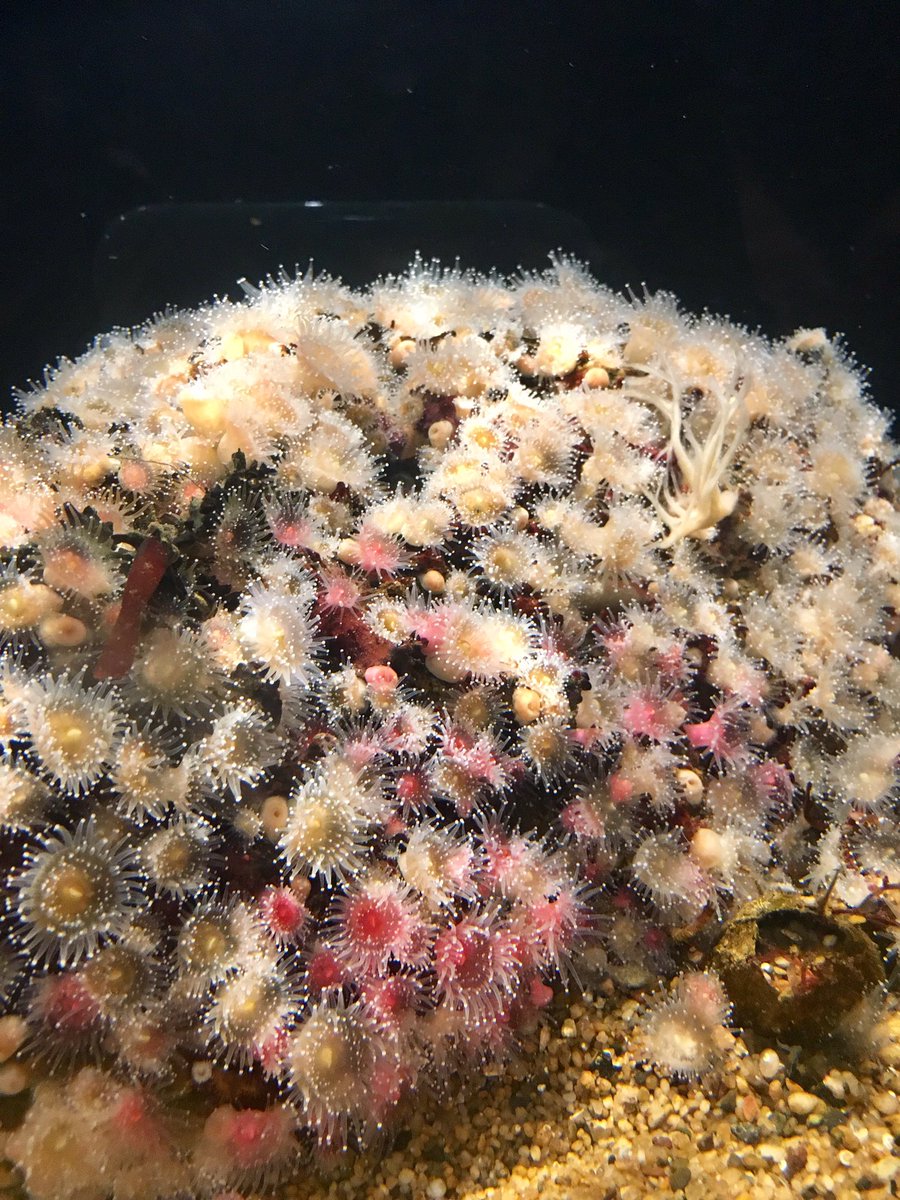
If you find yourself, much like Eliot’s Lydgate, struggling to escape the hampering threadlike pressure of small social conditions, less the Universe swallow you whole. Then it is important to remember that it is quite impossible to do everything, and take some time to yourself and enjoy Santa Cruz. I myself did as Eliot would and ran away to explore the wonders of the shore at the aquarium – enjoying the opportunity to hold a starfish, stroke a sea anemone, and let time dilate within an undulating jellyfish’s watery whirl.

Picture1.png

Dickens Universe, at its core, encourages us to emerge from the Californian redwoods and see the world beyond our own institutions, allowing us to learn from students and staff across the globe. So that we begin to perceive the larger web of scholarship, our own place in it, and how incalculably diffusive it has the potential to be.