Categories
longer blog posts

Defining Curiosity in the Victorian Era

What is curiosity? Does it change according to the ebbs and flows of time? While today we might associate it with an involuntary odyssey down a Wikipedia rabbit-hole, in which the infinite regress of clicking just one. more. link.  is all too tantalising, the Victorians were far more likely to sate their curiosity by studying a literal rabbit-hole.

Down_the_Rabbit_Hole

However, just as our curiosity encounters a certain lack of control as we proceed to surf the web ad infinitum the Victorian’s similarly associated curiosity with disorder. The phrase ‘down the rabbit hole’ functioned both as a metaphor for an entry into the unknown, and a disorienting or mentally deranging experience. Alice transforms from an active protagonist who finds Wonderland ‘curiouser and curiouser’ into an object of curiosity herself whether as a curious flower that can move around and has ‘untidy’ petals or as giant with a neck like a ‘Serpent.’ Curiosity is both a force wrought by humans, and a supposedly inanimate object that somehow exudes curiosity.

 Barbara Benedict in Curiosity: A Cultural History of Early Modern Inquiry (2002) discusses the ‘fluid exchange between agency and objectivity, curiosity and curiousness’. She sees curiosity as ‘the mark of a threatening ambition, an ambition that takes the form of a perceptible violation of species and categories: an ontological transgression that is registered empirically. To Benedict, ‘curiosity is seeing your way out of your place. It is looking beyond’.

Alice experiences exist betwixt and between these conflicting categories; she is treated alternately as one who is innocent or experienced, as miniature or gigantic, as a replica or an ‘original’ or as an subject and an object.

Curiosity is not only inseparable from visual experience, but also inextricable with the idea of transgressing binaries or crossing boundaries.

fernrose

The Victorians equally loved beauty in its natural form and beauty artificially shaped by human hands; they would often sit side by side in one museum or curiosity cabinet. Cabinets of curiosity would serve scientific advancement, functioning as physical representations of knowledge, but they were also ultimately works of art.

Likewise, many collections are now effectively specimens of anthropology, that function primarily as vectors into the psyche of the past, rather than sole specimens of natural history.

This clash of conflicting curiosity that seems to reverberate disparate and often paradoxical interests is a hallmark of the Victorian era. Isobel Armstrong in Victorian Glassworlds (2008) highlights ‘the optical shock and exhaustion of the eye [which] produced an intense disorientation that undermined ordering principles: a surreal heterogeneity juxtaposed erotic and mundane objects.’ One can imagine this was most apparent at The Great Exhibition of 1851. The building, containing nearly one million square feet of glass, and dubbed ‘The Crystal Palace’ by the editor of Punch, and a ‘magical fairyland’ by Queen Victoria. Among the many reactions to the panoply of the Exhibition were complaints about the overwhelming, and conflicting kaleidoscope of visual stimulus.

wallpaper
Wallpaper illustrating the Crystal Palace. About 1853-5 ( from The V&A)


The Crystal Palace reminds us of one more important aspect of curiosity, its association with glass. A curious glance in the Victorian era was almost always mediated through glass: whether via a microscope; magnifying glass; vivarium; conservatory; window; camera or picture frame. Glass, as an agent of curiosity that sharpens the eye and focuses the senses held far more metaphorical weight to the culture at large than it does today – even though we too often express or satisfy or curiosity through the glass of a computer or television screen.

The Victorians, like us, were not only storytellers of the natural environment. The cabinet of curiosity was regarded not only as a microcosm of the natural world but also as a memory theatre that captured the dreams and emotions of its collector like that of a ‘pensieve’ in Harry Potter. Equally, Victorian wonders like the diorama (a miniature or life-size scene in which figures, taxidermy, and other objects are arranged in a naturalistic setting) allowed people to experience the ecosystem of not only of another country but of another time. So extensive was the reach of Victorian curiosity that we can imagine the interplanetary dioramas the Victorian’s would have expected of the future. Let us hope we do not disappoint them.

cabinet

Categories
longer blog posts

Dietary Didacticism in Wonderland

[NB: I wrote this piece for the Journal of Victorian Culture Online for ‘Alice’ Day who have kindly agreed that I can share it here also.]

 At the turn of the century, victorian psychologist James Sully remarked that ‘the child is little more than an incarnation of appetite which knows no restraint’. (1) This conception of the child as a fiendish manifestation of gluttony haunted middle-class Victorian girlhood and had the power to bring about a culture of noxious dietary didacticism.

Lewis Carroll’s Alice books show many signs of being wrought in such a climate.

 According to Lewis Carroll’s nephew the ‘healthy appetites of his young friends filled [Carroll] with alarm’ so much so he let slip remarks like ‘please be careful, because she eats a good deal too much’. (2) Carroll even sent a small knife to a young girl as a birthday present and assured her if she used it to cut her dinner into tiny pieces she would ‘be safe from eating too much’ and could ideally ‘find that when the others have finished you have only had one mouthful’. (3)

Carroll’s fixation with feminine growth is interlaced with the progressive conception of Alice as a character. According to Carroll originally the ‘dream-Alice, in thy foster-father’s eyes’ was as ‘loving as a dog and gentle as a fawn’ so innocent ‘Sin and Sorrow are [to her] but names – empty words’. However, this winsome innocent is not the Alice we meet in Wonderland who wields her appetite to assert her dominance (‘Nurse Do let’s pretend that I’m a hungry hyena, and you’re a bone!’)

Alice_Liddell
Alice Liddel,  published as a miniature on the last page of the original Alice’s Adventures Underground (1861)

Nina Auerbach, in ‘Alice and Wonderland: A Curious Child’, discusses the physical differences between Alice Liddell, Carroll’s aforementioned ‘dream-Alice’ and Mary Baddcock, the model Carroll suggested for John Tenniel’s illustrations. Alice Liddell is ‘strikingly sensuous and otherworldly’, whilst Mary Baddcock ‘is blonde and pudgy, with squinting eyes, folded arms and an intimidating frown’. (4)

didactic3
‘Little Miss Budget’ Punch ‘Dessert, Miss? Oh dear, no! You’ll have to wait a bit yet. We’ve only just got to the second course!’

John Tenniel’s Alice, based on Mary Baddock, curiously resembles archetypes of the spoilt victorian girl. Typically conceived in publications like Punch. The above image depicts a stout young dinner-guest requesting dessert: the Butler replies ‘Oh dear, no! You’ll have to wait a bit yet. We’ve only just got to the second course!’ (5) Both Alice and ‘Miss Budget’ are characterised by eager plump appendages, frilly pinafores, stockings and polished shoes. Thus, Carroll’s shift to a blonde decidedly plump Alice – in many ways better embodies the typical middle-class girl who must be cured of her insatiable cravings. Just as the pictorial Alice resembles this indulgent archetype the textual Alice is wilfully preoccupied with dessert; she insists upon taking a slice out of the personified pudding despite having engaged him in a formal conversation and is shamed for doing so the pudding exclaiming, ‘I wonder how you’d like it, if I were to cut a slice out of YOU, you creature!’

didactic2
‘Drink Me’ by John Tenniel

Auerbach goes on to suggest Wonderland supportively houses ‘the chaos of [Alice’s] growth’ she believes as Alice ‘explodes out of Wonderland hungry and unregenerate Carroll ‘trace[s] the chaos of a little girl’s psyche’ with ‘sympathetic delicacy and precision’. (4)

However, time and again Carroll explicitly greets Alice’s hunger and obstinacy not with sympathy but with derision and censure. When Alice hesitantly asks the Duchess ‘why does your cat grin like that?’ the Duchess responds ‘it’s a Cheshire cat and that’s why. Pig!’ (48) the author implicitly verbally assaults Alice, for whilst Alice ‘saw in another moment that it was addressed to the baby’ she jumps at the ‘sudden violence’ of ‘Pig!’ and originally assumes the word is meant for her. The narrative continues to imply Alice possesses a voracious appetite that must be cured; just as the trial scene suggests Alice’s appetite is criminally reprehensible (she mistakes the evidence ‘a large dish of tarts’ (95) for refreshments) the tea party functions as a lesson in dietary restraint. Alice in the rearmost seat is always ‘a good deal worse off than before’ (62) as every time the Hatter yells ‘change!’ she is greeted with a milk-spilled plate that has already been plundered by three other people. Furthermore, as Lisa Coar, in ‘Sugar and Spice and All Things Nice: The Victorian Woman’s All-Consuming Predicament’, notes the tea itself, uncalorific and caffeinated, is an ‘ascetic: it masks hunger, it feeds without food’. (6)

‘You look a little shy: let me introduce you to that leg of a mutton,’ said the Red Queen. ‘Alice-Mutton: Mutton-Alice.’ The leg of mutton got up in a dish and made a little bow to Alice, who looked at it rather anxiously.

Carroll’s creations are suffused with dietary anxiety. The looking-glass queens who refuse to eat what one has been formally ‘introduced to’ painstakingly (almost purposefully) present themselves to every item on the menu. Similarly, the ephemeral bread-and-butterfly lives on a fatally restrictive diet of ‘weak tea with cream in it’. This undercurrent of  foreboding even suffuses the intertextual stories of Wonderland; the sisters at the bottom of the well in the dormouse’s story grow ill from their diet of treacle, whilst the Oyster’s of The Walrus and the Carpenter” are tricked into being consumed at the promise of a ‘treat’. The act of eating is framed not as pleasurable but as a distressing, confusing, anxiety ridden affair from the cacophonous tea party where the dormouse is doused into the pot of tea, to the trial at the end of the novel that surrounds the stolen tarts. Furthermore,  Alice’s consumption of items of food throughout the novel – becomes an almost literal manifestation of body dysmorphic disorder – as her rapid fluctuations in size correlate not only with her appetite but with her emotions.


pig
Alice and the piglet

An early reviewer of Alice unconsciously traces the underlying power-play at work in the novel. At first the reviewer tries to catergorise Wonderland as a collective hive dream of ‘childish mind[s]’ a ‘charming’ ‘pleasant’ ‘happy place’. However, he struggles to reconcile how ‘disturbed’ he feels by the presence of a strange ‘cleverness’ that ‘causes us to wake from our dream.’ His discomfort at the controlling adult presence can also be detected in his hasty uneasy dismissal (‘but it is all proper enough’) of Alice’s distress at her involuntary body fluctuations. The reviewer in an attempt to neutralise the controlling authorial presence, hastily asserts that the caterpillar ‘changes too, and is probably likewise confused at his transformation’. (7)

By the time we reach Through the Looking Glass, as Lisa Coar suggests, Alice is seemingly cured of what Carroll might call her nutritional neurosis – when offered biscuits by Carroll’s Red Queen, Alice, ‘though it wasn’t at all what she wanted’, forces down one biscuit out of politeness but emphatically refuses a second helping’ . (5)

The White Queen similarly, presents Alice with a dietary dilemma. Her proclamation that ‘the rule is, jam tomorrow and jam yesterday – but never jam to-day’. (169) cloaks the promise of food in Carrollian logic that withdraws said promise and renders the White Queen’s offer void. Her rule is a pun on a mnemonic for remembering the distinction between the Latin words nunc and jam; both mean ‘now’, but nunc is only used in the present, while jam can only be used in the past and future and is therefore presently never available.

Thus, although by Carroll’s sequel Alice is seemingly cured of her ‘uncontrollable’ appetite Alice’s dietary anxiety, in a novel notably titled Through the Looking Glass remains.


References

Arthur Rackham’s illustrations of Alice (1907) are available at Project Gutenberg <http://www.gutenberg.org/files/28885/28885-h/28885-h.htm/&gt;

John Tenniel’s illustrations of Alice are have been obtained from The Victorian Web [accessed April 2016] <http://www.victorianweb.org/art/illustration/tenniel//&gt;

(1) James Sully, ‘Studies in Childhood’, Popular Science Monthly, 47:48 (1895), pp. 648-64, p. 650

(2) Collingwood, The Life and Letters of Lewis Carroll, (New York: Century, 1899), p. 134.

(3) Lewis Carroll, ‘To Kathleen Tidy, March 30th 1861’, in The Letters of Lewis Carroll, vol. 1, p. 49.

(4) Nina Auerbach, ‘Alice and Wonderland: A Curious Child’ Victorian Studies, 17, (1973): 31-47, p. 35.

(5) Lisa Coar, ‘Sugar and Spice and All Things Nice: The Victorian Woman’s All-Consuming Predicament.’, Victorian Network, 4, (2012). P. 56-57.

Categories
Lewis Carroll's Alice

Alice Through the Magnifying Glass, Visual and Verbal Interplay in Wonderland

 What is the use of a book,’ thought Alice, ‘without pictures or conversation?’
nurseryaliceimg

At the start of Alice’s Adventures in Wonderland Alice’s very first thought – ‘What is the use of a book, without pictures or conversation?’ places the visual and verbal interplay at work in Carroll’s books under the magnifying glass.

It is as though this declarative desire for pictures spirits Alice away to Wonderland. Her imaginative dreaming creates the phantasmagorical images her sister’s book lacks.

As Helen Groth notes, the visual mediation of John Tenniel’s illustrations create ‘a more porous surface between Alice and her readers; ‘an intimate synchronous connection’ [2] that dynamically urges the reader forward. Tenniel’s illustrations are to be found at the metaphorical and literal centre of Carroll’s text. The narrator continually points readers towards them (‘if you don’t know what a Gryphon is, look at the picture’ (138).)  He even ensures that Alice’s imagined ‘tale’ of the mouse’s ‘tail’ is structured so that the ‘tail rhyme’ of the poem resembles a long tail.

FullSizeRender
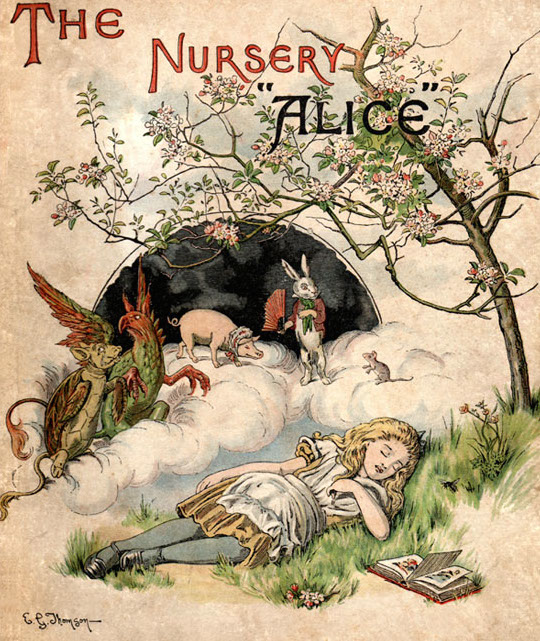
The Nursery Alice, [3] published for children aged ‘nought to five’ at the zenith of Alice’s popularity,  takes this visual focus further. The book houses enlarged coloured pictures that dwarf the text and allow Carroll to create tangential stories retrospectively inspired by Tenniel’s illustrations. Tenniel’s drawing of a foxglove, for example, inspires a quasi-etymological tale in which Carroll informs us Foxgloves are the gloves of Fairy Folk.

Furthermore, the narrator continually urges the reader to manipulate the illustrations so as to better understand the story. He encourages them to ‘shake the book and you’ll see [the rabbit] tremble’ and ‘turn up the corner of this leaf, [and] you’ll have Alice looking at the Grin: and she doesn’t look a bit more frightened than when she was looking at the Cat, does she?’. Carroll similarly urges the buyers of his postage stamp cases to ‘take the Case … you see Alice nursing the Duchess’s Baby? Pull it out – the Baby has turned into a Pig!’

stamp case

[The Wonderland Postage-Stamp Case – Designed by Lewis Carroll.]

These transformative uses of Tenniel’s illustrations celebrate visual-verbal interplay and suggest that pictures can aid a child’s inchoate understanding of the verbal text.

In ‘Wonderland’ the visual often threatens to dwarf the textual. Just as with one bite of the mushroom Alice oscillates from microscopic to gigantic, with one turn of the page the reader may find the text dwarfed by Tenniel’s rapidly ‘mushrooming’ illustrations. Thus, though the term ‘illustrate’ originally meant to ‘illuminate the mind’ the felicitous placement of illustrations in the first edition of Alice suggests that the drawings are not merely secondary elucidations, instead, they exist inextricably with the text itself. Carroll’s words are often not only referential towards the illustrations they are reliant upon them.

FullSizeRender[1]

For example, the courtroom scene on page 186 is curiously missing the Queen in order to fit in Carroll’s text. This enables an episode of  visual-verbal wordplay in which the pun ‘then the words don’t fit you’ (187) refers to the Queen’s pictorial lacuna and seems to be spoken by the pictorial rather than the textual King. It is for this reason that the ‘textual’ court greet his pun with ‘dead silence’ (187) as they cannot understand a joke that relies on the consciousness of their pictorial counterparts.

FullSizeRender[2]
Throughout the novel, the symbiotic relationship between visual and verbal continues to rely on the novel’s composition. When Alice’s body elongates the body of text mirrors her elongation. As 
Alice feels she is ‘opening out like the largest telescope that ever was!’ (15) her neck resembles the cylinder of a telescope extended from her compact body. The psychosomatic dissonance Alice experiences (she worries her feet won’t obey her unless she sends them new boots for Christmas) is reflected in the illustration. Tenniel details her wide eyes, open mouth and fanned out hair (which suggests a sudden altitude change), and her arms splayed out like one might do to slow their body whilst falling.

Later in the novel, Alice looks titanic in relation to the Rabbit, the hallway, and the page itself. Tenniel uses foreshortening – converging ceiling panels and highlighting Alice in the foreground whilst darkening the receding hallway. This creates a linear perspective that gives the illusion of depth and produces a rabbit-hole for the startled rabbit to retreat into. Tenniel’s imposing illustration creates a paradoxical disparity between text and image. After scolding herself for crying (‘you ought to be ashamed of yourself… a great girl like you!’) Alice tentatively addresses the rabbit ‘in a low, timid voice’ that quite belies her gargantuan size. Her hesitant posture suggests an answering recoil when the rabbit greets her not as a little girl but as a predator: scurrying away ‘into the darkness as hard as he could go.’ (18)

Lewis Carroll appears decidedly satisfied with Tenniel’s rendering of scale; according to a subsequent illustrator ‘Carroll would take a square inch of the drawing, count the lines … and compare their number with those on a square inch of illustration made for “Alice” by Tenniel! And in due course [he] would receive a long essay on the subject from Dodgson the mathematician’. [4] This emphasis on dimension and mathematical topography suggests that Carroll informed Tenniel in detail of the importance of depicting Alice’s oscillating growth.

Carroll himself used space and dimension to its full semantic capacity. In his illustration of the same scene,  Alice’s overgrown form is wrapped in a protective foetal position. But she is confined not by the Rabbit’s house but by the confines of her frame – functioning as an amateur ‘Trompe-l’oeil’, Carroll’s illusion of protuberance possesses a distinctly claustrophobic quality.

Contrastingly, Tenniel offers a near three-dimensional imprisonment: Alice’s elbow is painfully positioned in the corner of the room; her head bowed, and her arm forced through the window. The intense use of chiaroscuro combined with Alice’s reproachful expression presents an image reminiscent of a caged animal. This pictorial suggestion ties in with Alice’s anxiety regarding her fluctuating size, which is viscerally linked with conceptions of predation: ‘It was much pleasanter at home when one wasn’t always growing larger and smaller, and being ordered about by mice and rabbits. I almost wish I hadn’t gone down that rabbit-hole’ (46). In this context ‘the rabbit-hole’ becomes an evolutionary abyss in which Alice can both recapitulate into a creature of embryonic size and metamorphose into a being at the top of the food chain.

Tenniel and Carroll inextricably link Alice’s relative size with her survival. Tenniel’s illustration for page twenty-six depicts Alice nonchalantly swimming alongside a mouse. This evidently takes place after she fears he is a ‘walrus’ or ‘hippopotamus’ and instead remembers her own size and haughtily deduces it is ‘only a mouse’. Alice goes on to sadistically regales the mouse with tales of her cat. Even after she answers his cry ‘would you like cats if you were me?’ with the reluctant avowal ‘perhaps not’ she insensitively urges him not to ‘be angry about it’ and boasts that Dinah is ‘a capital one for catching mice’. (26) Tenniel’s drawing (bisecting Alice’s lyrical waxing) focuses on the divergent paths of the two figures: Alice regards the mouse with a vague sort of interest, her relaxed legs below the water propel her lazily in one direction, whilst the mouse’s taut legs frenetically drive his anxious straining form in the decidedly opposite direction. The illustrations and text work in tandem to imply what might happen if a mouse-sized Alice were to meet Dinah.

In ‘Alice in Wonderland: The Child as Swain’ Empson argues that ‘the pool of tears represents both the primeval sea from which life arose and amniotic fluid; the caucus-race which follows refers to the theory of natural selection; [and] the ape which appears in the illustrations is man’s simian ancestor.’ [5] This reading is supported by Tenniel’s illustration, which portrays Alice as an irrevocable member of the homogenous ‘queer-looking party’: her hair heavy with water is akin to the sodden feathers and fur of the other animals. The animals themselves are drawn with scientific accuracy and have been likened to contemporary taxonomy drawings.

Similarly, in her discussion on Darwinian narrative Gillian Beer asserts that ‘because of its preoccupation with time and with change, evolutionary theory has inherent affinities with the problems and processes of narrative’. [6] –  Alice in Wonderland is a novel that both textually and pictorially manifests these evolutionary fluctuations. Carroll’s disordered narrative, condemned by a contemporary review as all ‘loops, ties, and loose threads, entanglements, and inconsistencies’ [7] and Tenniel’s taxonomic, dimensionally inversive illustrations combine to produce a united text that, in carnivalesque protest, ousts Alice from her evolutionary position.


 A new edition of Alice illustrated by Arthur Rackham [8] is prefaced by the verse:

Enchanting Alice! Black-and-white

Has made your deeds perennial;

And naught save “Chaos and old Night”

Can part you now from Tenniel

Although this verse seems to suggest that Alice is immortalised in Tenniel’s drawings a later verse:

But still you are a Type, and based

In Truth, like Lear and Hamlet;

And Types may be re-draped to taste

In cloth-of-gold or camlet.

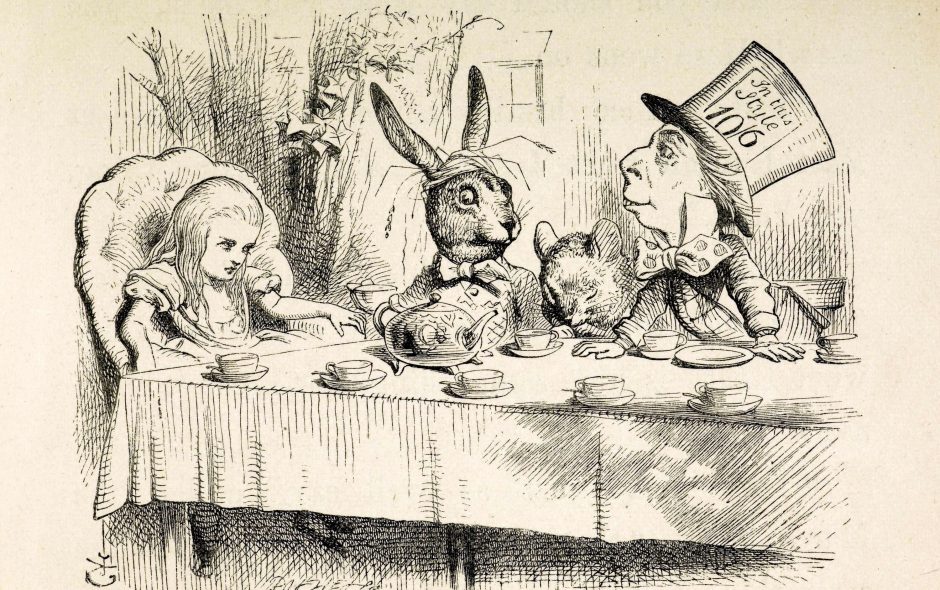
suggests that Alice can, like a new actress in a play, be ‘re-draped’ to new taste. However, I would argue that ‘afresh Costumier’ cannot imbibe his drawings with the same hermeneutic potential as Tenniel. Not only do the illustrations contain infamous details to the story that are not born from the text (the March-Hare’s hat of straw or the Hatter’s 10/6 price tag, for example) they are also visually synchronised with the narrative. Therefore, Tenniel’s work does not simply mirror Carroll’s narrative; instead it provides a kaleidoscopic reflection that like Carroll’s own looking-glass curiously transmutes its origins.


References

[1] Lewis Carroll, Alice’s Adventures in Wonderland (BookVirtual,2000) <https://www.adobe.com/be_en/active-use/pdf/Alice_in_Wonderland.pdf />

[2] Helen Groth, ‘Projections of Alice: anachronistic reading and the temporality of mediation.’ Textual Practice 26.4 (2012): 667-686.

[3] Lewis Carroll, The Nursery Alice, (London, Macmillan, 2010)

[4] Furniss, Some Victorian Men (London: John Lane, 1924)

[5] Empson, ‘Alice in Wonderland: The Child as Swain’, Some Versions of Pastoral (London: Chatto and Windus, 1935), 255.

[6] Gillian Beer, Darwin’s Plots (Cambridge University Press, 2000), p. 5.

[7] ‘Alice’s Adventures in Wonderland’, Athenaeum, (1865), p. 844.

[8] Alice’s Adventures in Wonderland with a poem by Austin Dobson (London: Doubleday, 1905)


This article has been cross-posted at The Victorian Web.

To be kept up to date on new posts from The Cabinet of Curiosity subscribe by WordPress or follow me on Twitter @rosalindmwhite.

← Back

Thank you for your response. ✨