In the mid nineteenth-century no handbag was complete without a Schloss Bijou Almanac. Anticipating the portability of kindles and tablets, the almanac was half the size of a postage stamp. One would store their almanac alongside a miniature magnifying glass in a small silk lined case.
The little book would contain ‘many tasteful vignettes’ (characteristic of the different months) and miniature portraits. (Such as the Princess Royal of England or the infant Charles Dickens.)
The almanac was principally put together by female contributors and marketed ‘for the ladies’. But later editions proclaimed to be – ‘suitable for [both the] purse pocket-book or [the] waistcoat pocket’.
In The Entomologist’s Dream (1909) by Edmund Dulac an entomologist – in a state of near collapse – bears witness to an ominous kaleidoscope of butterflies that envelop his bedroom in a mantle of blue chaos. The insect-collector’s beloved specimens have escaped: struggling from their skewers and shattering their glass-fronted prisons. (It is left up to viewer to determine whether they seek freedom or vengeance.)
The work is an illustration for Le Papillon Rouge (the red butterfly) by Gerard d’Houville, a tragic love story published in L ‘Illustration, Numero de Noel 1909 the French news and art magazine. (In the tale an entomologist plunders his collection, in a state of moonlit delirium, incensed with his failure to capture a blood red butterfly for his lady love.)
A sense of anxiety pervades the practice of entomology – the use of chloroform, killing jars and other lethal devices leaving many naturalists with a sense of guilt.
The killing jar was an ordinary glass preserving can, with a small lump of cyanide of potassium, covered by a thin layer of plaster. An entomologist was instructed to arrange the insect, once dead, in ‘a natural position’. Killing jars habitually resulted in a slow death for the imprisoned insect – it was difficult to settle upon a formula that would result in death swiftly without damaging the insect’s fragile carcass. In the midst of searching for such a ‘sweet spot’ an entomologist was often faced with specimens that were prone to spontaneous resurrection.
Much of the literature in the late 1840s ruminated upon the question of entomological suffering. Naturalists made use of insects to contemplate hierarchies of pain: paying special attention to cases of insect decapitation. One naturalist, for example, was shocked to see that a dragonfly he had just pinned through the thorax still clutched a struggling fly in its forelegs – and proceeded to eat it.
Similarly, George Henry Lewes affirmed that ‘an insect pinned to the table will continue to eat and a headless fly or worm will writhe and twist if touched.’
Imagining the horror of a man eating under such circumstances, many entomologists of the age (gladly) concluded that an insect was not capable of experiencing emotional trauma as we do. (Though they might ‘learn’ to avoid stimulus associated with sustained tissue damage.)
If we classify pain as an emotional response (a conscious experience) -does the question of insect pain hinge upon the concept of insect emotion? How on earth could we determine if an insect’s experience is intertwined with ‘anthropomorphic’ factors like mood, personality, disposition, or motivation?
(Hit me up with any other examples you have of ‘entomological anxiety’.)
To be kept up to date on new posts from The Cabinet of Curiosity subscribe by WordPress or follow me on Twitter @rosalindmwhite.
Throughout the nineteenth-century the mania for seashells steadily swelled; they featured on Christmas cards, and adorned countless keepsakes, jewellery, and furniture. The Gradgrind nursery in Charles Dickens’ Hard Times is equipped with a “little conchological cabinet, a little metallurgical cabinet, and a little mineralogical cabinet”, whilst, inspired by works of natural history, men and women scoured the seashore for conchological specimens. Conchology, unlike other branches of natural history such as zoology or mineralogy was easily accessible to everyone, and did not require specialist equipment. It also had the added bonus of including inanimate specimens that were not subject to disease or decay.
The Conchologist / G. Spratt del. ; Printed by G. E. Madeley ; Pubd by C. Tilt, Fleet Street.
George Spratt’s composite caricature of ‘The Conchologist’ offers a personification of the craze – a woman, fashioned from shells of marine life, is depicted scanning the sea-side for her kin: her basket is filled with sprigs of seaweed and various tide pool treasures. Her rather ineffectual sun-bonnet looks to be crafted from the soft-bodied bell of a jellyfish, while a quasi-vulval cowry shell, disturbingly enlarged, makes up the lower half of her body.
The Shell Grotto in Margate, is perhaps the most impressive example of conchological worship. In 1835 an architectural love letter to the humble shell was uncovered by a man and his son attempting to dig a duck pond. The son, falling from a hole in the ground, recovered from his tumble to find a chamber ‘papered’ with an exquisite tapestry of shells. The chamber was connected to a labyrinthian passage similarly shrouded with cockles, whelks, mussels and oyster shells forming intricate mosaics. We still do not know how, or why the grotto came to be nor who is responsible for its creation.
Victorian women made use of their collection in various handicraft projects. Many put together imitation bouquets: using various miniature shells to create the desired flower.
Soon enough collectors, having exhausted the beaches of Britain, took to harvesting more impressive shells from overseas. An army of merchants, catering for the increasing demand, set up shop in London.
The name of the global oil company “Shell” is, oddly enough, a reminder of the victorian love of conchology.
In 1833 one Marcus Samuel opened such a shop selling shells, curios, and other trinkets to natural history enthusiasts. By 1851 Marcus was described in the census as a ‘shell merchant’ and was listed as proprietor of ‘The Shell Shop’ in Houndsditch. He later formed the ‘Shell Transport and Trading Company.’ In 1882 his son (Marcus Junior) while travelling in the Caspian Sea, saw a potential for exporting oil from the region. He commissioned the world’s first purpose-built oil tanker and named the tanker the Murex, Latin for a type of snail shell, as a nod to the company’s beginnings. The first logo (1901) was a mussel shell, but by 1904 it was replaced with a scallop shell.
What is curiosity? Does it change according to the ebbs and flows of time? While today we might associate it with an involuntary odyssey down a Wikipedia rabbit-hole, in which the infinite regress of clicking just one. more. link. is all too tantalising, the Victorians were far more likely to sate their curiosity by studying a literal rabbit-hole.
However, just as our curiosity encounters a certain lack of control as we proceed to surf the web ad infinitum the Victorian’s similarly associated curiosity with disorder. The phrase ‘down the rabbit hole’ functioned both as a metaphor for an entry into the unknown, and a disorienting or mentally deranging experience. Alice transforms from an active protagonist who finds Wonderland ‘curiouser and curiouser’ into an object of curiosity herself whether as a curious flower that can move around and has ‘untidy’ petals or as giant with a neck like a ‘Serpent.’ Curiosity is both a force wrought by humans, and a supposedly inanimate object that somehow exudes curiosity.
Barbara Benedict in Curiosity: A Cultural History of Early Modern Inquiry (2002) discusses the ‘fluid exchange between agency and objectivity, curiosity and curiousness’. She sees curiosity as ‘the mark of a threatening ambition, an ambition that takes the form of a perceptible violation of species and categories: an ontological transgression that is registered empirically. To Benedict, ‘curiosity is seeing your way out of your place. It is looking beyond’.
Alice experiences exist betwixt and between these conflicting categories; she is treated alternately as one who is innocent or experienced, as miniature or gigantic, as a replica or an ‘original’ or as an subject and an object.
Curiosity is not only inseparable from visual experience, but also inextricable with the idea of transgressing binaries or crossing boundaries.
The Victorians equally loved beauty in its natural form and beauty artificially shaped by human hands; they would often sit side by side in one museum or curiosity cabinet. Cabinets of curiosity would serve scientific advancement, functioning as physical representations of knowledge, but they were also ultimately works of art.
Likewise, many collections are now effectively specimens of anthropology, that function primarily as vectors into the psyche of the past, rather than sole specimens of natural history.
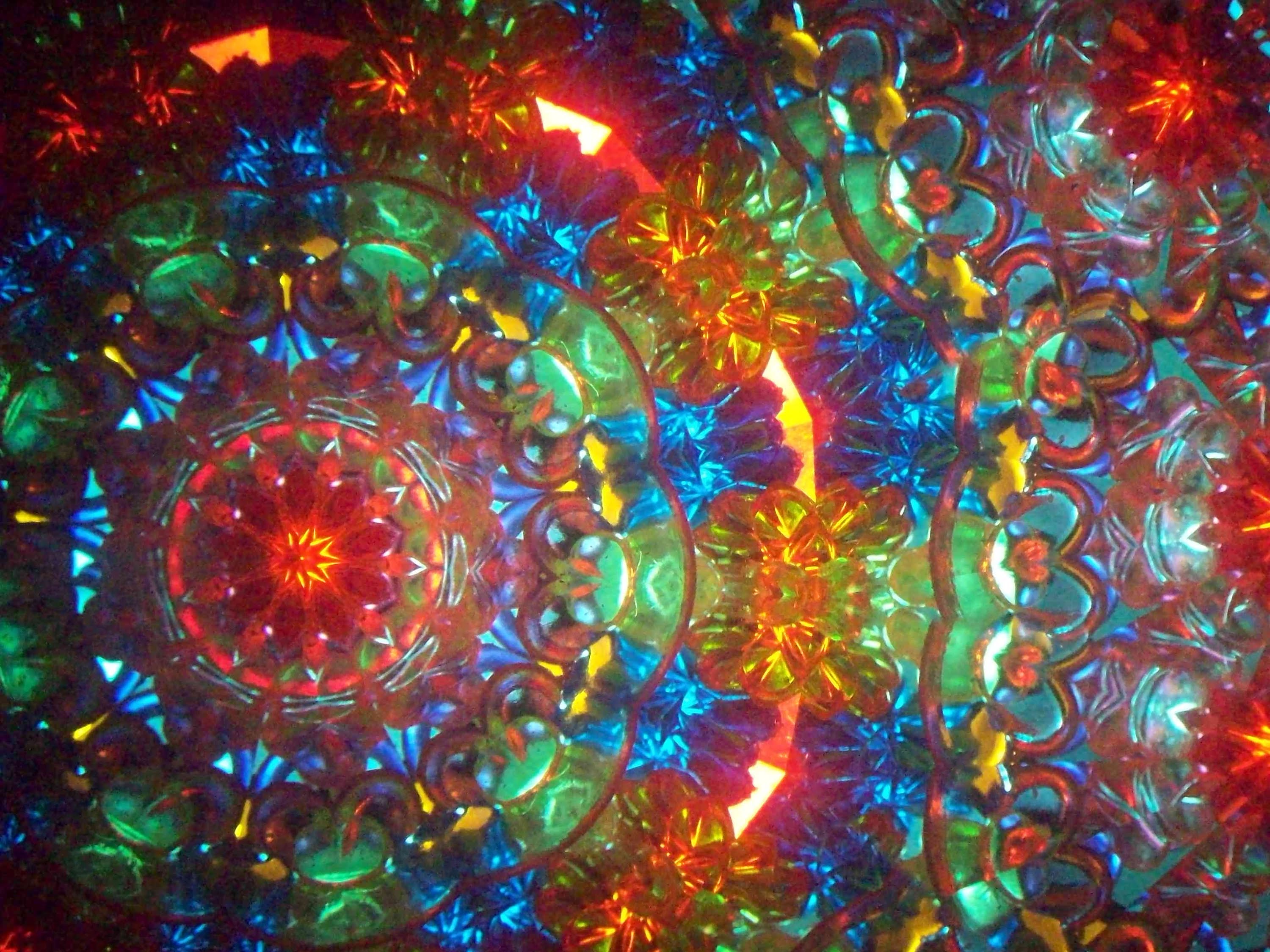
This clash of conflicting curiosity that seems to reverberate disparate and often paradoxical interests is a hallmark of the Victorian era. Isobel Armstrong in Victorian Glassworlds (2008) highlights ‘the optical shock and exhaustion of the eye [which] produced an intense disorientation that undermined ordering principles: a surreal heterogeneity juxtaposed erotic and mundane objects.’ One can imagine this was most apparent at The Great Exhibition of 1851. The building, containing nearly one million square feet of glass, and dubbed ‘The Crystal Palace’ by the editor of Punch, and a ‘magical fairyland’ by Queen Victoria. Among the many reactions to the panoply of the Exhibition were complaints about the overwhelming, and conflicting kaleidoscope of visual stimulus.
Wallpaper illustrating the Crystal Palace. About 1853-5 ( from The V&A)
The Crystal Palace reminds us of one more important aspect of curiosity, its association with glass. A curious glance in the Victorian era was almost always mediated through glass: whether via a microscope; magnifying glass; vivarium; conservatory; window; camera or picture frame. Glass, as an agent of curiosity that sharpens the eye and focuses the senses held far more metaphorical weight to the culture at large than it does today – even though we too often express or satisfy or curiosity through the glass of a computer or television screen.
The Victorians, like us, were not only storytellers of the natural environment. The cabinet of curiosity was regarded not only as a microcosm of the natural world but also as a memory theatre that captured the dreams and emotions of its collector like that of a ‘pensieve’ in Harry Potter. Equally, Victorian wonders like the diorama (a miniature or life-size scene in which figures, taxidermy, and other objects are arranged in a naturalistic setting) allowed people to experience the ecosystem of not only of another country but of another time. So extensive was the reach of Victorian curiosity that we can imagine the interplanetary dioramas the Victorian’s would have expected of the future. Let us hope we do not disappoint them.