Categories
Uncategorized

Georgiana Houghton, the Victorian Artist who Channeled the Spirits of the Dead


Image
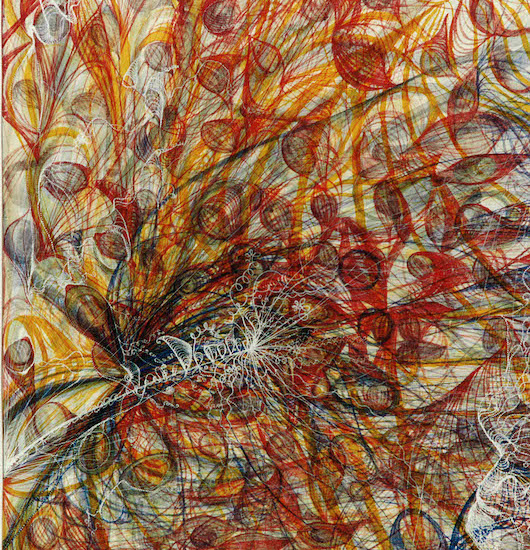
Georgiana Houghton, The Eye of the Lord (detail), 1861-1869. Courtesy of The Victorian Spiritualist Union, Melbourne.

Georgiana Houghton was a spiritualist medium who was trained in classical art but gave up painting after the death of her younger sister in 1851. A decade later, after she had become aquatinted with spiritualism she began once more to put coloured pencils and watercolours to paper. However, this time she said it was spirits of the dead who were guiding her hand. Through her mediumship she was acquainted with several Renaissance artists, as well as higher angelic beings. Houghton became the vessel through which they could exorcise their otherworldly aesthetic desires.

georgianahoughton
Georgiana Houghton, selections from the Invisible Beings series, 1872-76.

The nineteenth century with its ghosts and clairvoyants was the golden age of communion with the spirit world. The afterlife was figured not just as a sacred waiting-room but a place in which spirits continued to ‘live out’ their afterlife – evolving and communicating as they did when they were living. There was a seance in nearly every drawing room, including at Buckingham Palace. The spirits were believed to possess knowledge about moral and ethical issues that transcended our own. – This belief is almost palpable from the mesmeric, twisting force behind Houghton’s brush – her visual language is one of prepossessing immediacy.  

In 1871 Houghton rented a gallery in Bond Street and presented 155 of these works to a bewildered London audience. Houghton funded the project with her own money and for two months met visitors in the gallery to speak with them about her work. However, only one painting sold and now only 50 or so remain in known existence.

The critic from The Era newspaper pronounced it to be ‘the most astonishing exhibition in London at the present moment.’ The Daily News likened the works to ‘tangled threads of colored wool’ and concluded that ‘they deserve to be seen as the most extraordinary and instructive example of artistic aberration.’

John Ptak acquired one Houghton’s gallery catalogues from an 1871 art show in London. In her annotations, Houghton explains her unconventional aesthetic process –

In the execution of the Drawings my hand has been entirely guided by Spirits, no idea being formed in my own mind as to what was going to be produced.

Houghton set out to ‘obtain mediumship’ by holding hands with her mother at a small table for some months on end waiting for contact— Sundays, she believed, worked best, ‘as we should then be less disturbed by evil influences’.


spirit1

Georgiana Houghton, The Portrait of the Lord Jesus Christ, (detail), 1862, courtesy of The Victorian Spiritualist’ Union Melbourne, Australia.

Half a century before non-figurative art was popularised, Houghton’s drawings, in their psychedelic colours and passionate fluidity, in many ways,  anticipate the abstraction of early twentieth century art.
As Marco Pasi puts it:

Houghton transferred authorship and agency to the spirits. In doing so she could radicalise her artwork and make alien objects that could not be placed at the time in which they were made.

This summer, the Courtauld Gallery at Somerset House will mount an exhibition of Georgiana Houghton’s work. The exhibition will be opened from the 16th June to the 11th September 2016 and will be open daily from 10am-6pm.

Image
Georgiana Houghton, The Sheltering Wing of the Most High, c. 1861-61, courtesy of The Victorian Spiritualist Union, Melbourne.

References

Ptak, John F, ‘Spirit-Generated Art, 1871: Far-Outside Outsider Art’ (JF Ptak Science Books // Blog Bookstore, 1933)

Larsen, Pasi and Grant, Georgiana Houghton: Spirit Drawings (Paul Holberton Publishing, 2016)


To be kept up to date on new posts from The Cabinet of Curiosity subscribe by WordPress or follow me on Twitter @rosalindmwhite.

Categories
Uncategorized

Mesmerism, Madness and Witchcraft in Jane Eyre

FullSizeRender (1)
Jane Eyre as portrayed by Mia Wasikowska in the 2011 adaptation.

After first meeting Jane, Rochester furthers their relationship by masquerading as a gypsy to discover her true impressions of him.  His voice ‘wraps’ her in ‘a kind of dream’, ‘a web of mystification’, until she instinctually believes an ‘unseen spirit had been sitting for weeks by [her] heart watching its workings and taking record of every pulse’. (175) In a similar vein, Jane’s cousin, St. John, acquires ‘a certain influence’ over her that ‘took away [her] liberty of mind’ (352) until she ‘fell under a freezing spell’ (357) his ‘influence in [her] marrow – his hold on [her] limbs’. (359)

In both these moments, Bronte portrays her male characters as having a mesmeric power over her female protagonist.

Mesmerism, (originally animal magnetism)  was a therapeutic doctrine coined by Franz Mesmer in the eighteenth-century, but popularised by practitioners in the nineteenth. Mesmerists were thought to possess the power to place their subjects in a hypnotic state through the imposition of their own will on that of the subject. Mesmerism was often the practice of physicians, or gynaecologists, and was often used to ‘treat’ hysteria. 

In this context, mesmerism becomes a potent but volatile force when combined with romance.

Later in Jane Eyre, St. John’s ‘despotic’ effect on Jane is broken by Rochester’s magnetic disembodied voice, which sets her spirit ‘trembling’ in ‘exaltation’ (373) and calls her to Thornfield.  

However, unlike St. John, who wishes for perfect submission from Jane, Rochester’s language suggests that the power in their relationship mirrors a kind of erotic countertransference.

Rochester notes that Jane only ‘seems to submit’; for whilst he is compelled by ‘the sense of pliancy [she] impart[s]’ he is ‘conquered’ by her ‘influence’ that ‘has a witchery beyond any triumph [he] can win’. He figures Jane as a deceptively ‘soft, silken skein’ that he can manipulate ‘around [his] finger’ but ‘send[s] a thrill up [his] arm to [his] heart’. (229)

Sigmund Freud in 1910 and Carl Jung in 1909, both of whom specialised in cases of female hysteria,  warned against a patient’s influence on the physician’s unconscious feelings. They cite ‘cases of counter-transference when the analyst could not let go of the patient [and] both fall into the same dark hole of unconsciousness’. [2]

This psychic void mirrors Jane’s mounting fear, throughout the novel, of such a self-effacing abyss. It is this spiritual assimilation that Jane rallies against ‘it is my spirit that addresses your spirit; as if both had passed through the grave, and we stood at God’s feet, equal — as we are!’ (223)

Significantly, during the nineteenth-century the same mental vulnerability that was thought to predispose women to mesmeric susceptibility  was also thought to make them attuned spiritual conduits.  Psychiatry explicitly linked hysteria with female mediumship, pathologising it with terms like ‘psycholepsy’ and ‘mediomania’.

The spiritualism movement, in many ways, valorised the female mind and equipped women with a skill that afforded them a degree of financial independence. The fertile atmosphere of the séance not only provided spiritualists with the means to enter into the male domain of patriarchal discourse, but also allowed them to team up in order to trick countless men of scientific repute. Florence Cook, for example, a famous spiritualist, materialised during her séances as ‘Katie King,’ the spirit-world daughter of a seventeenth-century buccaneer.

 The image below typifies the artful luminaries many women became: a woman at the core of each table shrewdly orchestrates communion with the ‘other side’ by means of the hat; table-turning; or the pendulum.

mesmerism
A spiritualist meeting in a Paris drawing room, from L’Illustration (Paris, 1853)

In Jane Eyre it is frequently suggested that Jane’s hysteria makes her susceptible to the spirit world; locked in the room of her uncle’s death her nerves are ‘shaken’ with ‘agitation’ until she hears the ‘rushing of wings’ and sees ‘a swift darting beam’ ‘a herald of some coming vision from another world’. (12) She often speaks involuntarily; accosting her aunt with the demands of a man long dead, ‘what would Uncle say to you, if he were alive?’ whilst feeling ‘something spoke out of me over which I had no control’. (21)

Jane herself is also presented as an inherently transient or ghostly figure: an orphan who has no place in the family home; a governess who must leave when the child matures; and a young-woman who, before the novel’s close, becomes only an evanescent bride. Mary Daly’s theory of ‘female ghosthood’ posits that denial of physical and mental space creates ‘invisible and subliminal’ ‘space warps’ that often make women feel alienated ‘spacy or disorientated’. [3] These ‘space warps’ slowly distend every time Jane is denied entry to the third floor, or told Bertha is ‘the creature of [her] over-stimulated brain’. (250)

Jane’s spiritualism intermittently manifests as incipient witchcraft; she is wary of her tenuous link to the supernatural, making ‘sure that nothing worse than [her]self haunted the shadowy room’. Furthermore, Jane’s metonymical epithets (‘witch’ ‘cat’, ‘ignis fatuus’, ‘sprite,’ ‘imp’ ‘changeling’ ‘elf’ and ‘fairy’) combined with Rochester’s many assertions that Jane ‘has bewitched [his] horse’ or ‘has the look of another world’ (106) subtextually tie Jane’s link to the supernatural with her hysteria.

Just as ‘female passivity, [was considered] the leit-motif of powerful mediumship’ [4] Jane’s liminality empowers her; Jane is not fearful of Rochester’s threat of violence but feels ‘an inward power; a sense of influence, which support[s] [her]’. (267)


Jane, like the female spiritualist movement, harnesses her supposed passivity  – and transforms herself from a subject of masculine magnetism to a figure that possesses her own mesmerism.


References

Charlotte Bronte, Jane Eyre, (Wordsworth Classics, 1992)

C. G. Jung, Analytical Psychology: its Theory and Practice (London, 1976) p. 159 and p. 157.

[3] Mary Daly, Pure Lust: Elemental Feminist Philosophy, (The Women’s Press, 2001) p. 18.

[4] Vanessa D. Dickerson, Victorian Ghosts in the Noontide: Women Writers and the Supernatural, (University of Missouri Press, 1996) p. 119.


To be kept up to date on new posts from The Cabinet of Curiosity subscribe by WordPress or follow me on Twitter @rosalindmwhite.