Categories
longer blog posts

Affective Accretion: Reconciling the Material and the Emotional in Studies of the Victorian Era

How do we approach an age that, increasingly, feels unanchored from our emotional present? Why do the outsized passions and curious habits of the past, often evade faithful restoration? As we take what has been termed a ‘material turn’[1] in Victorian studies, appraising an object’s function has become secondary to uncovering an object’s emotional afterlife. We are still interested, for example, in a fossil’s paleontological value, but are perhaps more eager to learn that they were routinely licked by enthusiastic geologists tongue-testing for mineralisation. Our concern with the affective capacity of an object has led to an intersection between the study of materiality and the burgeoning field known as the ‘history of emotions.’

Categories
longer blog posts

‘I had no escape from it. I loved an animalcule:’ Romance Through the Microscope

fairy_illustration_victorian
“The Invisible World,” a frontispiece for a chapter on microscopy in The Fairy Tales of Science (1859)

Fitz-James O’Brien (1828-1862) was an Irish-American Civil War soldier and one of the forerunners of the Science-Fiction genre. His primary literary connection was with Harper’s Magazine – a periodical that he contributed to – in prose and verse- over sixty times. He likewise wrote for the New York Saturday Press, Putnam’s Magazine, Vanity Fair, and The Atlantic Monthly. To the latter he sent “The Diamond Lens” in 1858.

“The Diamond Lens”  tells the tale of Mr. Linley, a man who has  had an obsession with microscopy from childhood. He forges a new microscope lens with a diamond of one hundred and forty carats that has been submitted to electro-magnetic currents to rearrange its atoms. Beneath his new microscope he sees an enchanted realm of minuscule beauty. Common mildew becomes “enchanted gardens, filled with dells and avenues of the densest foliage and most astonishing erdure, while from the fantastic boughs of these microscopic forests hung strange fruits glittering with green, silver, and gold”. Such a descriptive passage would have been familiar to the Victorian reader by 1858.

commonob
Common Objects of the Microscope, by Rev. J Wood. (1880 edition.)

Charles Kingsley, for example in 1846 saw “in the tiniest piece of mould on a decayed fruit,’ a tiny animalcule amid a fairy-land of  inexhaustible wonders”. Such fervour frequently elicited ridicule, the Quarterly Journal of Science, Literature, and Art, for example, explains to us that a man who observes ‘a drop of stinking ditch-water or the amorous passions of worms and ants’ is likely to be regarded as ‘a puny, pitiful, pedant, whose passions and amusements were of a childish and even degrading complexion’. Unsurprisingly, children’s books of the era habitually married science or natural history with such a fairyland. Works like John Cargill Brough’s The Fairy Tales of Science: A Book for Youth (1859), or Arabella Buckley’s The Fairy-Land of Science (1878).

hg
‘Monster Soup’ a droplet of water from the River Thames.

Fitz-James O’Brien’s tale takes this convention a step further – into the genre of romance. His microscopist witnesses a ‘form’ moving slowly through the glades of a prismatic forest; ‘at last the violet pennons that trailed nearest to me vibrated; they were gently pushed aside, and the form floated out into the broad light.’ In this forest he sees what appears to be a ‘female human shape.’ Linley clarifies that when he say human, he ‘mean it possessed the outlines of humanity; but there the analogy ends.’

I can not, I dare not, attempt to inventory the charms of this divine revelation of perfect beauty. Those eyes of mystic violet, dewy and serene, evade my words. Her long, lustrous hair following her glorious head in a golden wake, like the track sown in heaven by a falling star, seems to quench my most burning phrases with its splendors. If all the bees of Hybla nestled upon my lips, they would still sing but hoarsely the wondrous harmonies of outline that inclosed her form.

Breathless with gazing on this lovely wonder, Linley withdraws his eye from the microscope: gazing with disbelief at ‘the colorless drop of water’ which imprisoned ‘this beautiful being.’ He bestows her with the name Animula. (A name derived from the word animalcule – a generic term for a microscopic animal.) Presumably Animula -with her ‘enchanting curves’, ‘earnest gaze’ and ‘delicate hands’- quite transcends the alien animalcules traditionally observed under the microscope. She has no tentacular protuberances, and does not wear a ring beating cilia around her person. Though her golden glow does suggest she may be bioluminescent.

Animalcule.  A Microscopic View of the different Animalcules. - Lower Center: London, Published as the Act directs, 12th Novr. 1796, by J. Wilkes.  Lower Right: J. Pass sculp. -  - J. Pass -  - John Wilkes - Encyclopaedia Londinensis; or, Universal Dictionary of Arts, Sciences, and Literature, Comprehending, Under One General Alphabetical Arrangement, all the Words and Substance of Every Kind of Dictionary Extant in the English Language. In which the Improved Departments of the Mechanical Arts, the Liberal Sciences, the Higher Mathematics, and the Several Branches of Polite Literature, are Selected from the Acts, Memoirs, and Transactions, of the Most Eminent Literary Societies, in Europe, Asia, and America - J. Adlard - London - November 12th, 1796 - B1-93 (cropped)
Animalcule. A Microscopic View of the different Animalcules. Lower Center: London, Published as the Act directs, 12th Novr. 1796, by J. Wilkes

By the time Animula disappears amid the opaline forest Linley’s ‘daylight had vanished’.  Tempering the paranoia that he has ‘suddenly gone blind’ he frets that Animula had ‘obeyed the summons’ ‘of a lover or husband’ and wishes he could ‘pierce the mystical walls that so inexorably rose to separate’ them.

With a bitter cry of anguish I fled from the room, and flinging myself on my bed, sobbed myself to sleep like a child.

After having a good cry Linley returns to his study at daybreak. Subsequently, in a passage bizarrely charged with voyertistic desire, the microscopist looks upon Animula as though she is a water nymph attempting to seduce a grecian hero.

I found the sylph bathing, as it were, with an expression of pleasure animating her features, in the brilliant light which surrounded her. She tossed her lustrous golden hair over her shoulders with innocent coquetry. She lay at full length in the transparent medium, in which she supported herself with ease, and gamboled with the enchanting grace that the nymph Salmacis might have exhibited when she sought to conquer the modest Hermaphroditus.

water
“Join me in my water droplet, you colossus peeping Tom!” Waterhouse Hylas and the Nymphs Manchester Art Gallery 1896

As the hours go by Animulas grows ‘thin and haggard’ – ‘her features contracted, and she  writhed, as if with some internal agony.’ After racking his brain ‘for the solution of this mystery’ Linley looks ‘down on the stage of the microscope.’ Only to find that ‘the water droplet had vanished.’

The awful truth burst upon me; it had evaporated, until it had become so minute as to be invisible to the naked eye; I had been gazing on its last atom, the one that contained Animula — and she was dying!

Like Ayesha, the immortal sorceress of H. Rider Haggard’s gothic fantasy She (1887), Animula’s limbs ‘shrivel up into nothings’: her eyes are ‘quenched into black dust’ her lustrous golden hair discolored’.

neville2
The slide work of James Neville (1840-1900)

Coming to terms with the fact that his unquenchable curiosity has killed his beloved, the microscopist promptly faints.

Fitz-James O’Brien ends his tale by informing us that his protagonist becomes known as ‘Linley, the mad microscopist’. He lives on the charity of young men who for ‘love of a joke’ invite him to lecture on optics – their laughter competing in his head with his ‘ghastly memories’, ‘the shapes of death’ which gripped his ‘lost Animula’.

Categories
longer blog posts

Defining Curiosity in the Victorian Era

What is curiosity? Does it change according to the ebbs and flows of time? While today we might associate it with an involuntary odyssey down a Wikipedia rabbit-hole, in which the infinite regress of clicking just one. more. link.  is all too tantalising, the Victorians were far more likely to sate their curiosity by studying a literal rabbit-hole.

Down_the_Rabbit_Hole

However, just as our curiosity encounters a certain lack of control as we proceed to surf the web ad infinitum the Victorian’s similarly associated curiosity with disorder. The phrase ‘down the rabbit hole’ functioned both as a metaphor for an entry into the unknown, and a disorienting or mentally deranging experience. Alice transforms from an active protagonist who finds Wonderland ‘curiouser and curiouser’ into an object of curiosity herself whether as a curious flower that can move around and has ‘untidy’ petals or as giant with a neck like a ‘Serpent.’ Curiosity is both a force wrought by humans, and a supposedly inanimate object that somehow exudes curiosity.

 Barbara Benedict in Curiosity: A Cultural History of Early Modern Inquiry (2002) discusses the ‘fluid exchange between agency and objectivity, curiosity and curiousness’. She sees curiosity as ‘the mark of a threatening ambition, an ambition that takes the form of a perceptible violation of species and categories: an ontological transgression that is registered empirically. To Benedict, ‘curiosity is seeing your way out of your place. It is looking beyond’.

Alice experiences exist betwixt and between these conflicting categories; she is treated alternately as one who is innocent or experienced, as miniature or gigantic, as a replica or an ‘original’ or as an subject and an object.

Curiosity is not only inseparable from visual experience, but also inextricable with the idea of transgressing binaries or crossing boundaries.

fernrose

The Victorians equally loved beauty in its natural form and beauty artificially shaped by human hands; they would often sit side by side in one museum or curiosity cabinet. Cabinets of curiosity would serve scientific advancement, functioning as physical representations of knowledge, but they were also ultimately works of art.

Likewise, many collections are now effectively specimens of anthropology, that function primarily as vectors into the psyche of the past, rather than sole specimens of natural history.

This clash of conflicting curiosity that seems to reverberate disparate and often paradoxical interests is a hallmark of the Victorian era. Isobel Armstrong in Victorian Glassworlds (2008) highlights ‘the optical shock and exhaustion of the eye [which] produced an intense disorientation that undermined ordering principles: a surreal heterogeneity juxtaposed erotic and mundane objects.’ One can imagine this was most apparent at The Great Exhibition of 1851. The building, containing nearly one million square feet of glass, and dubbed ‘The Crystal Palace’ by the editor of Punch, and a ‘magical fairyland’ by Queen Victoria. Among the many reactions to the panoply of the Exhibition were complaints about the overwhelming, and conflicting kaleidoscope of visual stimulus.

wallpaper
Wallpaper illustrating the Crystal Palace. About 1853-5 ( from The V&A)


The Crystal Palace reminds us of one more important aspect of curiosity, its association with glass. A curious glance in the Victorian era was almost always mediated through glass: whether via a microscope; magnifying glass; vivarium; conservatory; window; camera or picture frame. Glass, as an agent of curiosity that sharpens the eye and focuses the senses held far more metaphorical weight to the culture at large than it does today – even though we too often express or satisfy or curiosity through the glass of a computer or television screen.

The Victorians, like us, were not only storytellers of the natural environment. The cabinet of curiosity was regarded not only as a microcosm of the natural world but also as a memory theatre that captured the dreams and emotions of its collector like that of a ‘pensieve’ in Harry Potter. Equally, Victorian wonders like the diorama (a miniature or life-size scene in which figures, taxidermy, and other objects are arranged in a naturalistic setting) allowed people to experience the ecosystem of not only of another country but of another time. So extensive was the reach of Victorian curiosity that we can imagine the interplanetary dioramas the Victorian’s would have expected of the future. Let us hope we do not disappoint them.

cabinet

Categories
Lewis Carroll's Alice

Alice Through the Magnifying Glass, Visual and Verbal Interplay in Wonderland

 What is the use of a book,’ thought Alice, ‘without pictures or conversation?’
nurseryaliceimg

At the start of Alice’s Adventures in Wonderland Alice’s very first thought – ‘What is the use of a book, without pictures or conversation?’ places the visual and verbal interplay at work in Carroll’s books under the magnifying glass.

It is as though this declarative desire for pictures spirits Alice away to Wonderland. Her imaginative dreaming creates the phantasmagorical images her sister’s book lacks.

As Helen Groth notes, the visual mediation of John Tenniel’s illustrations create ‘a more porous surface between Alice and her readers; ‘an intimate synchronous connection’ [2] that dynamically urges the reader forward. Tenniel’s illustrations are to be found at the metaphorical and literal centre of Carroll’s text. The narrator continually points readers towards them (‘if you don’t know what a Gryphon is, look at the picture’ (138).)  He even ensures that Alice’s imagined ‘tale’ of the mouse’s ‘tail’ is structured so that the ‘tail rhyme’ of the poem resembles a long tail.

FullSizeRender
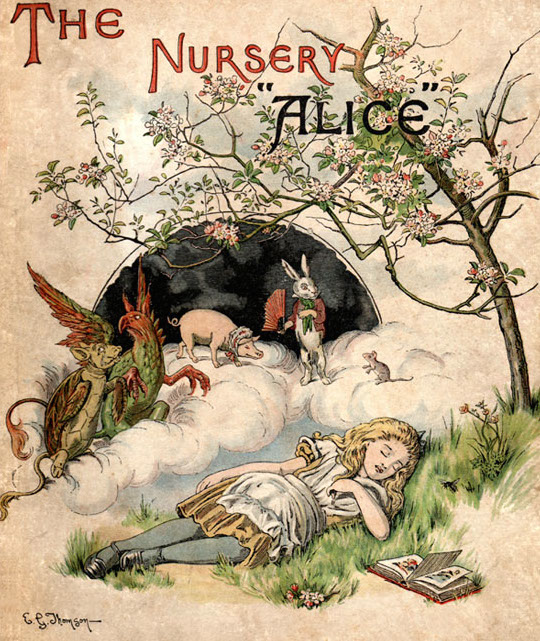
The Nursery Alice, [3] published for children aged ‘nought to five’ at the zenith of Alice’s popularity,  takes this visual focus further. The book houses enlarged coloured pictures that dwarf the text and allow Carroll to create tangential stories retrospectively inspired by Tenniel’s illustrations. Tenniel’s drawing of a foxglove, for example, inspires a quasi-etymological tale in which Carroll informs us Foxgloves are the gloves of Fairy Folk.

Furthermore, the narrator continually urges the reader to manipulate the illustrations so as to better understand the story. He encourages them to ‘shake the book and you’ll see [the rabbit] tremble’ and ‘turn up the corner of this leaf, [and] you’ll have Alice looking at the Grin: and she doesn’t look a bit more frightened than when she was looking at the Cat, does she?’. Carroll similarly urges the buyers of his postage stamp cases to ‘take the Case … you see Alice nursing the Duchess’s Baby? Pull it out – the Baby has turned into a Pig!’

stamp case

[The Wonderland Postage-Stamp Case – Designed by Lewis Carroll.]

These transformative uses of Tenniel’s illustrations celebrate visual-verbal interplay and suggest that pictures can aid a child’s inchoate understanding of the verbal text.

In ‘Wonderland’ the visual often threatens to dwarf the textual. Just as with one bite of the mushroom Alice oscillates from microscopic to gigantic, with one turn of the page the reader may find the text dwarfed by Tenniel’s rapidly ‘mushrooming’ illustrations. Thus, though the term ‘illustrate’ originally meant to ‘illuminate the mind’ the felicitous placement of illustrations in the first edition of Alice suggests that the drawings are not merely secondary elucidations, instead, they exist inextricably with the text itself. Carroll’s words are often not only referential towards the illustrations they are reliant upon them.

FullSizeRender[1]

For example, the courtroom scene on page 186 is curiously missing the Queen in order to fit in Carroll’s text. This enables an episode of  visual-verbal wordplay in which the pun ‘then the words don’t fit you’ (187) refers to the Queen’s pictorial lacuna and seems to be spoken by the pictorial rather than the textual King. It is for this reason that the ‘textual’ court greet his pun with ‘dead silence’ (187) as they cannot understand a joke that relies on the consciousness of their pictorial counterparts.

FullSizeRender[2]
Throughout the novel, the symbiotic relationship between visual and verbal continues to rely on the novel’s composition. When Alice’s body elongates the body of text mirrors her elongation. As 
Alice feels she is ‘opening out like the largest telescope that ever was!’ (15) her neck resembles the cylinder of a telescope extended from her compact body. The psychosomatic dissonance Alice experiences (she worries her feet won’t obey her unless she sends them new boots for Christmas) is reflected in the illustration. Tenniel details her wide eyes, open mouth and fanned out hair (which suggests a sudden altitude change), and her arms splayed out like one might do to slow their body whilst falling.

Later in the novel, Alice looks titanic in relation to the Rabbit, the hallway, and the page itself. Tenniel uses foreshortening – converging ceiling panels and highlighting Alice in the foreground whilst darkening the receding hallway. This creates a linear perspective that gives the illusion of depth and produces a rabbit-hole for the startled rabbit to retreat into. Tenniel’s imposing illustration creates a paradoxical disparity between text and image. After scolding herself for crying (‘you ought to be ashamed of yourself… a great girl like you!’) Alice tentatively addresses the rabbit ‘in a low, timid voice’ that quite belies her gargantuan size. Her hesitant posture suggests an answering recoil when the rabbit greets her not as a little girl but as a predator: scurrying away ‘into the darkness as hard as he could go.’ (18)

Lewis Carroll appears decidedly satisfied with Tenniel’s rendering of scale; according to a subsequent illustrator ‘Carroll would take a square inch of the drawing, count the lines … and compare their number with those on a square inch of illustration made for “Alice” by Tenniel! And in due course [he] would receive a long essay on the subject from Dodgson the mathematician’. [4] This emphasis on dimension and mathematical topography suggests that Carroll informed Tenniel in detail of the importance of depicting Alice’s oscillating growth.

Carroll himself used space and dimension to its full semantic capacity. In his illustration of the same scene,  Alice’s overgrown form is wrapped in a protective foetal position. But she is confined not by the Rabbit’s house but by the confines of her frame – functioning as an amateur ‘Trompe-l’oeil’, Carroll’s illusion of protuberance possesses a distinctly claustrophobic quality.

Contrastingly, Tenniel offers a near three-dimensional imprisonment: Alice’s elbow is painfully positioned in the corner of the room; her head bowed, and her arm forced through the window. The intense use of chiaroscuro combined with Alice’s reproachful expression presents an image reminiscent of a caged animal. This pictorial suggestion ties in with Alice’s anxiety regarding her fluctuating size, which is viscerally linked with conceptions of predation: ‘It was much pleasanter at home when one wasn’t always growing larger and smaller, and being ordered about by mice and rabbits. I almost wish I hadn’t gone down that rabbit-hole’ (46). In this context ‘the rabbit-hole’ becomes an evolutionary abyss in which Alice can both recapitulate into a creature of embryonic size and metamorphose into a being at the top of the food chain.

Tenniel and Carroll inextricably link Alice’s relative size with her survival. Tenniel’s illustration for page twenty-six depicts Alice nonchalantly swimming alongside a mouse. This evidently takes place after she fears he is a ‘walrus’ or ‘hippopotamus’ and instead remembers her own size and haughtily deduces it is ‘only a mouse’. Alice goes on to sadistically regales the mouse with tales of her cat. Even after she answers his cry ‘would you like cats if you were me?’ with the reluctant avowal ‘perhaps not’ she insensitively urges him not to ‘be angry about it’ and boasts that Dinah is ‘a capital one for catching mice’. (26) Tenniel’s drawing (bisecting Alice’s lyrical waxing) focuses on the divergent paths of the two figures: Alice regards the mouse with a vague sort of interest, her relaxed legs below the water propel her lazily in one direction, whilst the mouse’s taut legs frenetically drive his anxious straining form in the decidedly opposite direction. The illustrations and text work in tandem to imply what might happen if a mouse-sized Alice were to meet Dinah.

In ‘Alice in Wonderland: The Child as Swain’ Empson argues that ‘the pool of tears represents both the primeval sea from which life arose and amniotic fluid; the caucus-race which follows refers to the theory of natural selection; [and] the ape which appears in the illustrations is man’s simian ancestor.’ [5] This reading is supported by Tenniel’s illustration, which portrays Alice as an irrevocable member of the homogenous ‘queer-looking party’: her hair heavy with water is akin to the sodden feathers and fur of the other animals. The animals themselves are drawn with scientific accuracy and have been likened to contemporary taxonomy drawings.

Similarly, in her discussion on Darwinian narrative Gillian Beer asserts that ‘because of its preoccupation with time and with change, evolutionary theory has inherent affinities with the problems and processes of narrative’. [6] –  Alice in Wonderland is a novel that both textually and pictorially manifests these evolutionary fluctuations. Carroll’s disordered narrative, condemned by a contemporary review as all ‘loops, ties, and loose threads, entanglements, and inconsistencies’ [7] and Tenniel’s taxonomic, dimensionally inversive illustrations combine to produce a united text that, in carnivalesque protest, ousts Alice from her evolutionary position.


 A new edition of Alice illustrated by Arthur Rackham [8] is prefaced by the verse:

Enchanting Alice! Black-and-white

Has made your deeds perennial;

And naught save “Chaos and old Night”

Can part you now from Tenniel

Although this verse seems to suggest that Alice is immortalised in Tenniel’s drawings a later verse:

But still you are a Type, and based

In Truth, like Lear and Hamlet;

And Types may be re-draped to taste

In cloth-of-gold or camlet.

suggests that Alice can, like a new actress in a play, be ‘re-draped’ to new taste. However, I would argue that ‘afresh Costumier’ cannot imbibe his drawings with the same hermeneutic potential as Tenniel. Not only do the illustrations contain infamous details to the story that are not born from the text (the March-Hare’s hat of straw or the Hatter’s 10/6 price tag, for example) they are also visually synchronised with the narrative. Therefore, Tenniel’s work does not simply mirror Carroll’s narrative; instead it provides a kaleidoscopic reflection that like Carroll’s own looking-glass curiously transmutes its origins.


References

[1] Lewis Carroll, Alice’s Adventures in Wonderland (BookVirtual,2000) <https://www.adobe.com/be_en/active-use/pdf/Alice_in_Wonderland.pdf />

[2] Helen Groth, ‘Projections of Alice: anachronistic reading and the temporality of mediation.’ Textual Practice 26.4 (2012): 667-686.

[3] Lewis Carroll, The Nursery Alice, (London, Macmillan, 2010)

[4] Furniss, Some Victorian Men (London: John Lane, 1924)

[5] Empson, ‘Alice in Wonderland: The Child as Swain’, Some Versions of Pastoral (London: Chatto and Windus, 1935), 255.

[6] Gillian Beer, Darwin’s Plots (Cambridge University Press, 2000), p. 5.

[7] ‘Alice’s Adventures in Wonderland’, Athenaeum, (1865), p. 844.

[8] Alice’s Adventures in Wonderland with a poem by Austin Dobson (London: Doubleday, 1905)


This article has been cross-posted at The Victorian Web.

To be kept up to date on new posts from The Cabinet of Curiosity subscribe by WordPress or follow me on Twitter @rosalindmwhite.


← Back

Thank you for your response. ✨