The Constructing Scientific Communities (@Conscicom) project and the Hunterian Museum have co-curated an exhibition on the history of vaccination, which is now open. Vaccination: Medicine and the Masses will run in the Qvist Gallery at the Hunterian Museum until Saturday 17 September. Admission is free. Further information on the exhibition and the opening hours are available on the Museum’s website.
Conscicom has also announced three seminars taking place at St Anne’s College. The Politics of Participation: Early Nineteenth Century Scientific Citizens, (on the 10th May) Imaginary Engines- Lovelace, Babbage, and the Analytical Engine, (on the 18th May), and Names and Numbers: “Data” in Classical Natural History, 1758–1859 (on the 7th June.)
Embarrassing Bodies: Feeling Self-Conscious in the Nineteenth Century. Why were the Victorians so keenly aware of themselves? Why is the articulation of embarrassment such a preoccupation of nineteenth-century culture? This one-day symposium, funded by a Wellcome Trust ISSF Grant, will explore embarrassing moments in the nineteenth century, and consider the range of ways in which the period’s writers and thinkers represent and conceptualise these experiences
Sensational Butterflies is still on at The Natural History Museum. At the butterfly house on the Museum’s east lawn visitors can come face-to-face with tropical butterflies from around the world.
Science in Public: Past, Present and Future . University of Kent, Canterbury, 13-15 July 2016. Several panels will discuss questions of science and the public at different time periods; or consider relationships between historical and contemporary approaches to science in public
Bridging the Divide: Literature and Science. The relationship between literature and science has been a perennial subject of debate. Is there a divide between these two fields, or are they in fact two sides of one thing? The Universities of Kent and Sussex present a one-day conference on the 3rd June 2016, aimed at interrogating discourses around this subject.
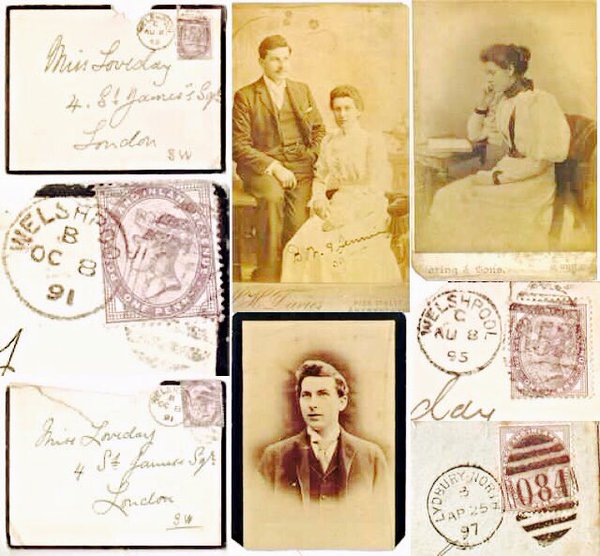
Great project help transcribe Victorian Love Letters from a Victorian Valet to a Housekeeper http://victorianloveletters.com
Call For Papers – The ” Heart ” and ” Science ” of Wilkie Collins and his Contemporaries, at Barts Pathology Museum, London.
Call For Papers – Object Lessons and Nature Tables: Research Collaborations Between Historians of Science and University Museums.
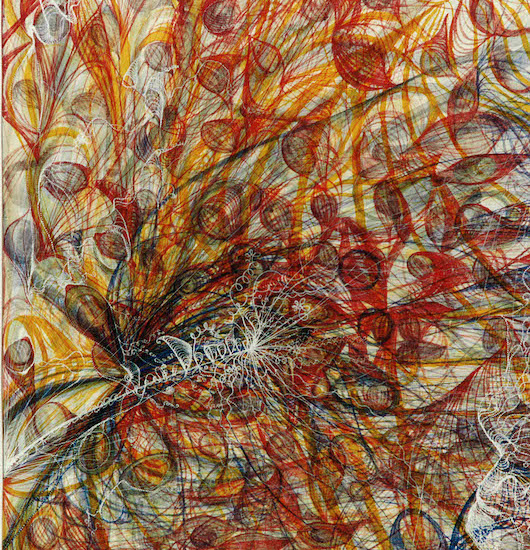
Georgiana Houghton, The Eye of the Lord (detail), 1861-1869. Courtesy of The Victorian Spiritualist Union, Melbourne.
Georgiana Houghton was a spiritualist medium who was trained in classical art but gave up painting after the death of her younger sister in 1851. A decade later, after she had become aquatinted with spiritualism she began once more to put coloured pencils and watercolours to paper. However, this time she said it was spirits of the dead who were guiding her hand. Through her mediumship she was acquainted with several Renaissance artists, as well as higher angelic beings. Houghton became the vessel through which they could exorcise their otherworldly aesthetic desires.
Georgiana Houghton, selections from the Invisible Beings series, 1872-76.
The nineteenth century with its ghosts and clairvoyants was the golden age of communion with the spirit world. The afterlife was figured not just as a sacred waiting-room but a place in which spirits continued to ‘live out’ their afterlife – evolving and communicating as they did when they were living. There was a seance in nearly every drawing room, including at Buckingham Palace. The spirits were believed to possess knowledge about moral and ethical issues that transcended our own. – This belief is almost palpable from the mesmeric, twisting force behind Houghton’s brush – her visual language is one of prepossessing immediacy.
Georgiana Houghton, The Love of God (detail), c.1861–1869 (detail). Courtesy of the Victorian Spiritualist Union, Melbourne.
Georgiana Houghton, The Glory of the Lord (detail), c. 1861–1869 (detail). Courtesy of the Victorian Spiritualist Union, Melbourne
In 1871 Houghton rented a gallery in Bond Street and presented 155 of these works to a bewildered London audience. Houghton funded the project with her own money and for two months met visitors in the gallery to speak with them about her work. However, only one painting sold and now only 50 or so remain in known existence.
The critic from The Era newspaper pronounced it to be ‘the most astonishing exhibition in London at the present moment.’ The Daily News likened the works to ‘tangled threads of colored wool’ and concluded that ‘they deserve to be seen as the most extraordinary and instructive example of artistic aberration.’
John Ptak acquired one Houghton’s gallery catalogues from an 1871 art show in London. In her annotations, Houghton explains her unconventional aesthetic process –
In the execution of the Drawings my hand has been entirely guided by Spirits, no idea being formed in my own mind as to what was going to be produced.
Houghton set out to ‘obtain mediumship’ by holding hands with her mother at a small table for some months on end waiting for contact— Sundays, she believed, worked best, ‘as we should then be less disturbed by evil influences’.
Georgiana Houghton, The Portrait of the Lord Jesus Christ, (detail), 1862, courtesy of The Victorian Spiritualist’ Union Melbourne, Australia.
Half a century before non-figurative art was popularised, Houghton’s drawings, in their psychedelic colours and passionate fluidity, in many ways, anticipate the abstraction of early twentieth century art.
As Marco Pasi puts it:
Houghton transferred authorship and agency to the spirits. In doing so she could radicalise her artwork and make alien objects that could not be placed at the time in which they were made.
This summer, the Courtauld Gallery at Somerset House will mount an exhibition of Georgiana Houghton’s work. The exhibition will be opened from the 16th June to the 11th September 2016 and will be open daily from 10am-6pm.
Georgiana Houghton, The Sheltering Wing of the Most High, c. 1861-61, courtesy of The Victorian Spiritualist Union, Melbourne.
References
Ptak, John F, ‘Spirit-Generated Art, 1871: Far-Outside Outsider Art’ (JF Ptak Science Books // Blog Bookstore, 1933)
Larsen, Pasi and Grant, Georgiana Houghton: Spirit Drawings (Paul Holberton Publishing, 2016)
To be kept up to date on new posts from The Cabinet of Curiosity subscribe by WordPress or follow me on Twitter @rosalindmwhite.
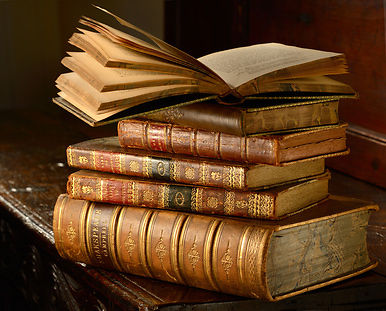
Browsing through the bookshelves of your modern university library – have you ever had a look at one of the conspicuously dusty of tomes that look like they would better belong in the restricted section of Hogwarts library?
The kind that, with their elegant gold leaf spines jutting out between laminated textbooks in tones of lurid orange or acid green, seem to exist almost outside of time?
Earlier this week, I attended the second ‘Objects in Focus’ workshop at Royal Holloway University of London, which brings together scholars across the arts and humanities to reflect on visual cultures within an interdisciplinary frame.
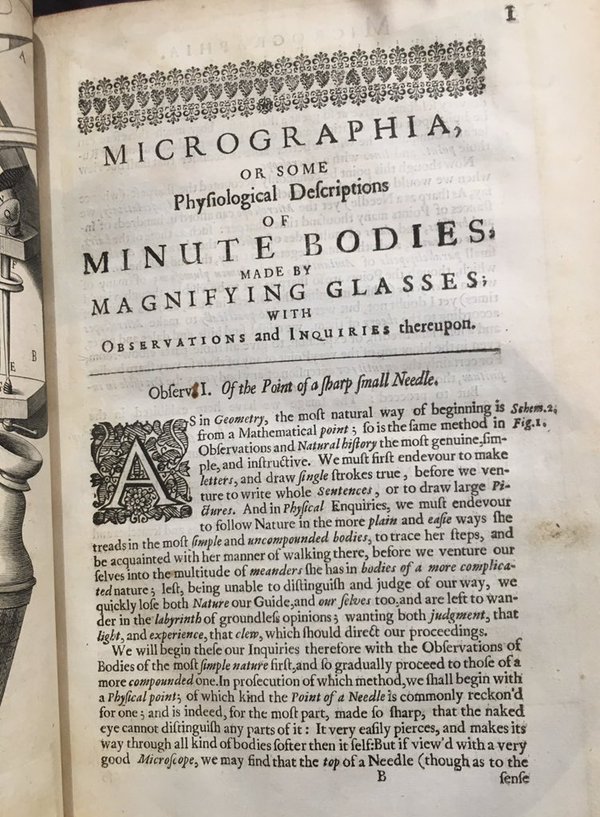
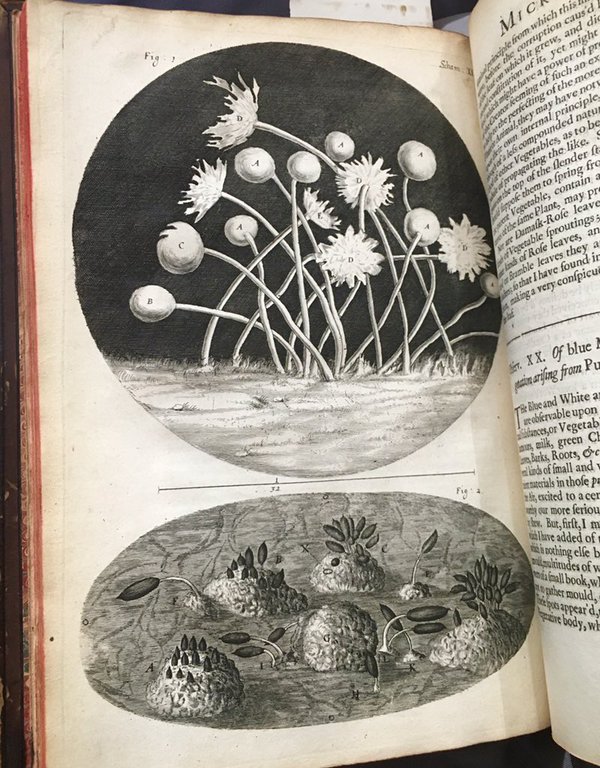
During our lunch break we were joined by the College Archivist, Annabel Valentine, who introduced us to some of the rare books available at the Archive – including Robert Hooke’s Micrographia. (1665)
During our conversation we discussed what constitutes a ‘rare’ book or material. This discussion inspired me to have a poke around the university library (in lieu of the archive) and see what rarities I might find. One quick sweep of the Modern Science department later – I came home armed with two Victorian natural history books!
A Year At The Shore (1865) by Philip Henry Gosse (the naturalist and populariser of the aquarium) contained some beautiful lithographs of marine life. The colour of Gosse’s illustrations were known to provoke not only awe but often disbelief. – His son Edmund Gosse recalls that several reviewers questioned the plates in Gosse’s work and ‘made a positive sensation [of The Aquarium (1856) which] marked an epoch in the annals of English book illustration’.
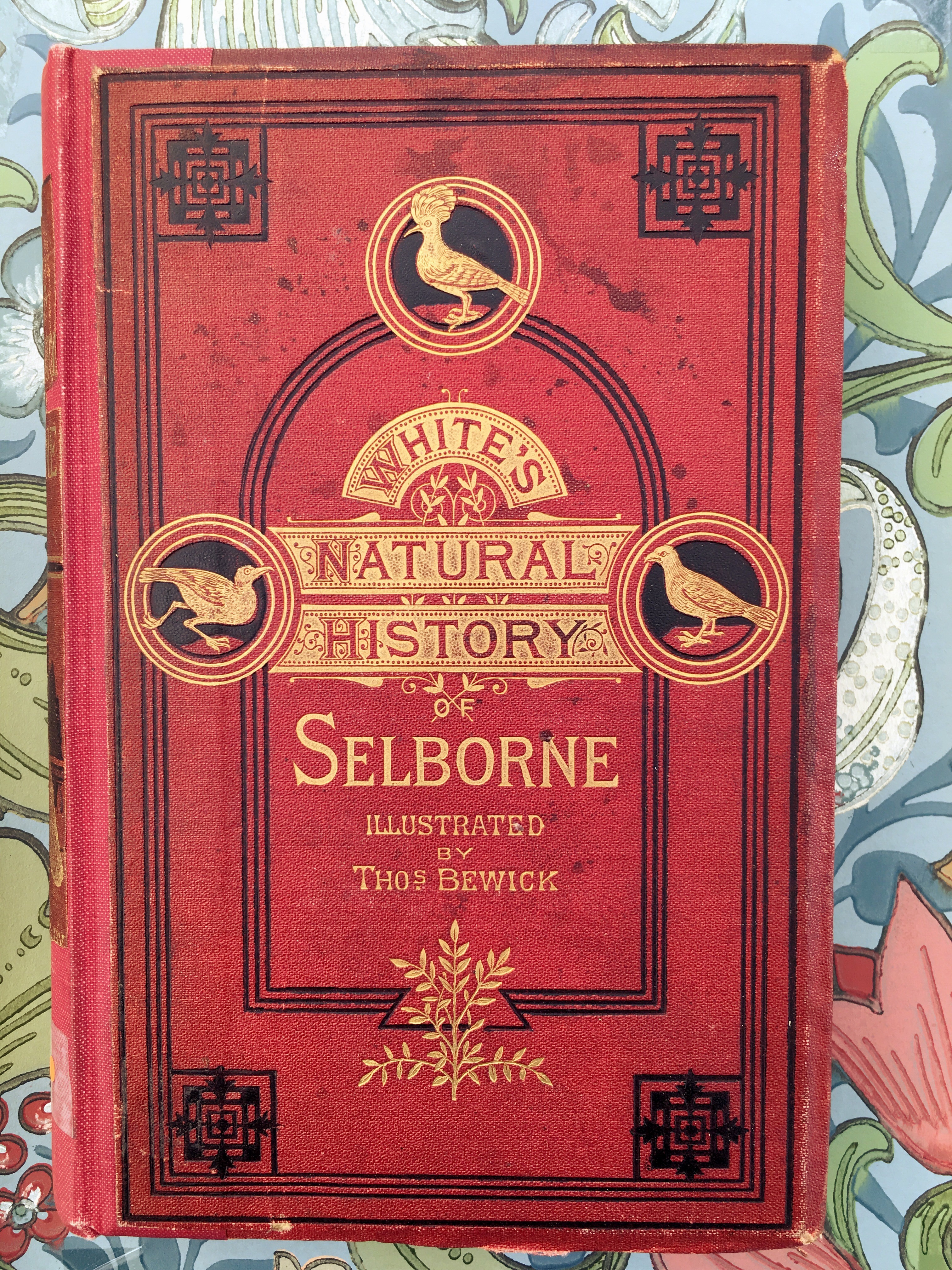
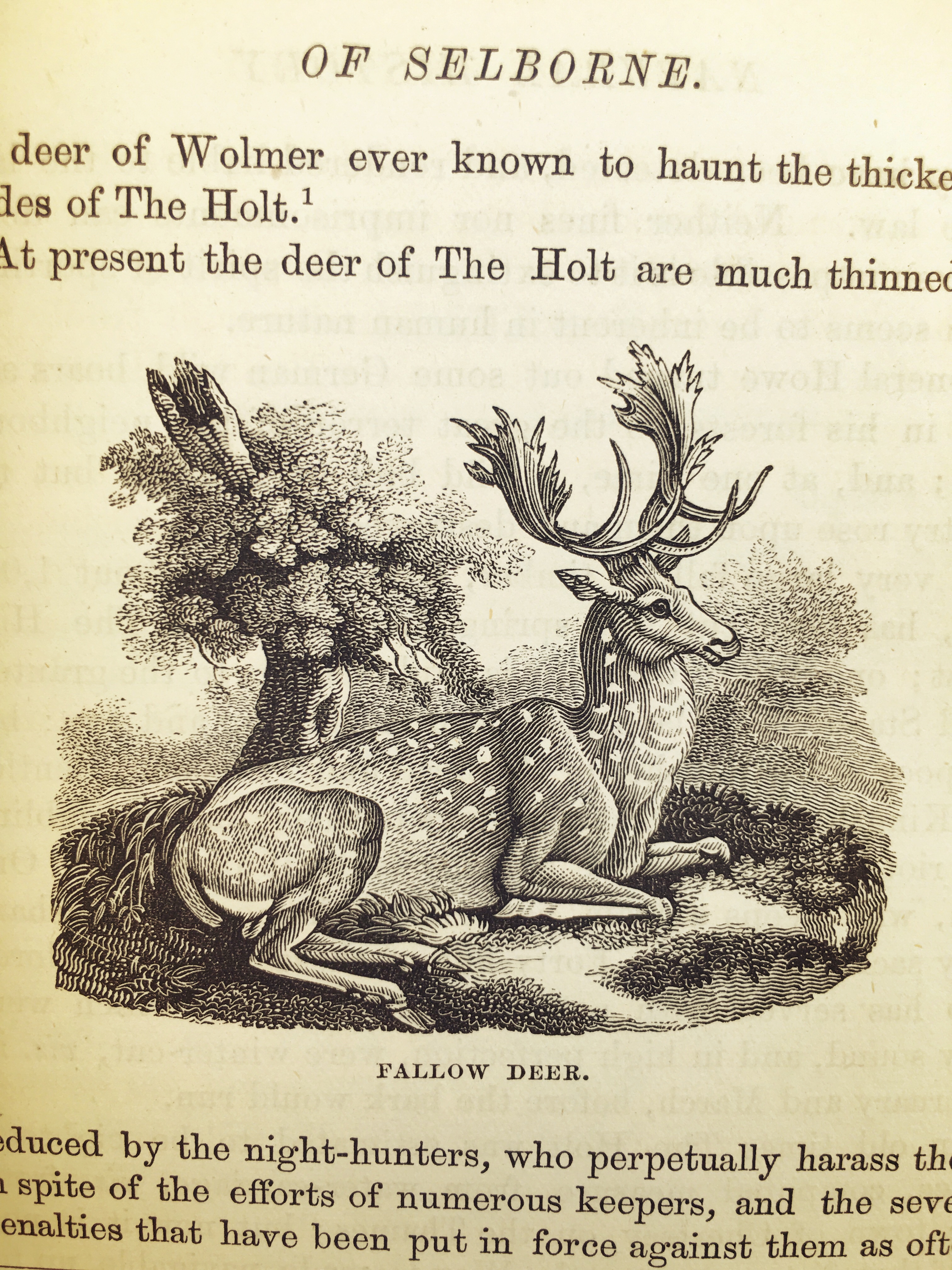
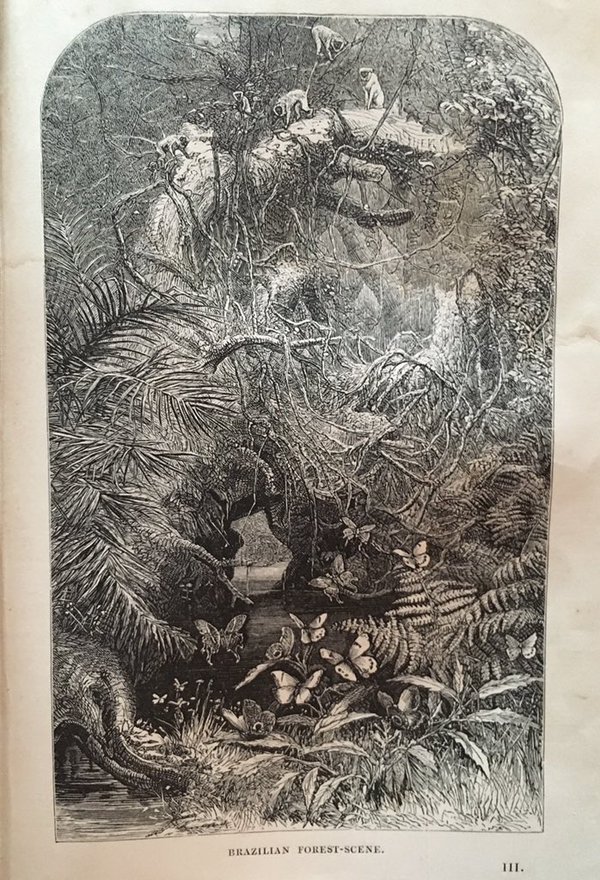
I also picked up The Natural History of Selborne (first published in 1789) by the naturalist and ornithologist Gilbert White.
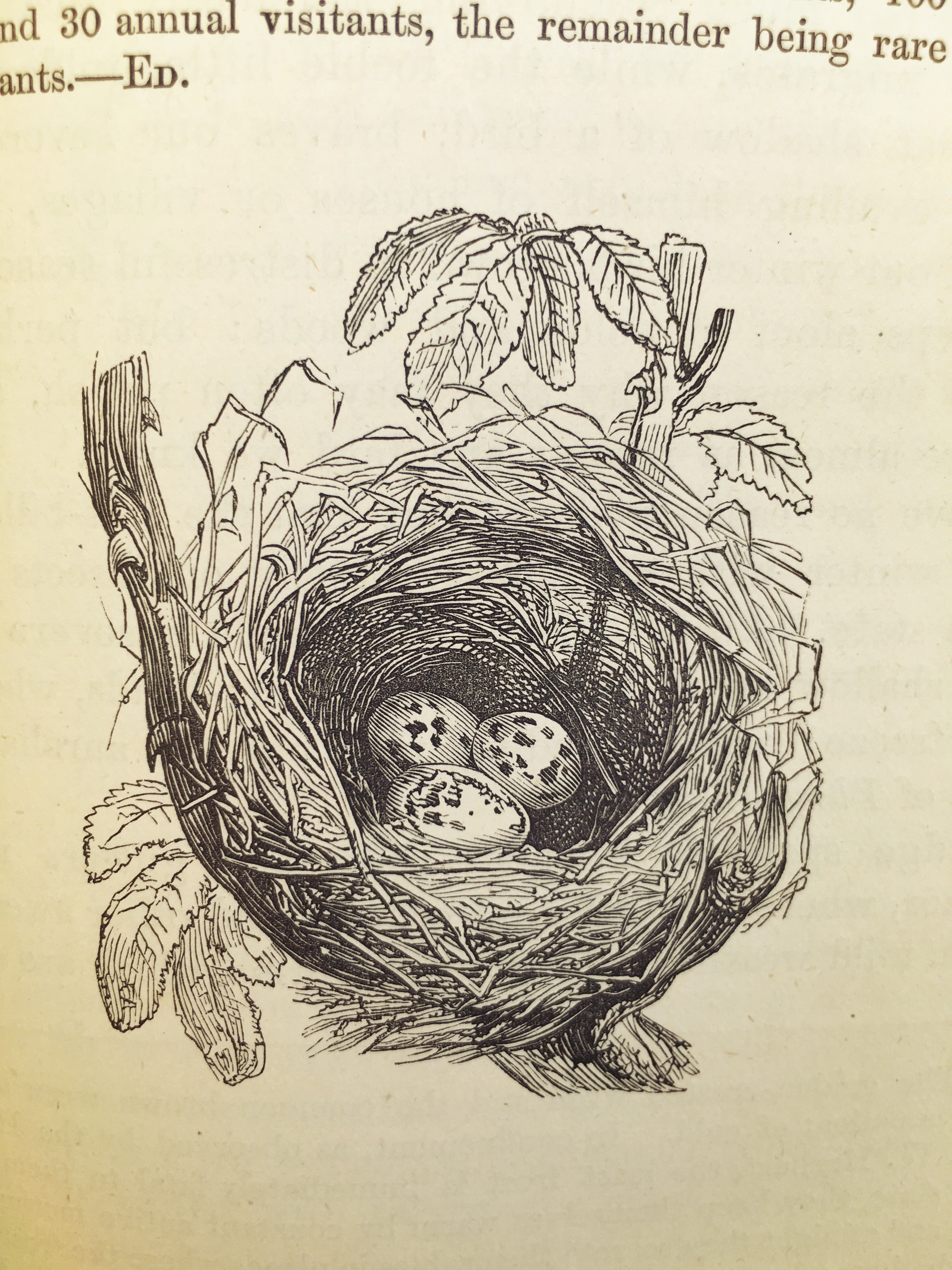
This 1875 edition included not only an assortment of intricate illustrations but also a comparative Naturalist’s Calendar, some selected poems, and (most surprising of all) a foldout facsimile from the journal of the Rev. Gilbert White.
Leafing through the pages of physical rather than digital texts offers scholars an invaluable opportunity to reflect upon the ‘haptics’ of the book. – Bringing touch into our scholarly practice provides an recapitulative invaluable tool that allows us to re-inhabit lived nineteenth-century experience. This becomes particularly poignant when you imagine nineteenth-century students browsing, and studying from the very same pages as you!
This post, then, operates as a reminder (to myself as well as to possible readers!) to liberate your library books from their modern shelves – and that primary sources of historical value are not just to be found in the archives.
Side note – the charity shop can also be a great place to come across some unexpected treasures. I recently tracked down Philip Henry Gosse’s beautiful work of poetical science The Romance of Natural History (1860-61) .
For more information on the ‘Objects in Focus’ workshop visit the blog or Twitter account @ObjectsFocus.
For more information on the rare books and special collections at RHUL, including titles dating from the sixteenth to the twenty-first century, see the website – items may only be viewed by prior appointment under supervision in the Archives reading room, which is open Wednesday to Friday, 9.30-1 and 2-4.30pm.
To be kept up to date on new posts from The Cabinet of Curiosity subscribe by WordPress or follow me on Twitter @rosalindmwhite.
Jane Eyre as portrayed by Mia Wasikowska in the 2011 adaptation.
After first meeting Jane,Rochester furthers their relationship by masquerading as a gypsy to discover her true impressions of him. His voice ‘wraps’ her in ‘a kind of dream’, ‘a web of mystification’, until she instinctually believes an ‘unseen spirit had been sitting for weeks by [her] heart watching its workings and taking record of every pulse’. (175) In a similar vein, Jane’s cousin, St. John, acquires ‘a certain influence’ over her that ‘took away [her] liberty of mind’ (352) until she ‘fell under a freezing spell’ (357) his ‘influence in [her] marrow – his hold on [her] limbs’. (359)
In both these moments, Bronte portrays her male characters as having a mesmeric power over her female protagonist.
Mesmerism, (originally animal magnetism) was a therapeutic doctrine coined by Franz Mesmer in the eighteenth-century, but popularised by practitioners in the nineteenth. Mesmerists were thought to possess the power to place their subjects in a hypnotic state through the imposition of their own will on that of the subject. Mesmerism was often the practice of physicians, or gynaecologists, and was often used to ‘treat’ hysteria.
In this context, mesmerism becomes a potent but volatile force when combined with romance.
Later in Jane Eyre, St. John’s ‘despotic’ effect on Jane is broken by Rochester’s magnetic disembodied voice, which sets her spirit ‘trembling’ in ‘exaltation’ (373) and calls her to Thornfield.
However, unlike St. John, who wishes for perfect submission from Jane, Rochester’s language suggests that the power in their relationship mirrors a kind of erotic countertransference.
Rochester notes that Jane only ‘seems to submit’; for whilst he is compelled by ‘the sense of pliancy [she] impart[s]’ he is ‘conquered’ by her ‘influence’ that ‘has a witchery beyond any triumph [he] can win’. He figures Jane as a deceptively ‘soft, silken skein’ that he can manipulate ‘around [his] finger’ but ‘send[s] a thrill up [his] arm to [his] heart’. (229)
Sigmund Freud in 1910 and Carl Jung in 1909, both of whom specialised in cases of female hysteria, warned against a patient’s influence on the physician’s unconscious feelings. They cite ‘cases of counter-transference when the analyst could not let go of the patient [and] both fall into the same dark hole of unconsciousness’. [2]
This psychic void mirrors Jane’s mounting fear, throughout the novel, of such a self-effacing abyss. It is this spiritual assimilation that Jane rallies against ‘it is my spirit that addresses your spirit; as if both had passed through the grave, and we stood at God’s feet, equal — as we are!’ (223)
Significantly, during the nineteenth-century the same mental vulnerability that was thought to predispose women to mesmeric susceptibility was also thought to make them attuned spiritual conduits. Psychiatry explicitly linked hysteria with female mediumship, pathologising it with terms like ‘psycholepsy’ and ‘mediomania’.
The spiritualism movement, in many ways, valorised the female mind and equipped women with a skill that afforded them a degree of financial independence. The fertile atmosphere of the séance not only provided spiritualists with the means to enter into the male domain of patriarchal discourse, but also allowed them to team up in order to trick countless men of scientific repute. Florence Cook, for example, a famous spiritualist, materialised during her séances as ‘Katie King,’ the spirit-world daughter of a seventeenth-century buccaneer.
The image below typifies the artful luminaries many women became: a woman at the core of each table shrewdly orchestrates communion with the ‘other side’ by means of the hat; table-turning; or the pendulum.
A spiritualist meeting in a Paris drawing room, from L’Illustration (Paris, 1853)
In Jane Eyre it is frequently suggested that Jane’s hysteria makes her susceptible to the spirit world; locked in the room of her uncle’s death her nerves are ‘shaken’ with ‘agitation’ until she hears the ‘rushing of wings’ and sees ‘a swift darting beam’ ‘a herald of some coming vision from another world’. (12) She often speaks involuntarily; accosting her aunt with the demands of a man long dead, ‘what would Uncle say to you, if he were alive?’ whilst feeling ‘something spoke out of me over which I had no control’. (21)
Jane herself is also presented as an inherently transient or ghostly figure: an orphan who has no place in the family home; a governess who must leave when the child matures; and a young-woman who, before the novel’s close, becomes only an evanescent bride. Mary Daly’s theory of ‘female ghosthood’ posits that denial of physical and mental space creates ‘invisible and subliminal’ ‘space warps’ that often make women feel alienated ‘spacy or disorientated’. [3] These ‘space warps’ slowly distend every time Jane is denied entry to the third floor, or told Bertha is ‘the creature of [her] over-stimulated brain’. (250)
Jane’s spiritualism intermittently manifests as incipient witchcraft; she is wary of her tenuous link to the supernatural, making ‘sure that nothing worse than [her]self haunted the shadowy room’. Furthermore, Jane’s metonymical epithets (‘witch’ ‘cat’, ‘ignis fatuus’, ‘sprite,’ ‘imp’ ‘changeling’ ‘elf’ and ‘fairy’) combined with Rochester’s many assertions that Jane ‘has bewitched [his] horse’ or ‘has the look of another world’ (106) subtextually tie Jane’s link to the supernatural with her hysteria.
Just as ‘female passivity, [was considered] the leit-motif of powerful mediumship’ [4] Jane’s liminality empowers her; Jane is not fearful of Rochester’s threat of violence but feels ‘an inward power; a sense of influence, which support[s] [her]’. (267)
Jane, like the female spiritualist movement, harnesses her supposed passivity – and transforms herself from a subject of masculine magnetism to a figure that possesses her own mesmerism.
References
Charlotte Bronte, Jane Eyre, (Wordsworth Classics, 1992)
C. G. Jung, Analytical Psychology: its Theory and Practice (London, 1976) p. 159 and p. 157.
[3] Mary Daly, Pure Lust: Elemental Feminist Philosophy, (The Women’s Press, 2001) p. 18.
[4] Vanessa D. Dickerson, Victorian Ghosts in the Noontide: Women Writers and the Supernatural, (University of Missouri Press, 1996) p. 119.
To be kept up to date on new posts from The Cabinet of Curiosity subscribe by WordPress or follow me on Twitter @rosalindmwhite.
#1 Curator Andrea Hart provides an audio slideshow of Rare Treasures. Which brings together some of the Museum’s most highly prized works of natural history literature, chosen for their scientific and artistic merit.
#2 New York Times article on the critical role natural history museums play in conversation.
#3 Look inside the storage archives at the Smithsonian’s Museum of Natural History
#4 750 field-notes from @FieldBookProj released on The Biodiversity Library – explore scientists’ records from the field.
#5 cultural events on Twitter: track #MuseumWeek to review the first worldwide cultural event dedicated to revealing the museum’s best kept secrets; follow @ObjectsFocus for updates on a series of workshops bringing together scholars across the arts and humanities to reflect on interdisciplinary research using visual material; track #bsls2016 to recap on the The British Society for Literature and Science Conference 2016.
#6 Twitter account of the week @StrangeAnimals Posting photos of amazing species and highlighting the wonders of evolution & the incredible diversity of life.
To be kept up to date on new posts from The Cabinet of Curiosity subscribe by WordPress or follow me on Twitter @rosalindmwhite.
Marianne North was an early female explorer, naturalist and painter. Her life, as she described it, was one of “wander and wonder and paint!” Her paintings are rendered with the vividness of colour and microscopic detail of the Pre-Raphaelite style. In her early recollections Marianne even longs for the tutelage of ‘old William Hunt.’
An excerpt from North’s journals, accompanied by a painting of the same scene, gives a sense of the emotional ecology at work in her art.
[View from the artist’s house on the Newcastle Road, Jamaica]
‘It almost took my breath away with its lovely fairy-like beauty; the very mist which always seemed to hang among the trees aim plants there made it the more lovely and mysterious. There were quantities of tree-ferns, and every other sort of fern, all growing piled on one another; trees with branches and stems quite covered with them … A close waxy pink was running up everything as well as the creeping fern, and many lycoodiums, mosses, and lichens. It was like a scene in a pantomime, too good to be real, the tree-fern fronds crossing and recrossing each other like network.’ [p. 50]
North looked after and travelled with her widowed father for much of her life. After his death in 1869, Marianne, financially independent at the age of forty, set off alone to explore and paint the world.
Her upbringing was curiously absent of much of the trappings of Victorian gender spheres and was ideal for the formative years of a future naturalist. Whilst reminiscing upon her childhood Marianne notes that ‘governesses hardly interfered with me in those days. Walter Scott or Shakespeare gave me their versions of history, and Robinson Crusoe and some other old books my ideas of geography.’ Her ‘garden was full of old-fashioned flowers [with] tiny paths and beds edged with box hedges, leading up to a quaint old pigeon-house covered with ivy, and beyond that was the park full of grand trees, and the church and village’. [p. 18]
During her artistic odyssey around the world Marianne displayed impressive grit and determination. Faced with numerous occasions where her gender was perceived as an obstacle to her pursuits Marianne proved impervious to derision. In Palermo, Italy, when her landlord ‘had a strong objection to travelling ladies, and always pretended he had no rooms for them, except on the fifth floor’ Marianne dauntlessly responded with ‘so to the fifth we went, and gained all the better view’. [p. 28]
Similarly, on a trip to the Niagara Falls North notes how ‘the Head Guide of the Falls, patronised me, and told me if I got chilled at any time just to go and ask his missus to give me a good cup of coffee, [as] it ‘ud do her heart good to make it for me’. However, un-phased Marianne settles down to work on the boulders below, between two huge roaring falls, and becomes the spectacle of the tourists who passed her by to look at her ‘at intervals’ in ‘suits of yellow oilskin’. [p. 36]
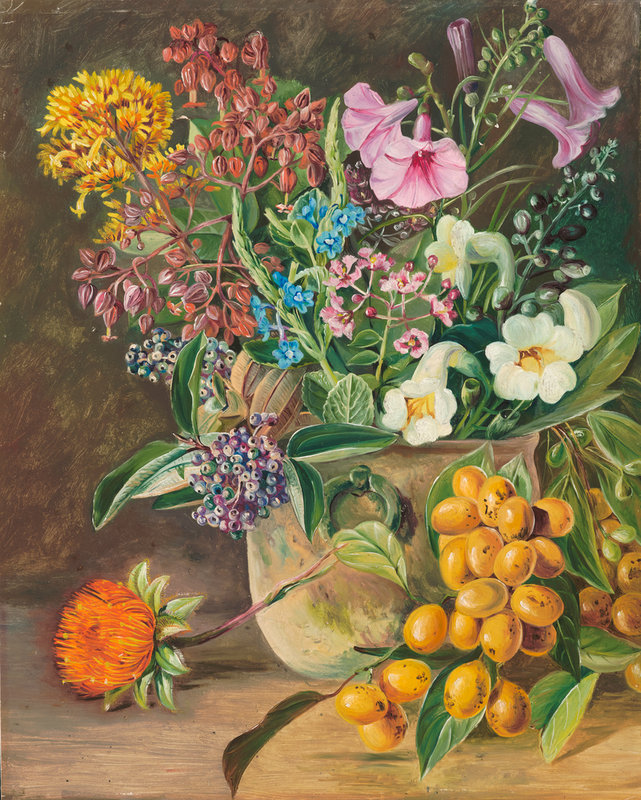
[An assortment of Marianne North’s paintings available at WikiPaintings.]
On her travels Marianne was often accompanied by a female chaperone. However, she was often vexed by her listless companion’s inability to keep up with her intrepid adventuring. In Southern Italy, fed up with ‘Elizabeth’s constant complaints and weariness’ which ‘ tire her out’ [p. 30] North took the steamer from Messina to Genoa and left both her apathetic attendant and her luggage at the inn. After her two day’s break for freedom she returned to Naples and picked up her trunks and Elizabeth, whom she put on a steamer to Genoa to be sent home.
Later on in her travels Marianne rather than be held back by a chaperone often ‘landed alone and friendless’ [p. 47] on an unknown shore despite ‘know[ing] nothing more trying to a shy person than landing for the first time among a strange people and language’. [p. 59.] Although she often found that ‘when the good people found my hobby for painting strange plants, they sent me all kinds of beautiful specimens.’ [p. 83]
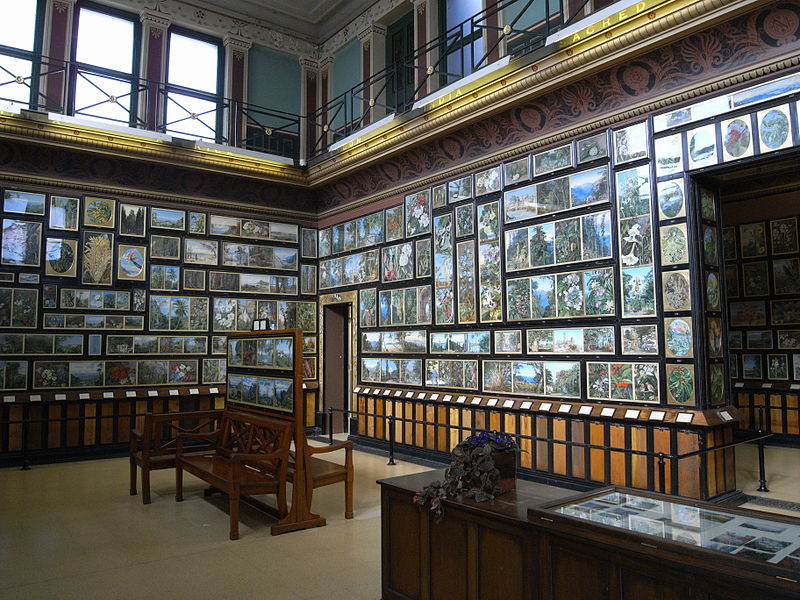
Unlike other female naturalists her father’s wealth afforded Marianne the adequate means to rescue her work from obscurity. In 1882, a gallery of Marianne North’s work opened at England’s Royal Botanic Gardens at Kew. Funded by North, the gallery was designed by James Fergusson under her supervision – Marianne herself arranging the paintings and crafting the frieze and decorations surrounding the doors to the gallery. North’s eight hundred and thirty two paintings provided the scientists at Kew and the general public with both empirical and aesthetic pleasure – the scientific accuracy of North’s paintings even lead to four plant species being named after her.
North’s unique style departed from the tradition of sketching a watercolour flower individuated onto a plain background – instead her paintings are rendered in vivid detail each brushstroke capturing her botanical specimens in their own immediate, thriving microcosm. At a time when photographs remained in black and white North’s emotive works of colour must have been a kaleidoscopic sight to behold. William Blunt in The Art of Botanical Illustration (1950) describes North’s gallery as ‘like a gigantic botanical postage-stamp album [where] yet further flowers scramble up the doorposts and across the lintels.’
Marianne North’s most famous supporter was Charles Darwin, the English naturalist whose meticulous observations became the foundation of evolutionary biology. In 1880 North was ‘asked by Mrs Lichfield to come and meet her father, Charles Darwin, who wanted to see me, but could not climb my stairs.’ North refers to Darwin as ‘the greatest man living, the most truthful, as well as the most unselfish and modest, [for] he was always trying to give others rather than himself the credit of his own great thoughts and work.’ [p. 151] Darwin’s ‘ power of bringing out other people’s best points’ extended to Marianne whom he advised to see and paint the Australian vegetation ‘which was unlike that of any other country’. North, taking Darwin’s advice as ‘a royal command’, went ‘at once’ and eagerly returned to Down house in 1881 to sit with Darwin and his children under a shady tree to inspect her paintings together. According to North, Darwin showed in ‘a few words how much more he knew about the subjects than anyone else, myself included, though I had seen them and he had not.’ Such was the intimacy of their mutual accord, that when North was readying to depart Darwin ‘insisted on packing [her] sketches and putting them even into the carriage with his own hands.’ [p. 197]
Darwin sent Marianne a short note after this visit to show his appreciation of her work and friendship.
2nd August 1881 My Dear Miss North, – I am much obliged for the “Australian Sheep,” which is very curious. If I had I seen it from a yard’s distance lying on a table, I would have wagered that it was a coral of the genus Porites.
I am so glad that I have seen your Australian pictures, and it was extremely kind of you to bring call up with considerable vividness scenes in various countries which I have seen, and it is no various countries which I have seen, and it is no small pleasure; but my mind in this respect must be a mere barren waste compared with your mind. I remain, dear Miss North, yours, truly obliged, CHARLES DARWIN
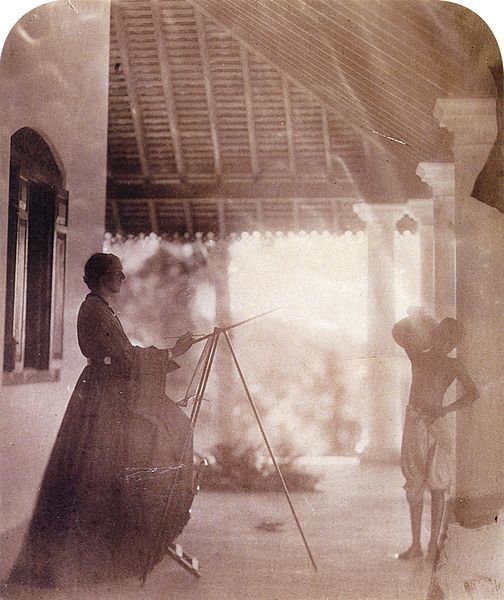
Marianne North painting a Tamil boy in Ceylon, 1877. (Photograph by Julia Margaret Cameron)
by Unknown photographer, sepia-toned vintage print on card, 1870s
According to Kew Garden’s Marianne North’s gallery is, to this day, “the only permanent solo exhibition by a female artist in Britain”. Natural history, thus, in many ways, functioned in the Victorian era as an agent of liberation that had the capacity to free women like Marianne North from the trappings of restrictive femininity.
A small sample of Marianne North’s botanical art is available via WikiPaintings.
All references to North’s recollections are from Marianne North, A Vision of Eden: The Life and Works of Marianne North (United Kingdom: Webb & Bower / The Royal Botanic Gardens, Kew, 1980).
To be kept up to date on new posts from The Cabinet of Curiosity subscribe by WordPress or follow me on Twitter @rosalindmwhite.
Cabinets of curiosities, also known as ‘wonder rooms’, were small collections of extraordinary objects which attempted to categorise and tell stories about the wonders of the world.
The Cabinet of Curiosity collects together various fragments, articles and trivia to create a microcosm of Victorian culture.
This blog will particularly focus on natural history, gender, fair tales, visual culture and the history of emotions.