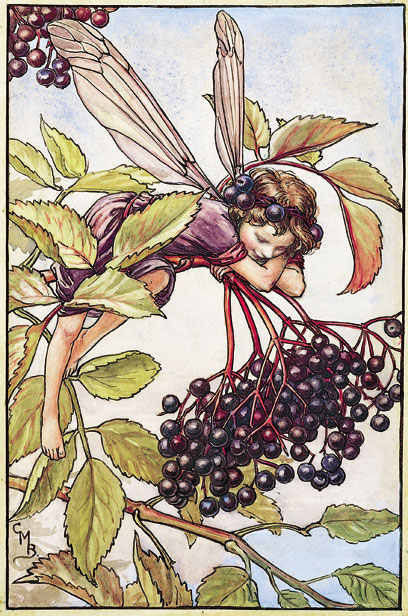
The fairy was often thought of as a mode of rebellion against the exactitude of science and technology.
This is exemplified in Turner’s Queen Mab’s Cave (1846) which is hazily wrought with a nebulous glow that appears to purposefully cloud the eye with a literal and metaphorical opacity. As the rocks, water and dappled light optically coalesce the fairies appear to be indeterminately in and out of both the water and our world. A contemporary reviewer attests to this reading noting Turner ‘admits of more than a usual employment of the vague, illusive, and fanciful; [he]… produce[s] a daylight dream … not painted but apparently flung upon the canvas in kaleidoscopic confusion.’

In 1917 two girls, Elsie Wright and Francis Griffiths, were said to have photographed fairies at the bottom of their garden. The Cottingley Fairies, as they became known, became the locus for the tension between ‘men of science’ and those who wished to retreat into the fairy realm.


Many eminent members of society including Arthur Conan Doyle viewed these images as authentic evidence: seen through clairvoyant eyes that could become clouded as the two girls approached adulthood, ‘the processes of puberty [proving] often fatal to psychic power.’ Proof of the existence of fairies, he believed, would ‘jolt the material 20th-century mind out of its heavy ruts in the mud, and make it admit that there is a glamour and mystery to life.”

In the 1980s Elsie and Frances admitted that the photographs were faked, Elsie had copied illustrations from a popular children’s book, Princess Mary’s Gift Book, published in 1914, They said they had then cut out the cardboard figures added wings, and supported them with hatpins. But Frances maintained that the fifth and final photograph was genuine.
This final photo is described by Arthur Conan Doyle as follows:
“Seated on the upper left hand edge with wing well displayed is an undraped fairy apparently considering whether it is time to get up. An earlier riser of more mature age is seen on the right possessing abundant hair and wonderful wings. Her slightly denser body can be glimpsed within her fairy dress.”

Fairies and Their Sun-Bath, the fifth and last photograph of the Cottingley Fairies.
Veiled by a grass, the concealed translucent fairy-folk optically mystifiy the eye. This effect is likely produced by a method of double exposure. William Mumbler’s deceptive double exposures of the dead in the 1860s used film already exposed with an image (usually of a doll or photo of the deceased) to trick customers into believing the spectral image residing in the photo was the spirit of their beloved. – The last Cottingley Fairies photograph is likely to have been taken using a similar process.
Today the photographs are thought of as the product of imaginative play. As Elsie Wright has said
If people wish to believe in fairies, there is no harm done. And if people wish to think of us as a couple of practical jokers, or two solemn faced Yorkshire comedians that’s alright too. But the word liar is a rough word for a true or untrue Fairy story.
However, a recent reappraisal of two photographs sheds a different light on this curious case.
The Secret of the Cottingley Fairies, (2017) by F.R. Maher presents an ingenious theory backed up by meticulous research. The photographs, that form the foundation of Maher’s theory have been known to folklorists and fans of the Cottingley Case for some time. I myself had come across the photos on Pinterest, that great nightmare of cyclical untethered images, and assumed they were copycat works.
F. R. Maher is the first to suggest that these photographs (taken in 1918) may not be copies, but may, in fact, have provided the inspiration for the famous hoax.

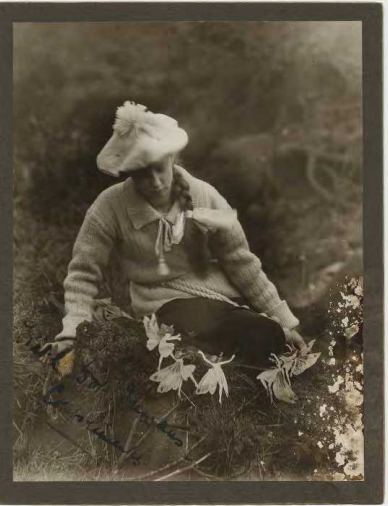
The second of the five photographs, showing Elsie with a winged gnome in comparison with Dorothy Inman’s photograph.
One of the photographs taken by Dorothy Inman in 1918, is held in the same collection as the Cottingley fairy material where it is labelled ‘Mrs Inman‟s Fake Photograph.’ Little else is known about this photo. In 1918, The Sphere, printed the second photograph of a young girl surrounded by fairies. Beneath the photo ‘A Fantastic Invasion of A Modern Garden’ the caption reads ‘An attempt to picture the Little Folk with which a child’s imagination will people even the most prosaic London garden, and the little girl who loved them.’As Maher notes, ‘the picture made no attempt to pass these figures off as real fairies’.

A Fantastic Invasion of A Modern Garden (April 1918) The Sphere.
Maher is the first to query the timeline of these photographs. As the story goes, the ‘original’ Cottingley photos were taken in 1917 and then ‘forgotten’ for over two years until Polly Wright, mother of Elsie took these photos to the Theosophical Society. Maher questions this chronology: suggesting that Arthur Wright, Elsie’s father and a keen amateur photographer, may have simply copied The Sphere photograph.
Maher’s theory rests on the simple fact that the Cottingley fairy photographs materialised into the wider world a year after The Sphere publication. Further evidence for Maher’s theory, such the curious lack of ageing Francis displays between 1917 and 1920, can be found in her book as well as on her blog post.
Maher’s ‘new’ evidence, and more tellingly its previous availability to researchers of the Cottingley myth, suggests that we have been rather too preoccupied with debating the fairies veracity, so much so, we have failed to interrogate their place in history.
The fact that we have managed to collectively ignore something hidden in plain sight – and as historians obsessed over the binary question of whether two young girls did or did not see glimpses of fairyland, suggests that we, like poor Arthur Conan Doyle, were all too eager to be taken in by the tale.
How likely is it that one of the many emminent men, determined to find verifiable proof of fairies, would have not retained cuttings or memories of fairies in the press prior to 1920?
Is it not more probable that men like Gardner and Doyle may have actively repressed all memory of these previous images? – To go out of their way to give-wings to the possibility that fairies might not only exist, but could be arrested beneath a photographic plate.
___
The Secret of the Cottingley Fairies by F.R. Maher is available to buy on Amazon. An interview with F.R. Maher on her discovery is available in the August 2017 issue of The Fortean Times.
See also:
Doyle, A., 1922, The Coming of Fairies. London: Hoddon.
Smith, Paul (1997), “The Cottingley Fairies: The End of a Legend”, in Narváez, Peter, The Good People: New Fairylore Essays, The University Press of Kentucky, pp. 371–405.