How do we approach an age that, increasingly, feels unanchored from our emotional present? Why do the outsized passions and curious habits of the past, often evade faithful restoration? As we take what has been termed a ‘material turn’[1] in Victorian studies, appraising an object’s function has become secondary to uncovering an object’s emotional afterlife. We are still interested, for example, in a fossil’s paleontological value, but are perhaps more eager to learn that they were routinely licked by enthusiastic geologists tongue-testing for mineralisation. Our concern with the affective capacity of an object has led to an intersection between the study of materiality and the burgeoning field known as the ‘history of emotions.’
The latest publication from the Darwin Correspondence Project, Darwin and Women, begins with its own taxonomic quandary. From the outset Samantha Evans, entrusted with the tricky task of uncovering Darwin’s intellectual interdependence with women through the fractured prism of his private correspondence, wisely chooses to forgo chronology for a thematic arrangement. This classification system, in which letters are sorted into 14 clusters, means that correspondents frequently reappear under different taxons. The book includes sections on botanical correspondence, observing humans, religion (a chapter edited by Paul White), companion animals, and a section on insects, “small, apparently insignificant creatures”, though, as Evans notes, no mention is made of outliers such as John Lubbock’s pet wasp. My favourite chapter, “Scientific wives and allies”, best illustrates the inextricable way in which the contributions of women interwove with Darwin’s vision of an entangled bank.
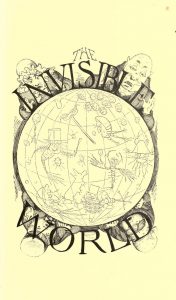
“The Invisible World,” a frontispiece for a chapter on microscopy in The Fairy Tales of Science (1859)
Fitz-James O’Brien (1828-1862) was an Irish-American Civil War soldier and one of the forerunners of the Science-Fiction genre. His primary literary connection was with Harper’s Magazine – a periodical that he contributed to – in prose and verse- over sixty times. He likewise wrote for the New York Saturday Press, Putnam’s Magazine, Vanity Fair, and The Atlantic Monthly. To the latter he sent “The Diamond Lens” in 1858.
“The Diamond Lens” tells the tale of Mr. Linley, a man who has had an obsession with microscopy from childhood. He forges a new microscope lens with a diamond of one hundred and forty carats that has been submitted to electro-magnetic currents to rearrange its atoms. Beneath his new microscope he sees an enchanted realm of minuscule beauty. Common mildew becomes “enchanted gardens, filled with dells and avenues of the densest foliage and most astonishing erdure, while from the fantastic boughs of these microscopic forests hung strange fruits glittering with green, silver, and gold”. Such a descriptive passage would have been familiar to the Victorian reader by 1858.
Common Objects of the Microscope, by Rev. J Wood. (1880 edition.)
Charles Kingsley, for example in 1846 saw “in the tiniest piece of mould on a decayed fruit,’ a tiny animalcule amid a fairy-land of inexhaustible wonders”. Such fervour frequently elicited ridicule, the Quarterly Journal of Science, Literature, and Art, for example, explains to us that a man who observes ‘a drop of stinking ditch-water or the amorous passions of worms and ants’ is likely to be regarded as ‘a puny, pitiful, pedant, whose passions and amusements were of a childish and even degrading complexion’. Unsurprisingly, children’s books of the era habitually married science or natural history with such a fairyland. Works like John Cargill Brough’s The Fairy Tales of Science: A Book for Youth (1859), or Arabella Buckley’s The Fairy-Land of Science (1878).
‘Monster Soup’ a droplet of water from the River Thames.
Fitz-James O’Brien’s tale takes this convention a step further – into the genre of romance. His microscopist witnesses a ‘form’ moving slowly through the glades of a prismatic forest; ‘at last the violet pennons that trailed nearest to me vibrated; they were gently pushed aside, and the form floated out into the broad light.’ In this forest he sees what appears to be a ‘female human shape.’ Linley clarifies that when he say human, he ‘mean it possessed the outlines of humanity; but there the analogy ends.’
I can not, I dare not, attempt to inventory the charms of this divine revelation of perfect beauty. Those eyes of mystic violet, dewy and serene, evade my words. Her long, lustrous hair following her glorious head in a golden wake, like the track sown in heaven by a falling star, seems to quench my most burning phrases with its splendors. If all the bees of Hybla nestled upon my lips, they would still sing but hoarsely the wondrous harmonies of outline that inclosed her form.
Breathless with gazing on this lovely wonder, Linley withdraws his eye from the microscope: gazing with disbelief at ‘the colorless drop of water’ which imprisoned ‘this beautiful being.’ He bestows her with the name Animula. (A name derived from the word animalcule – a generic term for a microscopic animal.) Presumably Animula -with her ‘enchanting curves’, ‘earnest gaze’ and ‘delicate hands’- quite transcends the alien animalcules traditionally observed under the microscope. She has no tentacular protuberances, and does not wear a ring beating cilia around her person. Though her golden glow does suggest she may be bioluminescent.
Animalcule. A Microscopic View of the different Animalcules. Lower Center: London, Published as the Act directs, 12th Novr. 1796, by J. Wilkes
By the time Animula disappears amid the opaline forest Linley’s ‘daylight had vanished’. Tempering the paranoia that he has ‘suddenly gone blind’ he frets that Animula had ‘obeyed the summons’ ‘of a lover or husband’ and wishes he could ‘pierce the mystical walls that so inexorably rose to separate’ them.
With a bitter cry of anguish I fled from the room, and flinging myself on my bed, sobbed myself to sleep like a child.
After having a good cry Linley returns to his study at daybreak. Subsequently, in a passage bizarrely charged with voyertistic desire, the microscopist looks upon Animula as though she is a water nymph attempting to seduce a grecian hero.
I found the sylph bathing, as it were, with an expression of pleasure animating her features, in the brilliant light which surrounded her. She tossed her lustrous golden hair over her shoulders with innocent coquetry. She lay at full length in the transparent medium, in which she supported herself with ease, and gamboled with the enchanting grace that the nymph Salmacis might have exhibited when she sought to conquer the modest Hermaphroditus.
“Join me in my water droplet, you colossus peeping Tom!” Waterhouse Hylas and the Nymphs Manchester Art Gallery 1896
As the hours go by Animulas grows ‘thin and haggard’ – ‘her features contracted, and she writhed, as if with some internal agony.’ After racking his brain ‘for the solution of this mystery’ Linley looks ‘down on the stage of the microscope.’ Only to find that ‘the water droplet had vanished.’
The awful truth burst upon me; it had evaporated, until it had become so minute as to be invisible to the naked eye; I had been gazing on its last atom, the one that contained Animula — and she was dying!
Like Ayesha, the immortal sorceress of H. Rider Haggard’s gothic fantasy She (1887), Animula’s limbs ‘shrivel up into nothings’: her eyes are ‘quenched into black dust’ her lustrous golden hair discolored’.
The slide work of James Neville (1840-1900)
Coming to terms with the fact that his unquenchable curiosity has killed his beloved, the microscopist promptly faints.
Fitz-James O’Brien ends his tale by informing us that his protagonist becomes known as ‘Linley, the mad microscopist’. He lives on the charity of young men who for ‘love of a joke’ invite him to lecture on optics – their laughter competing in his head with his ‘ghastly memories’, ‘the shapes of death’ which gripped his ‘lost Animula’.
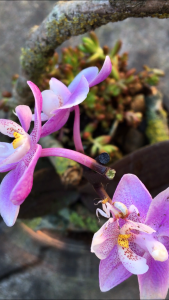
The orchid mantis, (Hymenopus coronatus) is renowned for its visual resemblance to an orchid in bloom. Its pink heart-shaped mid-and hind-legs are semi-opalescent and resemble delicate petals. Naturalists have puzzled over the orchid mantis since the early 19th century. Mr S. E, Peal of Assam (in correspondence with Dr Anderson) describes the deceptive resemblance: “I have just captured a little rose-pink Mantis that simulates a blossom beautifully”. Six months later he observed a second “beautifully white (wax-white) and larger than the previous pink one.” The travel writer James Hingston (in his 1879 account of wanderings in the Orient) also encountered the ambush predator:
Ophelia ready to ambush.
Ophelia the perfect model in her fairy dell.
I am taken by my kind host around his garden, and shown, among other things, a flower, an orchid, that catches and feeds upon live flies. It seized upon a butterfly while I was present, and enclosed it in its pretty but deadly leaves, as a spider would have enveloped it in network.
Alfred Russell Wallace first suggested that the orchid mantis’s ‘aggressive mimicry’ was a predatory strategy in 1877 when he recounted a story by British politician Sir Charles Dilk. In 1868 Dilk, while travelling through Indonesia, was shown a praying mantis that resembled a pink orchid flower. Wallace (1889) suggested that the appearance of an orchid with four petals and a broad labellum could be mimicked by the mantis’ four legs and broad abdomen, whereas the head and thorax of the mantis resembled the column of an orchid flower. In his 1889 book Darwinism Wallace describes the orchid mantis:
A beautiful drawing of this rare insect, Hymenopus bicornis (in the nymph or active pupa state), was kindly sent me by Mr. Wood-Mason, Curator of the Indian Museum at Calcutta. A species, very similar to it, inhabits Java, where it is said to resemble a pink orchid. Other Mantidae, of the genus Gongylus, have the anterior part of the thorax dilated and coloured either white, pink, or purple; and they so closely resemble flowers that, according to Mr. Wood-Mason, one of them, having a bright violet-blue prothoracic shield, was found in Pegu by a botanist, and was for a moment mistaken by him for a flower.
Alfred Russell Wallace and drawing of nymph of “Hymenopus bicornis in active pupa stage” by James Wood-Mason.
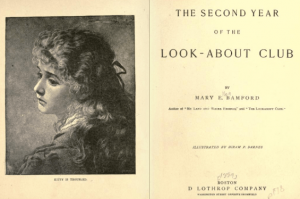
The orchid mantis was later featured in a number of books and articles on animal coloration (Wallace 1877; Wood-Mason 1878; Wallace 1889; Poulton 1890). America author Mary Ellen Bamford (1857-1946) featured the orchid mantis in the sequel to her children’s book The Look-About Club (1887.) Bamford’s series documented “the curious live things” found by a precocious group of young girls smitten with natural history.
The Look-About Club (1887.)
Papa told me some funny things about the mantis. He said that in Java there is a kind of pink mantis that, when it sits still, looks just like a pink orchid-flower. Papa said that this mantis likes to eat butterflies, and the butterflies suppose that the mantis is really a flower, and so they come near it and are caught.
According to the Papa of The Look-About Club the mantis is “of so divine a nature that to a child who asks it its way, it points it out by stretching out one of its legs, and rarely or never makes a mistake.” Chatterbox (a weekly British paper containing stories for children, published in the 19th and 20th centuries) likewise supposes in 1894 ‘that the unwary insects take the Mantis for an orchid and walk into a living grave.’
By the end of the century Wallace’s theory was taken as indisputable fact. L N Badenoch, for example, pays homage to the orchid mantis in True Tales of the Insects under the subtitle ‘alluring colouration and aggressive mimicry’ :
Colour, form, and attitude all conspire, in an inimitable manner, to produce the resemblance. Of the meaning of the resemblance there can be no doubt. Insects seem attracted to the mantis, as insects to flowers ; they settle upon it, and are instantly captured.
Alfred Russell Wallace’s initial theory has only recently (Hanlon & Rashid: 2013) been further investigated. The assumption that the orchid mantis’ morphology functions as a form of mimicry implies that the orchid mantis is cognitively misclassified as an orchid. However researchers recently concluded that the shape and color features of the orchid mantis’ body does not converge upon a specific flower. Using spectrometry to measure their overall coloration geometric morphometric techniques, researcher’s concluded that the mantis was seen by its prey as an approximation of various flowers. They have also been proven to attract more pollinators (per hour) than a number of control stimulus flowers. ( Hanlon et al: 2014) This predatory strategy ensures that the mantis does not discriminate its prey – attracting all manner of pollinators – into its waiting jaws.
Bamford, M. E., & D. Lothrop & Company. (1887). The Look-About Club, and the curious live things they found. Boston: D. Lothrop Co.
L. N. Badenoch, True Tales of the Insects, Dutton, 1899.
‘Coloration and morphology of the orchid mantis Hymenopus coronatus (Mantodea: Hymenopodidae)’, J.C. O’Hanlon, D. Li and Y. Norma-Rashid, Journal of Orthoptera Research, Vol. 22, No. 1 (2013), pp. 35-44.
J.C. O’Hanlon, G. I. Holwell, M.E. Herberstein; Predatory pollinator deception: Does the orchid mantis resemble a model species?, Current Zoology, Volume 60, Issue 1, 1 February 2014, Pages 90–103.
In the mid nineteenth-century no handbag was complete without a Schloss Bijou Almanac. Anticipating the portability of kindles and tablets, the almanac was half the size of a postage stamp. One would store their almanac alongside a miniature magnifying glass in a small silk lined case.
The little book would contain ‘many tasteful vignettes’ (characteristic of the different months) and miniature portraits. (Such as the Princess Royal of England or the infant Charles Dickens.)
The almanac was principally put together by female contributors and marketed ‘for the ladies’. But later editions proclaimed to be – ‘suitable for [both the] purse pocket-book or [the] waistcoat pocket’.
In The Entomologist’s Dream (1909) by Edmund Dulac an entomologist – in a state of near collapse – bears witness to an ominous kaleidoscope of butterflies that envelop his bedroom in a mantle of blue chaos. The insect-collector’s beloved specimens have escaped: struggling from their skewers and shattering their glass-fronted prisons. (It is left up to viewer to determine whether they seek freedom or vengeance.)
The work is an illustration for Le Papillon Rouge (the red butterfly) by Gerard d’Houville, a tragic love story published in L ‘Illustration, Numero de Noel 1909 the French news and art magazine. (In the tale an entomologist plunders his collection, in a state of moonlit delirium, incensed with his failure to capture a blood red butterfly for his lady love.)
A sense of anxiety pervades the practice of entomology – the use of chloroform, killing jars and other lethal devices leaving many naturalists with a sense of guilt.
The killing jar was an ordinary glass preserving can, with a small lump of cyanide of potassium, covered by a thin layer of plaster. An entomologist was instructed to arrange the insect, once dead, in ‘a natural position’. Killing jars habitually resulted in a slow death for the imprisoned insect – it was difficult to settle upon a formula that would result in death swiftly without damaging the insect’s fragile carcass. In the midst of searching for such a ‘sweet spot’ an entomologist was often faced with specimens that were prone to spontaneous resurrection.
Much of the literature in the late 1840s ruminated upon the question of entomological suffering. Naturalists made use of insects to contemplate hierarchies of pain: paying special attention to cases of insect decapitation. One naturalist, for example, was shocked to see that a dragonfly he had just pinned through the thorax still clutched a struggling fly in its forelegs – and proceeded to eat it.
Similarly, George Henry Lewes affirmed that ‘an insect pinned to the table will continue to eat and a headless fly or worm will writhe and twist if touched.’
Imagining the horror of a man eating under such circumstances, many entomologists of the age (gladly) concluded that an insect was not capable of experiencing emotional trauma as we do. (Though they might ‘learn’ to avoid stimulus associated with sustained tissue damage.)
If we classify pain as an emotional response (a conscious experience) -does the question of insect pain hinge upon the concept of insect emotion? How on earth could we determine if an insect’s experience is intertwined with ‘anthropomorphic’ factors like mood, personality, disposition, or motivation?
(Hit me up with any other examples you have of ‘entomological anxiety’.)
To be kept up to date on new posts from The Cabinet of Curiosity subscribe by WordPress or follow me on Twitter @rosalindmwhite.
Throughout the nineteenth-century the mania for seashells steadily swelled; they featured on Christmas cards, and adorned countless keepsakes, jewellery, and furniture. The Gradgrind nursery in Charles Dickens’ Hard Times is equipped with a “little conchological cabinet, a little metallurgical cabinet, and a little mineralogical cabinet”, whilst, inspired by works of natural history, men and women scoured the seashore for conchological specimens. Conchology, unlike other branches of natural history such as zoology or mineralogy was easily accessible to everyone, and did not require specialist equipment. It also had the added bonus of including inanimate specimens that were not subject to disease or decay.
The Conchologist / G. Spratt del. ; Printed by G. E. Madeley ; Pubd by C. Tilt, Fleet Street.
George Spratt’s composite caricature of ‘The Conchologist’ offers a personification of the craze – a woman, fashioned from shells of marine life, is depicted scanning the sea-side for her kin: her basket is filled with sprigs of seaweed and various tide pool treasures. Her rather ineffectual sun-bonnet looks to be crafted from the soft-bodied bell of a jellyfish, while a quasi-vulval cowry shell, disturbingly enlarged, makes up the lower half of her body.
The Shell Grotto in Margate, is perhaps the most impressive example of conchological worship. In 1835 an architectural love letter to the humble shell was uncovered by a man and his son attempting to dig a duck pond. The son, falling from a hole in the ground, recovered from his tumble to find a chamber ‘papered’ with an exquisite tapestry of shells. The chamber was connected to a labyrinthian passage similarly shrouded with cockles, whelks, mussels and oyster shells forming intricate mosaics. We still do not know how, or why the grotto came to be nor who is responsible for its creation.
Victorian women made use of their collection in various handicraft projects. Many put together imitation bouquets: using various miniature shells to create the desired flower.
Soon enough collectors, having exhausted the beaches of Britain, took to harvesting more impressive shells from overseas. An army of merchants, catering for the increasing demand, set up shop in London.
The name of the global oil company “Shell” is, oddly enough, a reminder of the victorian love of conchology.
In 1833 one Marcus Samuel opened such a shop selling shells, curios, and other trinkets to natural history enthusiasts. By 1851 Marcus was described in the census as a ‘shell merchant’ and was listed as proprietor of ‘The Shell Shop’ in Houndsditch. He later formed the ‘Shell Transport and Trading Company.’ In 1882 his son (Marcus Junior) while travelling in the Caspian Sea, saw a potential for exporting oil from the region. He commissioned the world’s first purpose-built oil tanker and named the tanker the Murex, Latin for a type of snail shell, as a nod to the company’s beginnings. The first logo (1901) was a mussel shell, but by 1904 it was replaced with a scallop shell.
I at least have so much to do in unravelling certain human lots, and seeing how they were woven and interwoven, that all the light I can command must be concentrated on this particular web, and not dispersed over that tempting range of relevancies called the universe. (2.15.1)
In an academic world where we are accustomed to reading multiple works in tandem, where we have to juggle disparate eras, genres, and styles, the opportunity to spend an entire week alone with a single novel is as rare as it is rewarding. This year, for the first time in 36 years, the organisers of Dickens Universe chose to illuminate a single work outside of Dickens’ oeuvre. The spotlight was torn from Charles Dickens and refocused onto his contemporary, George Eliot: zooming in on her meticulous study of provincial life, the once infamous Middlemarch. The chosen text provided us with a sample frame teeming with microscopic particulars and idiosyncratic details – revealing a work that through its focused myopia became known for its expansive influence.
The keynote papers each morning provided us with a centre of illumination with which to interpret Middlemarch: our thoughts and discussions arranging themselves, like the scratches of Eliot’s pier glass, in a series of concentric circles around each speaker’s provocative thesis. The cumulative effect of this was that each of us emerged at the conference’s close with a Venn diagram of overlapping interpretations of the novel that orbited around a constellation of different arguments.
My own thoughts centred around the concept of Middlemarch as text that, as Ruth Livesey put it, ‘flickers between particularity and universalism.’ Alongside Ruth’s talk on the middleness of Middlemarch, Summer Star’s examination of the significance of multitasking in Middlemarch as well as Helen Michie’s paper detailing the value of mid-page lexical forays helped me to foster new ways of thinking about my own work. Helen Michie’s paper, alighting on words such as ‘pilulous’ and ‘privacies,’ demonstrated how to refocus a text through the prism of a single word. – A methodology that yields surprisingly nuanced results and which, I hope, will inform my own research practice.
As Eliot Universe progressed it began to feel as though we had developed our own Middlemarch-esque microcosm, within the web-like redwood forest of Santa Cruz. As cohorts dining and dorming together we embraced a curious pseudo-provinciality. We adopted the same preoccupations: from how to pronounce various character’s names, to the oft heard question – is George Eliot funny (yes!). We shared a sense of collective disorientation, (‘are you lost too?’), and embarked on countless mutual quests (whether to find the Wi-Fi signal, bus stop, or a way to get into the cafeteria early.) Daily afternoon teas, ‘Post-Prandial Potations’, and graduate parties soon resembled Middlemarch’s whispering gallery, so a-buzz was the Eliot Universe hive-mind. Each of these informal events afforded us with the opportunity for countless fruitful discussions, as well as a healthy dose of gossip. Whilst the various workshops encouraged us to pool our collective tips, resources and teaching horror stories.
At times, Dickens Universe feels rather like an exercise in placing academia under the microscope. The occupation can be observed in all its sprawling intensity – as the week progresses, and stories of past and present ‘universes’ are shared between meals, there is a sense that any barriers between the professor and the student have been broken down. It is hard to articulate the nature with which Dickens Universe manages to dispel the hierarchal nature of academia – where other conferences have not. So, I will do as Eliot might, and provide a small anecdote, from which the whole can be expanded. – A quote from renowned Victorianist George Levine, spoken on the last day of Eliot Universe – ‘If you want to get the Ladislaw backstory straight, I recommend Schmoop.”
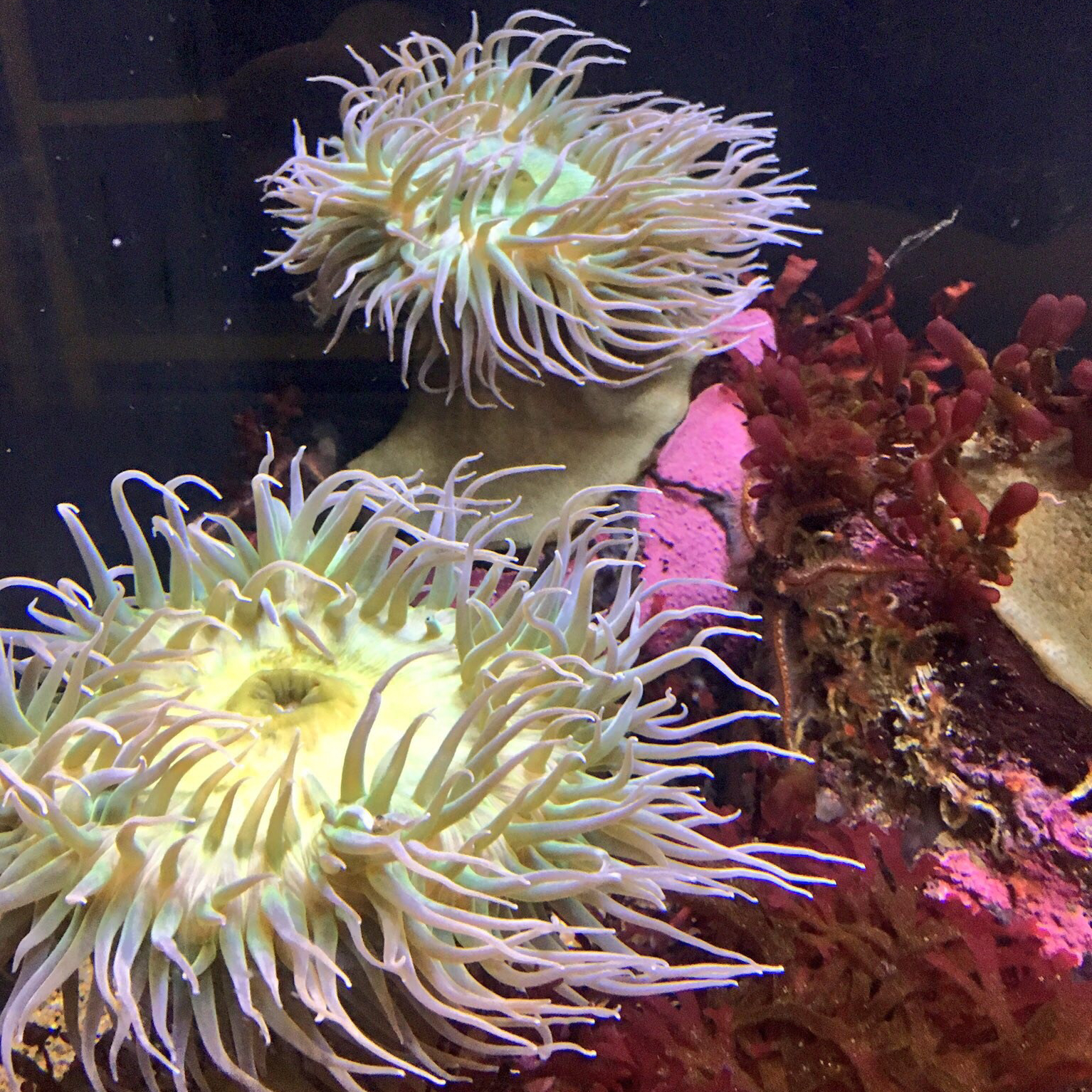
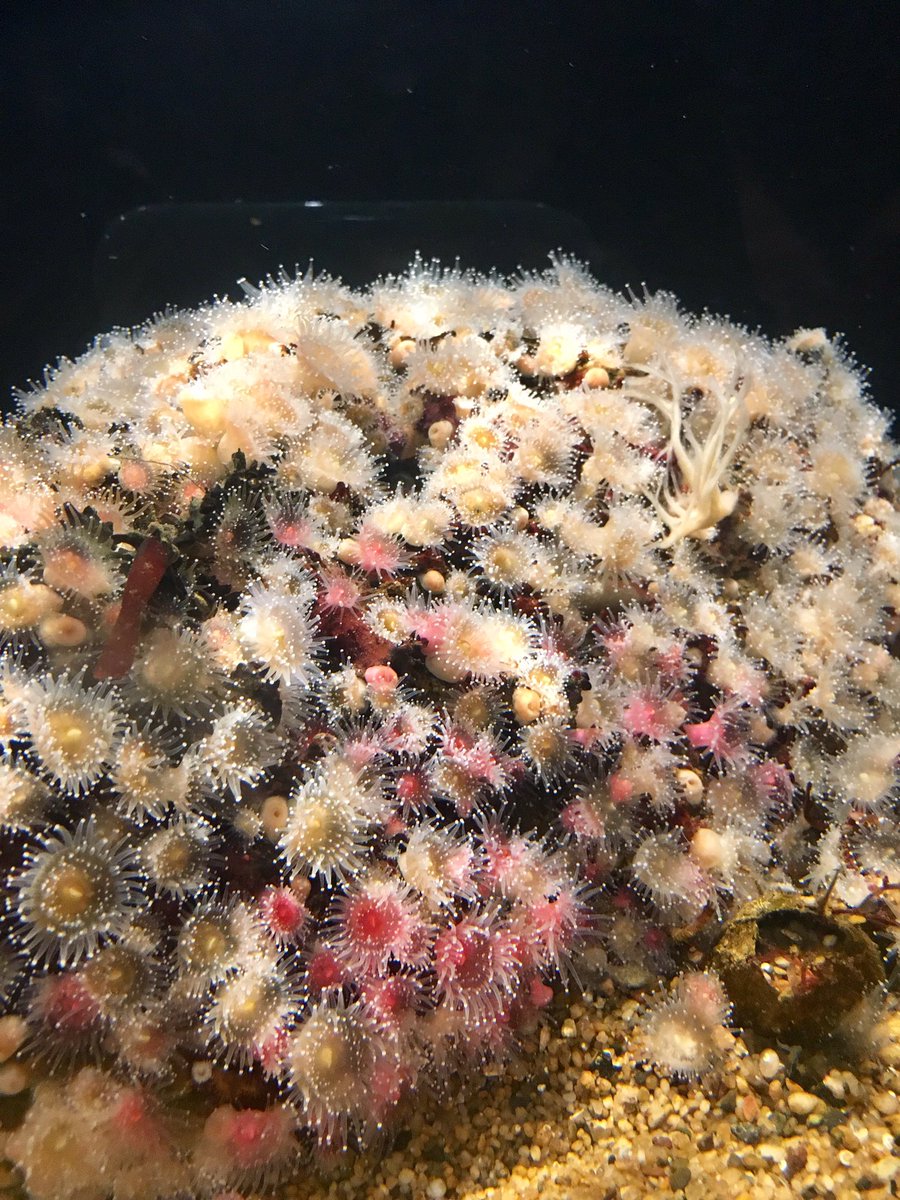
If you find yourself, much like Eliot’s Lydgate, struggling to escape the hampering threadlike pressure of small social conditions, less the Universe swallow you whole. Then it is important to remember that it is quite impossible to do everything, and take some time to yourself and enjoy Santa Cruz. I myself did as Eliot would and ran away to explore the wonders of the shore at the aquarium – enjoying the opportunity to hold a starfish, stroke a sea anemone, and let time dilate within an undulating jellyfish’s watery whirl.
Dickens Universe, at its core, encourages us to emerge from the Californian redwoods and see the world beyond our own institutions, allowing us to learn from students and staff across the globe. So that we begin to perceive the larger web of scholarship, our own place in it, and how incalculably diffusive it has the potential to be.
They say that beauty is everywhere, often hidden in plain sight.
In the case of the lost art of fore-edge painting this idea can be taken quite literally.
A fore-edge painting is a scene painstakingly rendered on the edges of a book; the pages are fanned and clamped as the artist works and then gilded with gold leaf when the book is closed. This creates a sense of ephemeral beauty: as the painting magically surfaces and then dissolves before ones eyes. The artists who crafted these priceless works of art would have been intimately involved with the specialised process of book-binding.
The university of Iowa, recently discovered secret fore-edge paintings on a selection of unassuming books on the Seasons by Robert Mudie.
Summer by Robert Mudie / Special Collections at the University of Iowa.
The text block would have to be held very tightly and it was necessary for the artist to use as dry a brush as possible – to prevent the water-colour spoiling the pages of the book. Water colour was preferred to other paints as it had the added benefit of being absorbed into book leaves without sticking the pages together, or crumbling over time.
The earliest secret fore-edge paintings were floral designs and biblical scenes. However, This popularity of this technique gained in currency in the late 18th century, in a shop owned by Edwards of Halifax.
Fore-edge painting by ‘Edwards of Halifax’ of Wilton House, ca. 1812, on one volume of a 1797 edition of Shakespeare’s plays.
However, the majority of fore-edge paintings date to the late 19th and early 20th century and have been carried out on books originally published in the early 19th century.
Some choice examples follow.
The Modern History of Hindustan, by Thomas Maurice, 1802, with a series of Hindu temples on the bank of a river and minarets of a Mohamedan mosque in the distance.
Latin and Italian poems of Milton translated into English verse, 1808 with a painting of the inn at Edmonton.
Characteristics of women, moral, political, and historical, v.2 1833, by Anna Jameson.
Lyrics of the Heart: With Other Poems, by Alaric Watts, 1851. & the Poetical Works of Robert Browning with Portraits. London: Ballantyne, Hanson & Co. 1899.
Princeton copy of an 1877 reprint of Alice in Wonderland (London: Macmillan and Co.)
For further research into the art of fore-edge painting see Jeff Weber’s Annotated Dictionary of Fore-Edge Painting Artists & Binders (Los Angeles, 2010)
Thank you for reading and please contact me if you come across any (contemporary) examples of victorian fore-edge painting using natural history books.
What is curiosity? Does it change according to the ebbs and flows of time? While today we might associate it with an involuntary odyssey down a Wikipedia rabbit-hole, in which the infinite regress of clicking just one. more. link. is all too tantalising, the Victorians were far more likely to sate their curiosity by studying a literal rabbit-hole.
However, just as our curiosity encounters a certain lack of control as we proceed to surf the web ad infinitum the Victorian’s similarly associated curiosity with disorder. The phrase ‘down the rabbit hole’ functioned both as a metaphor for an entry into the unknown, and a disorienting or mentally deranging experience. Alice transforms from an active protagonist who finds Wonderland ‘curiouser and curiouser’ into an object of curiosity herself whether as a curious flower that can move around and has ‘untidy’ petals or as giant with a neck like a ‘Serpent.’ Curiosity is both a force wrought by humans, and a supposedly inanimate object that somehow exudes curiosity.
Barbara Benedict in Curiosity: A Cultural History of Early Modern Inquiry (2002) discusses the ‘fluid exchange between agency and objectivity, curiosity and curiousness’. She sees curiosity as ‘the mark of a threatening ambition, an ambition that takes the form of a perceptible violation of species and categories: an ontological transgression that is registered empirically. To Benedict, ‘curiosity is seeing your way out of your place. It is looking beyond’.
Alice experiences exist betwixt and between these conflicting categories; she is treated alternately as one who is innocent or experienced, as miniature or gigantic, as a replica or an ‘original’ or as an subject and an object.
Curiosity is not only inseparable from visual experience, but also inextricable with the idea of transgressing binaries or crossing boundaries.
The Victorians equally loved beauty in its natural form and beauty artificially shaped by human hands; they would often sit side by side in one museum or curiosity cabinet. Cabinets of curiosity would serve scientific advancement, functioning as physical representations of knowledge, but they were also ultimately works of art.
Likewise, many collections are now effectively specimens of anthropology, that function primarily as vectors into the psyche of the past, rather than sole specimens of natural history.
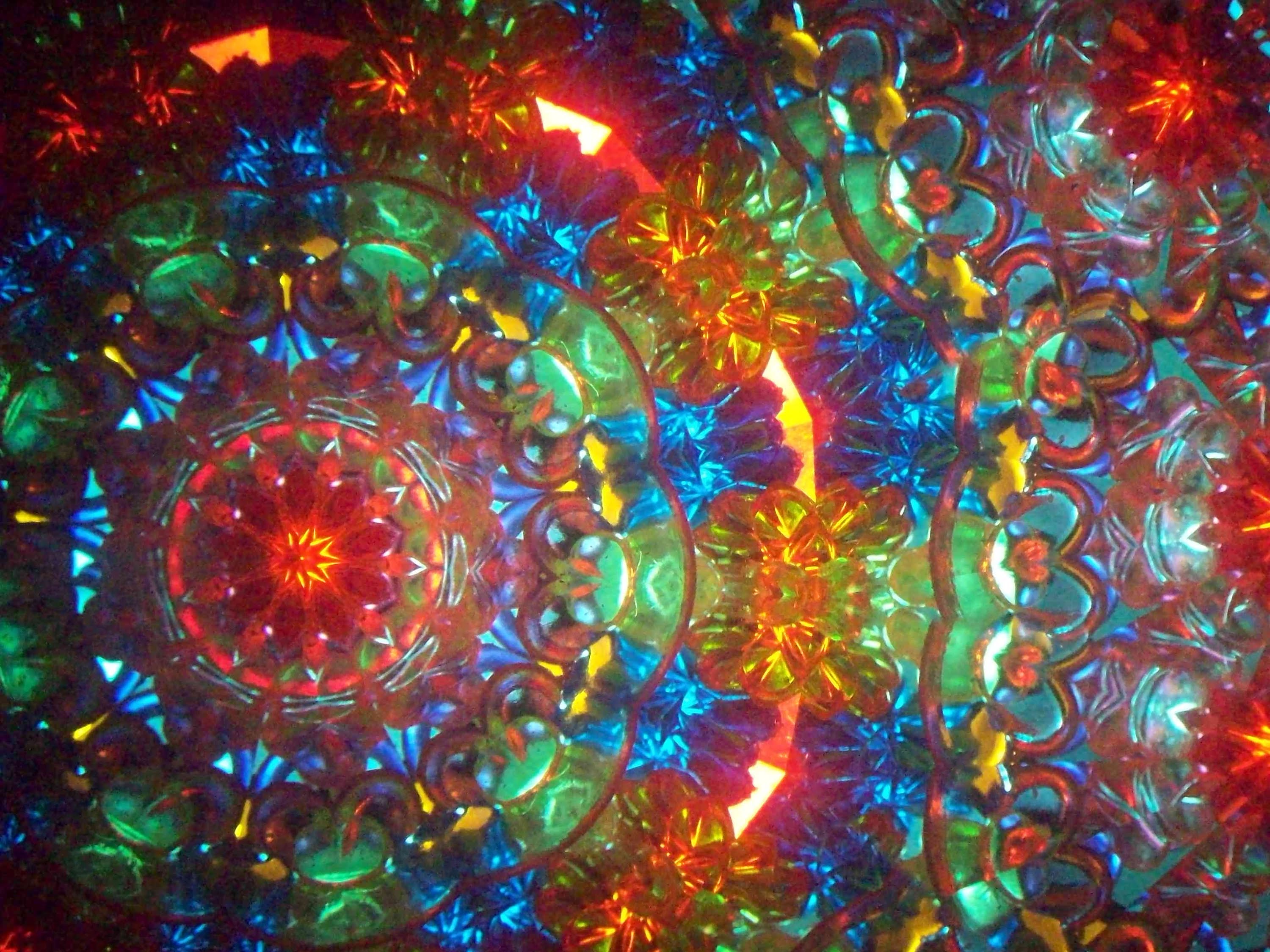
This clash of conflicting curiosity that seems to reverberate disparate and often paradoxical interests is a hallmark of the Victorian era. Isobel Armstrong in Victorian Glassworlds (2008) highlights ‘the optical shock and exhaustion of the eye [which] produced an intense disorientation that undermined ordering principles: a surreal heterogeneity juxtaposed erotic and mundane objects.’ One can imagine this was most apparent at The Great Exhibition of 1851. The building, containing nearly one million square feet of glass, and dubbed ‘The Crystal Palace’ by the editor of Punch, and a ‘magical fairyland’ by Queen Victoria. Among the many reactions to the panoply of the Exhibition were complaints about the overwhelming, and conflicting kaleidoscope of visual stimulus.
Wallpaper illustrating the Crystal Palace. About 1853-5 ( from The V&A)
The Crystal Palace reminds us of one more important aspect of curiosity, its association with glass. A curious glance in the Victorian era was almost always mediated through glass: whether via a microscope; magnifying glass; vivarium; conservatory; window; camera or picture frame. Glass, as an agent of curiosity that sharpens the eye and focuses the senses held far more metaphorical weight to the culture at large than it does today – even though we too often express or satisfy or curiosity through the glass of a computer or television screen.
The Victorians, like us, were not only storytellers of the natural environment. The cabinet of curiosity was regarded not only as a microcosm of the natural world but also as a memory theatre that captured the dreams and emotions of its collector like that of a ‘pensieve’ in Harry Potter. Equally, Victorian wonders like the diorama (a miniature or life-size scene in which figures, taxidermy, and other objects are arranged in a naturalistic setting) allowed people to experience the ecosystem of not only of another country but of another time. So extensive was the reach of Victorian curiosity that we can imagine the interplanetary dioramas the Victorian’s would have expected of the future. Let us hope we do not disappoint them.

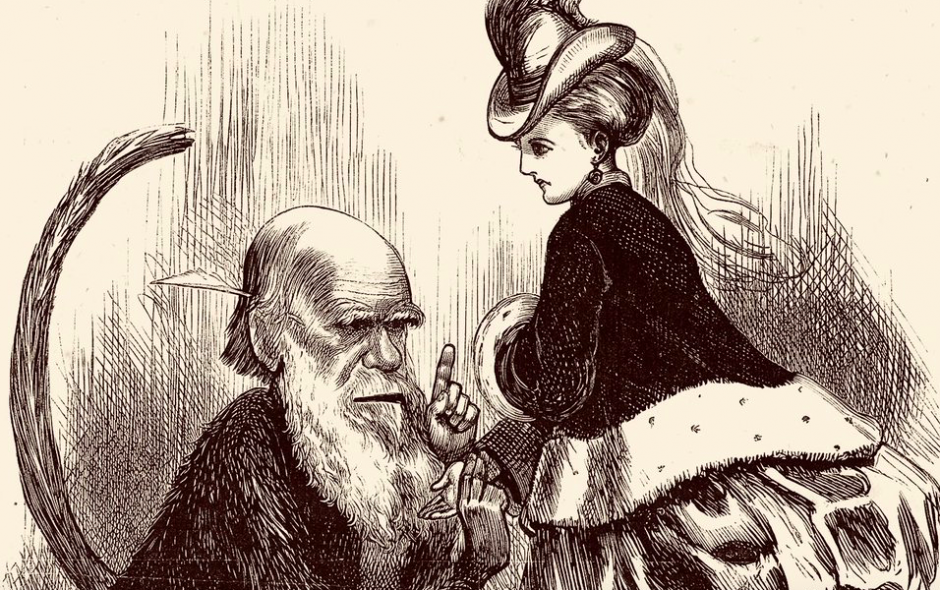
 The latest publication from the Darwin Correspondence Project, Darwin and Women, begins with its own taxonomic quandary. From the outset Samantha Evans, entrusted with the tricky task of uncovering Darwin’s intellectual interdependence with women through the fractured prism of his private correspondence, wisely chooses to forgo chronology for a thematic arrangement. This classification system, in which letters are sorted into 14 clusters, means that correspondents frequently reappear under different taxons. The book includes sections on botanical correspondence, observing humans, religion (a chapter edited by Paul White), companion animals, and a section on insects, “small, apparently insignificant creatures”, though, as Evans notes, no mention is made of outliers such as John Lubbock’s pet wasp. My favourite chapter, “Scientific wives and allies”, best illustrates the inextricable way in which the contributions of women interwove with Darwin’s vision of an entangled bank.