Categories
longer blog posts

Dietary Didacticism in Wonderland

[NB: I wrote this piece for the Journal of Victorian Culture Online for ‘Alice’ Day who have kindly agreed that I can share it here also.]

 At the turn of the century, victorian psychologist James Sully remarked that ‘the child is little more than an incarnation of appetite which knows no restraint’. (1) This conception of the child as a fiendish manifestation of gluttony haunted middle-class Victorian girlhood and had the power to bring about a culture of noxious dietary didacticism.

Lewis Carroll’s Alice books show many signs of being wrought in such a climate.

 According to Lewis Carroll’s nephew the ‘healthy appetites of his young friends filled [Carroll] with alarm’ so much so he let slip remarks like ‘please be careful, because she eats a good deal too much’. (2) Carroll even sent a small knife to a young girl as a birthday present and assured her if she used it to cut her dinner into tiny pieces she would ‘be safe from eating too much’ and could ideally ‘find that when the others have finished you have only had one mouthful’. (3)

Carroll’s fixation with feminine growth is interlaced with the progressive conception of Alice as a character. According to Carroll originally the ‘dream-Alice, in thy foster-father’s eyes’ was as ‘loving as a dog and gentle as a fawn’ so innocent ‘Sin and Sorrow are [to her] but names – empty words’. However, this winsome innocent is not the Alice we meet in Wonderland who wields her appetite to assert her dominance (‘Nurse Do let’s pretend that I’m a hungry hyena, and you’re a bone!’)

Alice_Liddell
Alice Liddel,  published as a miniature on the last page of the original Alice’s Adventures Underground (1861)

Nina Auerbach, in ‘Alice and Wonderland: A Curious Child’, discusses the physical differences between Alice Liddell, Carroll’s aforementioned ‘dream-Alice’ and Mary Baddcock, the model Carroll suggested for John Tenniel’s illustrations. Alice Liddell is ‘strikingly sensuous and otherworldly’, whilst Mary Baddcock ‘is blonde and pudgy, with squinting eyes, folded arms and an intimidating frown’. (4)

didactic3
‘Little Miss Budget’ Punch ‘Dessert, Miss? Oh dear, no! You’ll have to wait a bit yet. We’ve only just got to the second course!’

John Tenniel’s Alice, based on Mary Baddock, curiously resembles archetypes of the spoilt victorian girl. Typically conceived in publications like Punch. The above image depicts a stout young dinner-guest requesting dessert: the Butler replies ‘Oh dear, no! You’ll have to wait a bit yet. We’ve only just got to the second course!’ (5) Both Alice and ‘Miss Budget’ are characterised by eager plump appendages, frilly pinafores, stockings and polished shoes. Thus, Carroll’s shift to a blonde decidedly plump Alice – in many ways better embodies the typical middle-class girl who must be cured of her insatiable cravings. Just as the pictorial Alice resembles this indulgent archetype the textual Alice is wilfully preoccupied with dessert; she insists upon taking a slice out of the personified pudding despite having engaged him in a formal conversation and is shamed for doing so the pudding exclaiming, ‘I wonder how you’d like it, if I were to cut a slice out of YOU, you creature!’

didactic2
‘Drink Me’ by John Tenniel

Auerbach goes on to suggest Wonderland supportively houses ‘the chaos of [Alice’s] growth’ she believes as Alice ‘explodes out of Wonderland hungry and unregenerate Carroll ‘trace[s] the chaos of a little girl’s psyche’ with ‘sympathetic delicacy and precision’. (4)

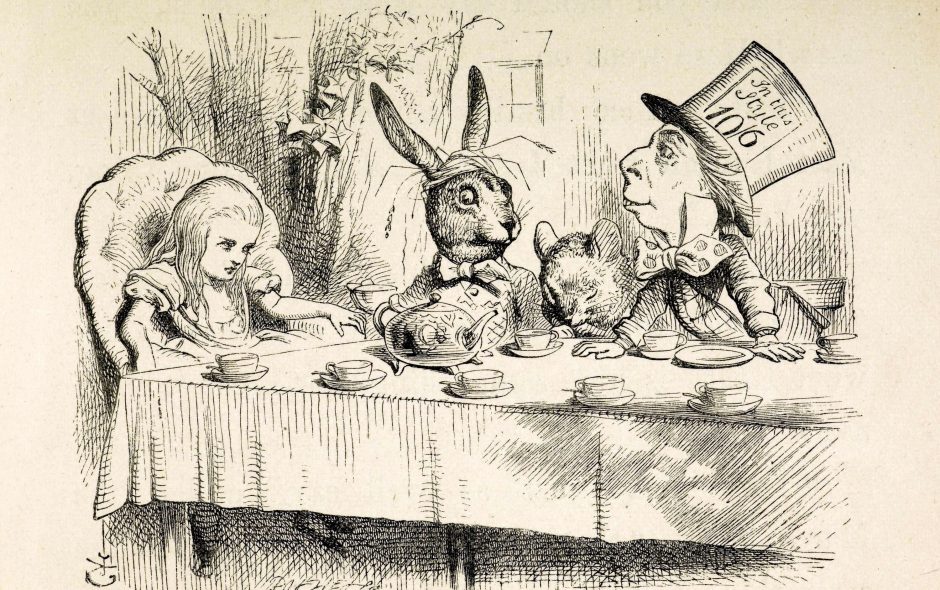
However, time and again Carroll explicitly greets Alice’s hunger and obstinacy not with sympathy but with derision and censure. When Alice hesitantly asks the Duchess ‘why does your cat grin like that?’ the Duchess responds ‘it’s a Cheshire cat and that’s why. Pig!’ (48) the author implicitly verbally assaults Alice, for whilst Alice ‘saw in another moment that it was addressed to the baby’ she jumps at the ‘sudden violence’ of ‘Pig!’ and originally assumes the word is meant for her. The narrative continues to imply Alice possesses a voracious appetite that must be cured; just as the trial scene suggests Alice’s appetite is criminally reprehensible (she mistakes the evidence ‘a large dish of tarts’ (95) for refreshments) the tea party functions as a lesson in dietary restraint. Alice in the rearmost seat is always ‘a good deal worse off than before’ (62) as every time the Hatter yells ‘change!’ she is greeted with a milk-spilled plate that has already been plundered by three other people. Furthermore, as Lisa Coar, in ‘Sugar and Spice and All Things Nice: The Victorian Woman’s All-Consuming Predicament’, notes the tea itself, uncalorific and caffeinated, is an ‘ascetic: it masks hunger, it feeds without food’. (6)

‘You look a little shy: let me introduce you to that leg of a mutton,’ said the Red Queen. ‘Alice-Mutton: Mutton-Alice.’ The leg of mutton got up in a dish and made a little bow to Alice, who looked at it rather anxiously.

Carroll’s creations are suffused with dietary anxiety. The looking-glass queens who refuse to eat what one has been formally ‘introduced to’ painstakingly (almost purposefully) present themselves to every item on the menu. Similarly, the ephemeral bread-and-butterfly lives on a fatally restrictive diet of ‘weak tea with cream in it’. This undercurrent of  foreboding even suffuses the intertextual stories of Wonderland; the sisters at the bottom of the well in the dormouse’s story grow ill from their diet of treacle, whilst the Oyster’s of The Walrus and the Carpenter” are tricked into being consumed at the promise of a ‘treat’. The act of eating is framed not as pleasurable but as a distressing, confusing, anxiety ridden affair from the cacophonous tea party where the dormouse is doused into the pot of tea, to the trial at the end of the novel that surrounds the stolen tarts. Furthermore,  Alice’s consumption of items of food throughout the novel – becomes an almost literal manifestation of body dysmorphic disorder – as her rapid fluctuations in size correlate not only with her appetite but with her emotions.


pig
Alice and the piglet

An early reviewer of Alice unconsciously traces the underlying power-play at work in the novel. At first the reviewer tries to catergorise Wonderland as a collective hive dream of ‘childish mind[s]’ a ‘charming’ ‘pleasant’ ‘happy place’. However, he struggles to reconcile how ‘disturbed’ he feels by the presence of a strange ‘cleverness’ that ‘causes us to wake from our dream.’ His discomfort at the controlling adult presence can also be detected in his hasty uneasy dismissal (‘but it is all proper enough’) of Alice’s distress at her involuntary body fluctuations. The reviewer in an attempt to neutralise the controlling authorial presence, hastily asserts that the caterpillar ‘changes too, and is probably likewise confused at his transformation’. (7)

By the time we reach Through the Looking Glass, as Lisa Coar suggests, Alice is seemingly cured of what Carroll might call her nutritional neurosis – when offered biscuits by Carroll’s Red Queen, Alice, ‘though it wasn’t at all what she wanted’, forces down one biscuit out of politeness but emphatically refuses a second helping’ . (5)

The White Queen similarly, presents Alice with a dietary dilemma. Her proclamation that ‘the rule is, jam tomorrow and jam yesterday – but never jam to-day’. (169) cloaks the promise of food in Carrollian logic that withdraws said promise and renders the White Queen’s offer void. Her rule is a pun on a mnemonic for remembering the distinction between the Latin words nunc and jam; both mean ‘now’, but nunc is only used in the present, while jam can only be used in the past and future and is therefore presently never available.

Thus, although by Carroll’s sequel Alice is seemingly cured of her ‘uncontrollable’ appetite Alice’s dietary anxiety, in a novel notably titled Through the Looking Glass remains.


References

Arthur Rackham’s illustrations of Alice (1907) are available at Project Gutenberg <http://www.gutenberg.org/files/28885/28885-h/28885-h.htm/&gt;

John Tenniel’s illustrations of Alice are have been obtained from The Victorian Web [accessed April 2016] <http://www.victorianweb.org/art/illustration/tenniel//&gt;

(1) James Sully, ‘Studies in Childhood’, Popular Science Monthly, 47:48 (1895), pp. 648-64, p. 650

(2) Collingwood, The Life and Letters of Lewis Carroll, (New York: Century, 1899), p. 134.

(3) Lewis Carroll, ‘To Kathleen Tidy, March 30th 1861’, in The Letters of Lewis Carroll, vol. 1, p. 49.

(4) Nina Auerbach, ‘Alice and Wonderland: A Curious Child’ Victorian Studies, 17, (1973): 31-47, p. 35.

(5) Lisa Coar, ‘Sugar and Spice and All Things Nice: The Victorian Woman’s All-Consuming Predicament.’, Victorian Network, 4, (2012). P. 56-57.

Categories
Uncategorized

Charles Kingsley’s The Water Babies and The Origins Debate.

the water babies

Linley Sambourne’s cartoon ‘Man is but a Worm’, appearing in Punch in 1882 in depicts the evolution of man; from worm, to ape, to an archetypal top-hatted Victorian gentleman, concluding with an image that had fast become an emblem for evolutionary theory – the bearded Darwin himself. The cartoon ridicules the idea of a relation between the two species, using grotesque caricature to depict Darwin’s theory as nothing more than comical absurdity.

543px-Man_is_But_a_Worm

Like Linley Sambourne’s cartoon, Charles Kingsley’s The Water Babies parodies much of the discourse surrounding the origins debate. However,  Kingsley does not choose to satirise the theory of natural selection itself, instead Kingsley parodies the reaction Darwin’s ideas provoked. The novel ‘argues against purely physical definitions of humanity’. [2] Kingsley takes a bone of contention in the origins debate, The Great Hippocampus Question (which debated upon the similarities between the anatomy of apes and men) and lampoons the debate as ‘the great hippopotamus debate’, using humour to emphasis the absurdity of reducing humanity to anatomy.

‘You may think that there are other more important differences between you and an ape, such as being able to speak… and knowing right from wrong and saying your prayers; but that is a child’s fancy my dear…if a hippopotamus major is ever discovered in one single ape’s brain nothing will save your great-great-great-great-great-greater-greatest-grandmother from having been an ape too.’

Rather than ridicule the idea of natural selection Kingsley takes the essence of the theory and transforms it into what he terms ‘Fairy Science’.  As Anne Chassagnol notes:

‘Darwin’s theory is quite a fairy-like concept concerning as it does metamorphosis…[and] focusing frequently upon fantastical, often miniature animals including, larvae, beetles and butterflies’.  [3]

Kingsley adopts these characteristics of science and re-imagines them as tenets of fairy-tale. Tom’s odyssey begins with his metamorphosis: like a butterfly he leaves his old husk behind and devolves into an eft in preparation for his moral evolution.

In On the Origin of Species (1859) Darwin emphasises that the natural world is characterised by a struggle for survival. He urges us to remember that ‘birds which are idly singing around us mostly live on insects and are thus constantly destroying life’ . [4] This struggle for survival is depicted in The Water Babies. The trout ‘gobble the beetles and leeches… [and swim] about with great worms hanging out of their mouths, tugging and kicking to get away’ . The otter despairs how men speared her ‘poor dead husband’ . Even Tom is described as being at the bottom of the food chain; the otter first decreeing that Tom ‘is not worth eating after all’ and then threatening that the salmon will eat him and then they will eat the salmon. This struggle is imperative to Tom’s passage into adulthood. Gradually he moves up the evolutionary ladder no longer fraternising with the gnats, the dragonflies and the sea snails, and instead talking to Ellie and other water babies.

The logical inversion of Darwin’s theory, devolution, is made a concrete possibility in The Water Babies. As Mrs Bedonebyasyoudid asserts ‘if I can turn beasts into men, I can by the same law of circumstance and selection and competition, turn men into beasts’. Tom observes many examples of this throughout his journey: some of the salmon become ill adapted through their atrophy and as a result ‘grow ugly and brown and spotted;’ the Tomtoddies turn into radishes, as their brains are so filled with water due to their preoccupation with ‘The Examiner;’ the Doasyoulikes, a race of idle humans, ‘grow so stupid … [that] they have almost forgotten how to talk… [and] will all be apes very soon’.

Tom himself is described at the beginning of the tale as a ‘little black ape’ , which immediately emphasises his risk of degeneracy. Furthermore, he is described to be quite at home in a chimney; ‘a mole underground’ he is adapting to his uncivilized surroundings, and therefore is presented as being on the wrong evolutionary tract. Kingsley uses Tom as a symbol for Victorian anxieties about the degeneration of the poor, who: unclean; uneducated and faithless seemed symptomatic of social degeneration on a national level. This connection between moral decay and evolutionary decline was unequivocally assumed, as although by the 1830s the term ‘evolution’ was used in its modern sense, prior to this it was ‘a term for individual growth’, which ‘only further helped to forge and explicit connection between the two processes’. [2]

Kingsley responds to the anxiety of degeneration with the concept of recapitulation, an idea which suggested that ‘the development of the individual repeats the development of the human race’. Just as ‘the human foetus passes in the womb through the evolutionary stages of life on earth … the growing child passes through physical and psychological stages of savagery and barbarism’. [5]

In The Water Babies the fairies spirit Tom away from London, where he is at risk of evolving into a double of Mr Grimes; he imagines that when he himself is a master ‘he would bully [his apprentices] and knock them about, just as his master did to him’ . They reduce him to an embryonic size and submerge him in a womb-like water-world, where Tom must ‘re-inhabit nature to achieve his own humanity, [in order to] transcend his origins.’ [2] Mrs Bedonebyasyoudid embodies nature’s absolute justice; she ‘cannot help punishing people when they do wrong … [she] work[s] by machinery … wound up carefully [so that she] cannot help keep going’. She does not interfere, allowing the water babies to learn from their mistakes, and adapt accordingly.

However, her code of conduct does differ from Darwinian selection. The natural education Tom is subject to is not reliant on qualities that nurture survival, but on qualities that nurture Christian virtue. It is not survival of the fittest but survival of the moral. For example, Tom grows prickles not because he has done something contrary to his survival but because he has done something contrary to Christian morality; ‘when his soul grew all prickly with naughty tempers, his body could not help growing prickly too’. The use of the word ‘punish’ throughout the novel (the tommodites are ‘punished’ for worshipping the ‘idol’ examination, the salmon ‘properly punished’ for their slothful nature) magnifies the sense that God uses the seemingly autonomous model of natural selection to enact divine punishment. Kingsley only reconciles religion with science, by making the two entities one and the same; faith in the universal laws of science becomes synonymous with faith in divine presence.

This is made irrefutably clear at the end of the novel when Tom and Ellie learn that all the fairies who have throughout Tom’s journey governed nature’s law are one and the same. This epiphany is met with ‘a clear, white, blazing light’ emblematic of divine presence. To Kingsley ‘evolution must have meaning and purpose, two attributes that Darwin had tried to eliminate from his own theory’. [6] Kingsley separates the evolution of man from the evolution of all other organisms, upholding modern man as a superior being because of his moral choices. The notion of Mrs Bedonebyasyoudid’s ‘downhill as well as uphill road’ is made clear; Tom learns Christian principles, and therefore is no longer at risk of remaining a degenerate ‘little black ape,’ nor a ‘poor little heathen’, instead he journeys upon the ‘uphill road’ becoming a ‘great man of science’.

The Water Babies functions simultaneously as a tale of evolutionary recapitulation and as a religious pilgrimage. Tom’s return to a pre-human morphology allows him to spiritually as well as physically adapt to achieve a redemptive end. Parallel to this, physical evolution and moral evolution are inextricably intertwined, as Kingsley hypothesises ‘your soul makes your body just as a snail makes his shell.’ Kingsley takes the idea of evolution as a grotesque struggle and moralises it, likening each transitional stage of physical advancement with moral improvement, and moral decline with physical deterioration. Faith in the indefinite, a tenet of religious belief becomes a prerequisite for scientific practice –

‘You must not say that this cannot be, or that is contrary to nature. You do not know what nature is or what she can do’.

Overall, the Darwinian subtext present in The Water Babies is paramount to the novel’s moral sentiment, that although ‘some people say that [bad behaviour] … is nature, and only proof that we are all originally descended from beasts of prey’, ‘little boys can help it and must help it’ otherwise ‘by doing only what they liked’ they are at risk of degeneracy and ‘will all be apes very soon’.


References

[1] Kingsley, Charles, The Water Babies, (Oxford: Oxford University Press, 1995).

[2] Straley, Jessica, Of Beasts and Boys: Kingsley, Spencer and the Theory of Recapitulation’, Victorian Studies, Vol. 49, No. 4, (2007) pp. 587-609.

[3] Anne Chassangnol, ‘Darwin in Wonderland: Evolution, Involution and Natural Selection in The Water Babies’, University of Toulouse, France, (2010) p. 1.

[4] Charles Darwin, On the Origin of Species, (Oxford University, 1859) p. 62.

[5] Moore, K.L. and Persaud, T.V.N., The Developing Human; Clinically Oriented Embryology, Fifth Edition, (Philadelphia: 1993), p. 608.

[6]  Joseph Green, ‘“THE GREAT FAIRY SCIENCE”: THE MARRIAGE OF NATURAL HISTORY AND FANTASY IN VICTORIAN CHILDREN’S LITERATURE’, (University of Missouri-Columbia, 2009) p. 161.


Categories
Uncategorized

The Strange Story of Anna Kingsford

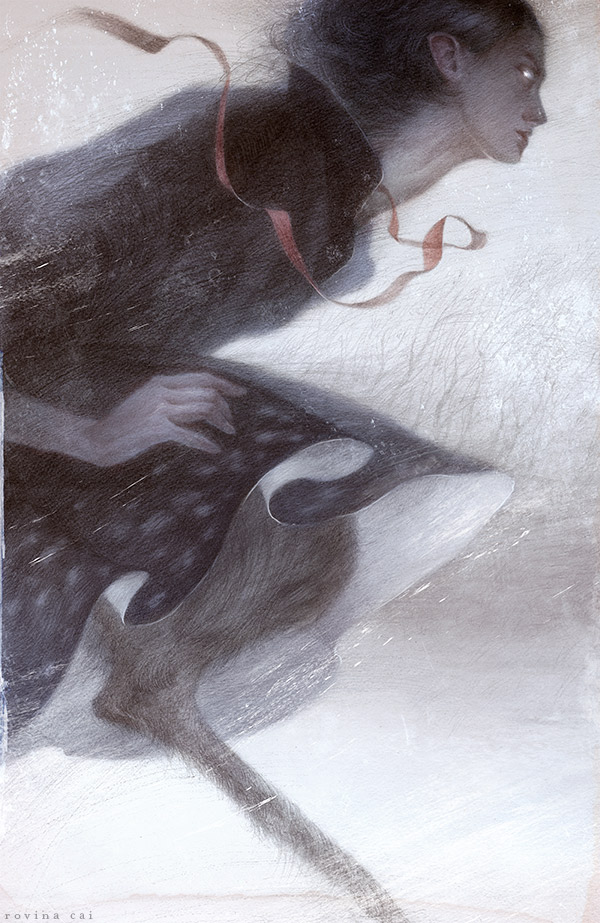
 [ illustrations ‘Cold Wind’ & ‘Fake it till you make it’  by Rovina Cai]

As the only Victorian medical student at the time to graduate without having experimented on a single animal, a theosophist, who believed in knowledge of God through spiritual ecstasy, a spiritualist who communed with Anne Boleyn, (her supposed ancestor), and a proponent of animal and women’s rights who fiercely denounced vivisection – Anna Kingsford, traversed all manner of Victorian debates. She is, however, surprisingly absent from academic scholarship.

As a child Anna spent her time in her father’s library, alternately conversing with flowers or with fairies; she was a ‘born seer…seeing apparitions and divining the characters and fortunes of people.’ Her psychic abilities became linked from a young age to her kinship with animals. Deborah Rudacille notes that as a child, Kingsford enjoyed foxhunting, until one day she had a vision of herself as the fox.

IMG_3504
Anna Kingsford 16 September 1846 – 22 February 1888

In order to escape unwanted suitors, when she was twenty-one she married her cousin, an Anglican clergyman named Algernon Kingsford, on the condition that she would continue to lead a fully autonomous life. Rereading their early courtship letters later in life she bemusedly notes ‘they are full of declarations that my chief reason for marrying was to be independent and free!’ Shortly after her marriage, after dreaming of a visit from Mary Magdalene, Kingsford converted to Catholicism. Her husband respected her independence and supported her in her choices, as well as in her later conversion to theosophy – on the grounds that it promoted gender equality.

In these years of spiritual conversion, Kingsford became a feminist and vegetarian; in 1872 she bought The Lady’s Own Paper, and took up work as its editor, becoming acquainted with the famous writer, feminist, and anti-vivisectionist Frances Power Cobbe.

In 1873 Anna enrolled for medical study in Paris in order to acquire the scientific knowledge to argue against vivisection and advocate a vegetarian diet. Her final thesis, L’Alimentation Végétale de l’Homme, was on the benefits of vegetarianism, published in English as The Perfect Way in Diet (1881).

punch
‘Grand Show of Prize Vegetarians’ by John Leech Punch (1852)


Kingsford wrote to her husband in 1874:

Things are not going well for me. My chef at the Charité strongly disapproves of women students and took this means of showing it. About a hundred men (no women except myself) went round the wards today, and when we were all assembled before him to have our names written down, he called and named all the students except me, and then closed the book. I stood forward upon this, and said quietly, “Et moi aussi, monsieur.” [And me, Sir.] He turned on me sharply, and cried, “Vous, vous n’êtes ni homme ni femme; je ne veux pas inscrire vôtre nom.” [You, you are neither man nor woman; I don’t want to write your name.] I stood silent in the midst of a dead silence.

In 1877, After listening to one of her instructors, Dr. Claude Bernard, exhorting slowly baking live animals to death in order to study body heat, Anna, flew from her seat, labeled her teacher ‘Murderer!’ and refused to return to the classroom. Sickened by Parisian animal experimentation, (she wrote of ‘trying vainly to shut out the piteous shrieks and cries which floated incessantly towards [her] up the staircase’ at night) Anna arranged for private tuition and refused to dissect a single animal. In an effort to ‘root this curse of torture’, she habitually volunteered herself for dissection so that the doctors would leave the animals alone.

Soon after her exchange with Dr. Claude Bernard, Anna records feeling as though she became ‘a spiritual thunderbolt’ who, with all her might, willed the doctor dead. Soon after this episode, and after fainting from the extent of her fury, Kingsford wrote to Maitland (her confidante and later biographer) of the doctor’s sudden death:

‘Woe be to the torturers! I will make it dangerous, nay, deadly, to be a vivisector. It is the only argument that will affect them. Meanwhile, thank God the head of the gang is dead!’

Spellbound by her extrasensory powers, Kingsford set her sights on Dr. Paul Bert, ‘the most notorious of the vivisecting fraternity’, a doctor known for keeping all who slept by his laboratory awake with the cries of semi-dissected animals. After Dr. Bert died in November 1886 Kingsford wrote again of her triumph:

I have killed Paul Bert, as I killed Claude Bernard; as I will kill Louis Pasteur, and after him the whole tribe of vivisectors – it is a magnificent power to have, and one that transcends all vulgar methods of dealing out justice to tyrants.

Fortunately for Louis Pasteur, Kingsford’s psychic homicide ‘took from [her] nervous force’; after being caught in rainstorm (whilst investigating Pasteur’s laboratory) Kingsford developed pneumonia, and later tuberculosis. She died on February 22, 1888 spending her final days, according to her friend Sir Richard Burton, ‘suffering in mind and soul’ ‘at the sights and sounds connected with Parisian vivisection.’


Maitland, Edward, Anna Kingsford: Her Life, Letters, Diary and Work, 2 Vols. (Whitefish: Kessinger Publishing, 2003)

To be kept up to date on new posts from The Cabinet of Curiosity subscribe by WordPress or follow me on Twitter @rosalindmwhite.

Categories
Lewis Carroll's Alice

Alice Through the Magnifying Glass, Visual and Verbal Interplay in Wonderland

 What is the use of a book,’ thought Alice, ‘without pictures or conversation?’

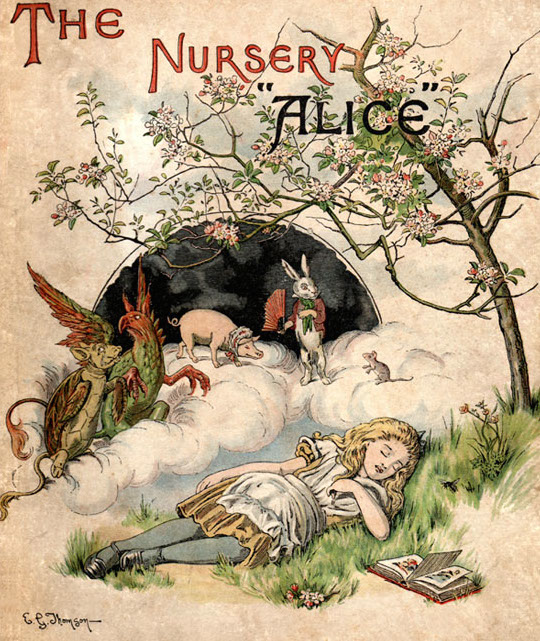
nurseryaliceimg

At the start of Alice’s Adventures in Wonderland Alice’s very first thought – ‘What is the use of a book, without pictures or conversation?’ places the visual and verbal interplay at work in Carroll’s books under the magnifying glass.

It is as though this declarative desire for pictures spirits Alice away to Wonderland. Her imaginative dreaming creates the phantasmagorical images her sister’s book lacks.

As Helen Groth notes, the visual mediation of John Tenniel’s illustrations create ‘a more porous surface between Alice and her readers; ‘an intimate synchronous connection’ [2] that dynamically urges the reader forward. Tenniel’s illustrations are to be found at the metaphorical and literal centre of Carroll’s text. The narrator continually points readers towards them (‘if you don’t know what a Gryphon is, look at the picture’ (138).)  He even ensures that Alice’s imagined ‘tale’ of the mouse’s ‘tail’ is structured so that the ‘tail rhyme’ of the poem resembles a long tail.

FullSizeRender
The Nursery Alice, [3] published for children aged ‘nought to five’ at the zenith of Alice’s popularity,  takes this visual focus further. The book houses enlarged coloured pictures that dwarf the text and allow Carroll to create tangential stories retrospectively inspired by Tenniel’s illustrations. Tenniel’s drawing of a foxglove, for example, inspires a quasi-etymological tale in which Carroll informs us Foxgloves are the gloves of Fairy Folk.

Furthermore, the narrator continually urges the reader to manipulate the illustrations so as to better understand the story. He encourages them to ‘shake the book and you’ll see [the rabbit] tremble’ and ‘turn up the corner of this leaf, [and] you’ll have Alice looking at the Grin: and she doesn’t look a bit more frightened than when she was looking at the Cat, does she?’. Carroll similarly urges the buyers of his postage stamp cases to ‘take the Case … you see Alice nursing the Duchess’s Baby? Pull it out – the Baby has turned into a Pig!’

stamp case

[The Wonderland Postage-Stamp Case – Designed by Lewis Carroll.]

These transformative uses of Tenniel’s illustrations celebrate visual-verbal interplay and suggest that pictures can aid a child’s inchoate understanding of the verbal text.

In ‘Wonderland’ the visual often threatens to dwarf the textual. Just as with one bite of the mushroom Alice oscillates from microscopic to gigantic, with one turn of the page the reader may find the text dwarfed by Tenniel’s rapidly ‘mushrooming’ illustrations. Thus, though the term ‘illustrate’ originally meant to ‘illuminate the mind’ the felicitous placement of illustrations in the first edition of Alice suggests that the drawings are not merely secondary elucidations, instead, they exist inextricably with the text itself. Carroll’s words are often not only referential towards the illustrations they are reliant upon them.

FullSizeRender[1]

For example, the courtroom scene on page 186 is curiously missing the Queen in order to fit in Carroll’s text. This enables an episode of  visual-verbal wordplay in which the pun ‘then the words don’t fit you’ (187) refers to the Queen’s pictorial lacuna and seems to be spoken by the pictorial rather than the textual King. It is for this reason that the ‘textual’ court greet his pun with ‘dead silence’ (187) as they cannot understand a joke that relies on the consciousness of their pictorial counterparts.

FullSizeRender[2]
Throughout the novel, the symbiotic relationship between visual and verbal continues to rely on the novel’s composition. When Alice’s body elongates the body of text mirrors her elongation. As 
Alice feels she is ‘opening out like the largest telescope that ever was!’ (15) her neck resembles the cylinder of a telescope extended from her compact body. The psychosomatic dissonance Alice experiences (she worries her feet won’t obey her unless she sends them new boots for Christmas) is reflected in the illustration. Tenniel details her wide eyes, open mouth and fanned out hair (which suggests a sudden altitude change), and her arms splayed out like one might do to slow their body whilst falling.

Later in the novel, Alice looks titanic in relation to the Rabbit, the hallway, and the page itself. Tenniel uses foreshortening – converging ceiling panels and highlighting Alice in the foreground whilst darkening the receding hallway. This creates a linear perspective that gives the illusion of depth and produces a rabbit-hole for the startled rabbit to retreat into. Tenniel’s imposing illustration creates a paradoxical disparity between text and image. After scolding herself for crying (‘you ought to be ashamed of yourself… a great girl like you!’) Alice tentatively addresses the rabbit ‘in a low, timid voice’ that quite belies her gargantuan size. Her hesitant posture suggests an answering recoil when the rabbit greets her not as a little girl but as a predator: scurrying away ‘into the darkness as hard as he could go.’ (18)

Lewis Carroll appears decidedly satisfied with Tenniel’s rendering of scale; according to a subsequent illustrator ‘Carroll would take a square inch of the drawing, count the lines … and compare their number with those on a square inch of illustration made for “Alice” by Tenniel! And in due course [he] would receive a long essay on the subject from Dodgson the mathematician’. [4] This emphasis on dimension and mathematical topography suggests that Carroll informed Tenniel in detail of the importance of depicting Alice’s oscillating growth.

Carroll himself used space and dimension to its full semantic capacity. In his illustration of the same scene,  Alice’s overgrown form is wrapped in a protective foetal position. But she is confined not by the Rabbit’s house but by the confines of her frame – functioning as an amateur ‘Trompe-l’oeil’, Carroll’s illusion of protuberance possesses a distinctly claustrophobic quality.

Contrastingly, Tenniel offers a near three-dimensional imprisonment: Alice’s elbow is painfully positioned in the corner of the room; her head bowed, and her arm forced through the window. The intense use of chiaroscuro combined with Alice’s reproachful expression presents an image reminiscent of a caged animal. This pictorial suggestion ties in with Alice’s anxiety regarding her fluctuating size, which is viscerally linked with conceptions of predation: ‘It was much pleasanter at home when one wasn’t always growing larger and smaller, and being ordered about by mice and rabbits. I almost wish I hadn’t gone down that rabbit-hole’ (46). In this context ‘the rabbit-hole’ becomes an evolutionary abyss in which Alice can both recapitulate into a creature of embryonic size and metamorphose into a being at the top of the food chain.

Tenniel and Carroll inextricably link Alice’s relative size with her survival. Tenniel’s illustration for page twenty-six depicts Alice nonchalantly swimming alongside a mouse. This evidently takes place after she fears he is a ‘walrus’ or ‘hippopotamus’ and instead remembers her own size and haughtily deduces it is ‘only a mouse’. Alice goes on to sadistically regales the mouse with tales of her cat. Even after she answers his cry ‘would you like cats if you were me?’ with the reluctant avowal ‘perhaps not’ she insensitively urges him not to ‘be angry about it’ and boasts that Dinah is ‘a capital one for catching mice’. (26) Tenniel’s drawing (bisecting Alice’s lyrical waxing) focuses on the divergent paths of the two figures: Alice regards the mouse with a vague sort of interest, her relaxed legs below the water propel her lazily in one direction, whilst the mouse’s taut legs frenetically drive his anxious straining form in the decidedly opposite direction. The illustrations and text work in tandem to imply what might happen if a mouse-sized Alice were to meet Dinah.

In ‘Alice in Wonderland: The Child as Swain’ Empson argues that ‘the pool of tears represents both the primeval sea from which life arose and amniotic fluid; the caucus-race which follows refers to the theory of natural selection; [and] the ape which appears in the illustrations is man’s simian ancestor.’ [5] This reading is supported by Tenniel’s illustration, which portrays Alice as an irrevocable member of the homogenous ‘queer-looking party’: her hair heavy with water is akin to the sodden feathers and fur of the other animals. The animals themselves are drawn with scientific accuracy and have been likened to contemporary taxonomy drawings.

Similarly, in her discussion on Darwinian narrative Gillian Beer asserts that ‘because of its preoccupation with time and with change, evolutionary theory has inherent affinities with the problems and processes of narrative’. [6] –  Alice in Wonderland is a novel that both textually and pictorially manifests these evolutionary fluctuations. Carroll’s disordered narrative, condemned by a contemporary review as all ‘loops, ties, and loose threads, entanglements, and inconsistencies’ [7] and Tenniel’s taxonomic, dimensionally inversive illustrations combine to produce a united text that, in carnivalesque protest, ousts Alice from her evolutionary position.


 A new edition of Alice illustrated by Arthur Rackham [8] is prefaced by the verse:

Enchanting Alice! Black-and-white

Has made your deeds perennial;

And naught save “Chaos and old Night”

Can part you now from Tenniel

Although this verse seems to suggest that Alice is immortalised in Tenniel’s drawings a later verse:

But still you are a Type, and based

In Truth, like Lear and Hamlet;

And Types may be re-draped to taste

In cloth-of-gold or camlet.

suggests that Alice can, like a new actress in a play, be ‘re-draped’ to new taste. However, I would argue that ‘afresh Costumier’ cannot imbibe his drawings with the same hermeneutic potential as Tenniel. Not only do the illustrations contain infamous details to the story that are not born from the text (the March-Hare’s hat of straw or the Hatter’s 10/6 price tag, for example) they are also visually synchronised with the narrative. Therefore, Tenniel’s work does not simply mirror Carroll’s narrative; instead it provides a kaleidoscopic reflection that like Carroll’s own looking-glass curiously transmutes its origins.


References

[1] Lewis Carroll, Alice’s Adventures in Wonderland (BookVirtual,2000) <https://www.adobe.com/be_en/active-use/pdf/Alice_in_Wonderland.pdf />

[2] Helen Groth, ‘Projections of Alice: anachronistic reading and the temporality of mediation.’ Textual Practice 26.4 (2012): 667-686.

[3] Lewis Carroll, The Nursery Alice, (London, Macmillan, 2010)

[4] Furniss, Some Victorian Men (London: John Lane, 1924)

[5] Empson, ‘Alice in Wonderland: The Child as Swain’, Some Versions of Pastoral (London: Chatto and Windus, 1935), 255.

[6] Gillian Beer, Darwin’s Plots (Cambridge University Press, 2000), p. 5.

[7] ‘Alice’s Adventures in Wonderland’, Athenaeum, (1865), p. 844.

[8] Alice’s Adventures in Wonderland with a poem by Austin Dobson (London: Doubleday, 1905)


This article has been cross-posted at The Victorian Web.

To be kept up to date on new posts from The Cabinet of Curiosity subscribe by WordPress or follow me on Twitter @rosalindmwhite.


← Back

Thank you for your response. ✨

Categories
Uncategorized

Georgiana Houghton, the Victorian Artist who Channeled the Spirits of the Dead


Image
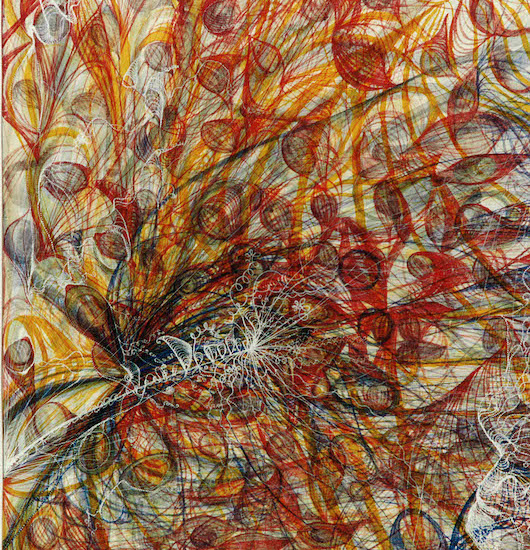
Georgiana Houghton, The Eye of the Lord (detail), 1861-1869. Courtesy of The Victorian Spiritualist Union, Melbourne.

Georgiana Houghton was a spiritualist medium who was trained in classical art but gave up painting after the death of her younger sister in 1851. A decade later, after she had become aquatinted with spiritualism she began once more to put coloured pencils and watercolours to paper. However, this time she said it was spirits of the dead who were guiding her hand. Through her mediumship she was acquainted with several Renaissance artists, as well as higher angelic beings. Houghton became the vessel through which they could exorcise their otherworldly aesthetic desires.

georgianahoughton
Georgiana Houghton, selections from the Invisible Beings series, 1872-76.

The nineteenth century with its ghosts and clairvoyants was the golden age of communion with the spirit world. The afterlife was figured not just as a sacred waiting-room but a place in which spirits continued to ‘live out’ their afterlife – evolving and communicating as they did when they were living. There was a seance in nearly every drawing room, including at Buckingham Palace. The spirits were believed to possess knowledge about moral and ethical issues that transcended our own. – This belief is almost palpable from the mesmeric, twisting force behind Houghton’s brush – her visual language is one of prepossessing immediacy.  

In 1871 Houghton rented a gallery in Bond Street and presented 155 of these works to a bewildered London audience. Houghton funded the project with her own money and for two months met visitors in the gallery to speak with them about her work. However, only one painting sold and now only 50 or so remain in known existence.

The critic from The Era newspaper pronounced it to be ‘the most astonishing exhibition in London at the present moment.’ The Daily News likened the works to ‘tangled threads of colored wool’ and concluded that ‘they deserve to be seen as the most extraordinary and instructive example of artistic aberration.’

John Ptak acquired one Houghton’s gallery catalogues from an 1871 art show in London. In her annotations, Houghton explains her unconventional aesthetic process –

In the execution of the Drawings my hand has been entirely guided by Spirits, no idea being formed in my own mind as to what was going to be produced.

Houghton set out to ‘obtain mediumship’ by holding hands with her mother at a small table for some months on end waiting for contact— Sundays, she believed, worked best, ‘as we should then be less disturbed by evil influences’.


spirit1

Georgiana Houghton, The Portrait of the Lord Jesus Christ, (detail), 1862, courtesy of The Victorian Spiritualist’ Union Melbourne, Australia.

Half a century before non-figurative art was popularised, Houghton’s drawings, in their psychedelic colours and passionate fluidity, in many ways,  anticipate the abstraction of early twentieth century art.
As Marco Pasi puts it:

Houghton transferred authorship and agency to the spirits. In doing so she could radicalise her artwork and make alien objects that could not be placed at the time in which they were made.

This summer, the Courtauld Gallery at Somerset House will mount an exhibition of Georgiana Houghton’s work. The exhibition will be opened from the 16th June to the 11th September 2016 and will be open daily from 10am-6pm.

Image
Georgiana Houghton, The Sheltering Wing of the Most High, c. 1861-61, courtesy of The Victorian Spiritualist Union, Melbourne.

References

Ptak, John F, ‘Spirit-Generated Art, 1871: Far-Outside Outsider Art’ (JF Ptak Science Books // Blog Bookstore, 1933)

Larsen, Pasi and Grant, Georgiana Houghton: Spirit Drawings (Paul Holberton Publishing, 2016)


To be kept up to date on new posts from The Cabinet of Curiosity subscribe by WordPress or follow me on Twitter @rosalindmwhite.

Categories
Uncategorized

Mesmerism, Madness and Witchcraft in Jane Eyre

FullSizeRender (1)
Jane Eyre as portrayed by Mia Wasikowska in the 2011 adaptation.

After first meeting Jane, Rochester furthers their relationship by masquerading as a gypsy to discover her true impressions of him.  His voice ‘wraps’ her in ‘a kind of dream’, ‘a web of mystification’, until she instinctually believes an ‘unseen spirit had been sitting for weeks by [her] heart watching its workings and taking record of every pulse’. (175) In a similar vein, Jane’s cousin, St. John, acquires ‘a certain influence’ over her that ‘took away [her] liberty of mind’ (352) until she ‘fell under a freezing spell’ (357) his ‘influence in [her] marrow – his hold on [her] limbs’. (359)

In both these moments, Bronte portrays her male characters as having a mesmeric power over her female protagonist.

Mesmerism, (originally animal magnetism)  was a therapeutic doctrine coined by Franz Mesmer in the eighteenth-century, but popularised by practitioners in the nineteenth. Mesmerists were thought to possess the power to place their subjects in a hypnotic state through the imposition of their own will on that of the subject. Mesmerism was often the practice of physicians, or gynaecologists, and was often used to ‘treat’ hysteria. 

In this context, mesmerism becomes a potent but volatile force when combined with romance.

Later in Jane Eyre, St. John’s ‘despotic’ effect on Jane is broken by Rochester’s magnetic disembodied voice, which sets her spirit ‘trembling’ in ‘exaltation’ (373) and calls her to Thornfield.  

However, unlike St. John, who wishes for perfect submission from Jane, Rochester’s language suggests that the power in their relationship mirrors a kind of erotic countertransference.

Rochester notes that Jane only ‘seems to submit’; for whilst he is compelled by ‘the sense of pliancy [she] impart[s]’ he is ‘conquered’ by her ‘influence’ that ‘has a witchery beyond any triumph [he] can win’. He figures Jane as a deceptively ‘soft, silken skein’ that he can manipulate ‘around [his] finger’ but ‘send[s] a thrill up [his] arm to [his] heart’. (229)

Sigmund Freud in 1910 and Carl Jung in 1909, both of whom specialised in cases of female hysteria,  warned against a patient’s influence on the physician’s unconscious feelings. They cite ‘cases of counter-transference when the analyst could not let go of the patient [and] both fall into the same dark hole of unconsciousness’. [2]

This psychic void mirrors Jane’s mounting fear, throughout the novel, of such a self-effacing abyss. It is this spiritual assimilation that Jane rallies against ‘it is my spirit that addresses your spirit; as if both had passed through the grave, and we stood at God’s feet, equal — as we are!’ (223)

Significantly, during the nineteenth-century the same mental vulnerability that was thought to predispose women to mesmeric susceptibility  was also thought to make them attuned spiritual conduits.  Psychiatry explicitly linked hysteria with female mediumship, pathologising it with terms like ‘psycholepsy’ and ‘mediomania’.

The spiritualism movement, in many ways, valorised the female mind and equipped women with a skill that afforded them a degree of financial independence. The fertile atmosphere of the séance not only provided spiritualists with the means to enter into the male domain of patriarchal discourse, but also allowed them to team up in order to trick countless men of scientific repute. Florence Cook, for example, a famous spiritualist, materialised during her séances as ‘Katie King,’ the spirit-world daughter of a seventeenth-century buccaneer.

 The image below typifies the artful luminaries many women became: a woman at the core of each table shrewdly orchestrates communion with the ‘other side’ by means of the hat; table-turning; or the pendulum.

mesmerism
A spiritualist meeting in a Paris drawing room, from L’Illustration (Paris, 1853)

In Jane Eyre it is frequently suggested that Jane’s hysteria makes her susceptible to the spirit world; locked in the room of her uncle’s death her nerves are ‘shaken’ with ‘agitation’ until she hears the ‘rushing of wings’ and sees ‘a swift darting beam’ ‘a herald of some coming vision from another world’. (12) She often speaks involuntarily; accosting her aunt with the demands of a man long dead, ‘what would Uncle say to you, if he were alive?’ whilst feeling ‘something spoke out of me over which I had no control’. (21)

Jane herself is also presented as an inherently transient or ghostly figure: an orphan who has no place in the family home; a governess who must leave when the child matures; and a young-woman who, before the novel’s close, becomes only an evanescent bride. Mary Daly’s theory of ‘female ghosthood’ posits that denial of physical and mental space creates ‘invisible and subliminal’ ‘space warps’ that often make women feel alienated ‘spacy or disorientated’. [3] These ‘space warps’ slowly distend every time Jane is denied entry to the third floor, or told Bertha is ‘the creature of [her] over-stimulated brain’. (250)

Jane’s spiritualism intermittently manifests as incipient witchcraft; she is wary of her tenuous link to the supernatural, making ‘sure that nothing worse than [her]self haunted the shadowy room’. Furthermore, Jane’s metonymical epithets (‘witch’ ‘cat’, ‘ignis fatuus’, ‘sprite,’ ‘imp’ ‘changeling’ ‘elf’ and ‘fairy’) combined with Rochester’s many assertions that Jane ‘has bewitched [his] horse’ or ‘has the look of another world’ (106) subtextually tie Jane’s link to the supernatural with her hysteria.

Just as ‘female passivity, [was considered] the leit-motif of powerful mediumship’ [4] Jane’s liminality empowers her; Jane is not fearful of Rochester’s threat of violence but feels ‘an inward power; a sense of influence, which support[s] [her]’. (267)


Jane, like the female spiritualist movement, harnesses her supposed passivity  – and transforms herself from a subject of masculine magnetism to a figure that possesses her own mesmerism.


References

Charlotte Bronte, Jane Eyre, (Wordsworth Classics, 1992)

C. G. Jung, Analytical Psychology: its Theory and Practice (London, 1976) p. 159 and p. 157.

[3] Mary Daly, Pure Lust: Elemental Feminist Philosophy, (The Women’s Press, 2001) p. 18.

[4] Vanessa D. Dickerson, Victorian Ghosts in the Noontide: Women Writers and the Supernatural, (University of Missouri Press, 1996) p. 119.


To be kept up to date on new posts from The Cabinet of Curiosity subscribe by WordPress or follow me on Twitter @rosalindmwhite.