In 2021 I co-wrote Pre-Raphaelites in the Spirit World alongside Professor Barrie Bullen and Lenore Beaky. This fascinating project entailed transcribing, contextualising and providing explanatory notes for William Michael Rossetti’s Séance Diary – a remarkable document in both the history of Pre-Raphaelitism and nineteenth-century spiritualism.
In this previously unpublished manuscript, Rossetti meticulously recorded twenty séances between 1865 and 1868. The original motive was the death, in 1862, of Dante Gabriel Rossetti’s wife, Elizabeth Siddal. He felt a profound sense of guilt about her and began these séances to reassure himself that she was happy in the afterlife. Messages came from many spirits within the Pre-Raphaelite circle and provide an unprecedented record of spiritualist activity in the late nineteenth century. Questions and answers fill the pages of the diary, many of them communicating uncannily accurate information or details that could be known only to the participants.
This book also includes another unpublished document showing spiritualism in action. It comprises a long letter to Dante Gabriel Rossetti written in 1856 from the artist and spiritualist medium Anna Mary Howitt recounting her interactions with the spirit world and her (sometimes violent) experiences as she became aware of the extent of her psychic powers. Both sections of this book provide an original insight into the cult of spiritualism and throw considerable light on the interactions between members of the Pre-Raphaelite circle and beyond.
You can currently use code WMR22 for 30% off 💫 or its available on Amazon!
Happy to share that I’m taking on the role of editor for the CLiC Fiction Blog (as Research Fellow at the University of Birmingham) If you are a teacher, historian or literary scholar interested in delving into the CLiC corpora, need any guidance navigating the CLiC app, or are interested in submitting an article let me know! 📚🔎
CLiC (Corpus Linguistics in Context) lets users search for particular words and phrases, study them in context, see how they are distributed across 19thC texts, and compare different texts with one another.
We’re looking for articles that focus on particular details or overarching patterns within our corpora. 📖 Scholars of all career stages welcome, so share widely! More details are available here.
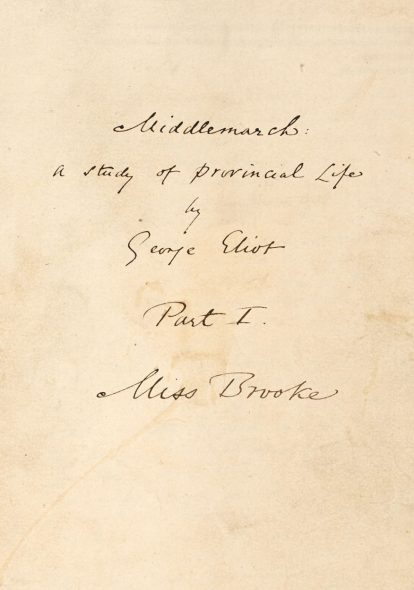
In this blog post, for CLiC Fiction I explore how corpus linguistic tools can be used to illuminate the semantic texture of George Eliot’s writing.
I make use of the CLiC Web App (Mahlberg et al. 2020). From the outset, George Eliot frames Middlemarch: A Study of Provincial Life (1871) as a pseudo-scientific sample of the complex human dynamics that can be found in a provincial town. Using the metaphor of an optical microscope, the narrator vows to concentrate ‘all the light [they] can command’ on ‘unravelling certain human lots and seeing how they [are] woven and interwoven’ (102).
Even with a microscope directed on a water-drop we find ourselves making interpretations which turn out to be rather coarse; for whereas under a weak lens you may seem to see a creature exhibiting an active voracity […] a stronger lens reveals to you certain tiniest hairlets which make vortices for these victims while the swallower waits passively at his receipt of custom.
A ‘strong lens applied to Mrs Cadwallader’s match-making’, Eliot suggests, will show a parallel ‘play of minute causes’ (41). This metaphorical microscope reappears throughout the narrative. Ineffectual intellectual Edward Casaubon — who ‘dreams in footnotes’ — is so single-minded that Mrs Cadwallader suspects a drop of his blood under a slide, would reveal ‘all semicolons and parentheses’ (49). Ego, Eliot infers, can act as a ‘tiny speck very close to our vision’ that ‘blot[s] out the glory of the world and leave[s] only a margin by which we see the blot’, for there is ‘no speck so troublesome as self’ (589).
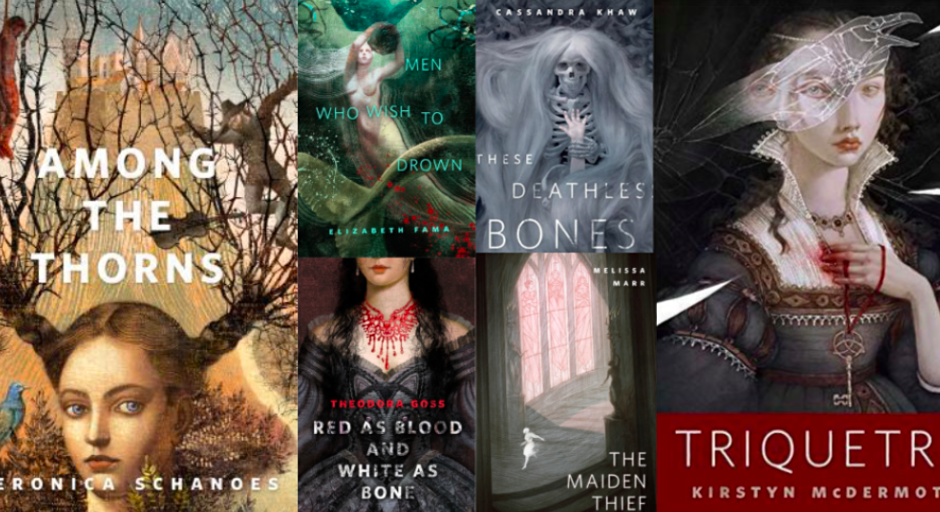
A dark fantasy about a kitchen girl obsessed with fairy tales, who, upon discovering a ragged woman outside the castle during a storm, takes her in–certain she’s a princess in disguise.
A dark fantasy novelette about a teenager whose town is plagued by the annual disappearances of girls and young women. Her father blames her when one of her sisters is one of the taken.
A dark fantasy taking place in seventeenth century Germany, about a young woman who is intent on avenging the brutal murder of her peddler father many years earlier, by a vagabond with a magic fiddle.
A dark fantasy novelette about the fraught relationship between Snow White and her stepmother after Snow White marries the prince and has her own child.
Follow me on Goodreads, for more fantasy recommendations.
Do check out my article in the latest issue of theJournal of Pre-Raphaelite Studies – “What of Her Glass Without Her?” Prismatic Desire and Autoerotic Anxiety in the Art and Poetry of Dante Rossetti. / Vol. 28, 2019, p. 16-35.
Journeying through the looking glass, this paper examines autoerotic anxiety in the works of Pre-Raphaelite artist and poet Dante Gabriel Rossetti. The Pre-Raphaelite muse, enshrined within the metaphor of the mirror, became a prism through which the artist sought to refract his own desires. In this hermeneutic hall of mirrors feminine identity habitually recedes into the distance. At times, however, the female muse becomes a defiant mirror image that holds the artist in her reflexive thrall. Incorporating phenomena such as “the Venus effect”, Lacanian mirror theory, psychiatric photography, and the Contagious Diseases Act of 1864: I will examine how the looking glass, as a reflective, translucent medium, became inextricably intertwined with femininity. This paper draws on Isobel Armstrong’s Victorian Glassworlds and the work of pre-Raphaelite scholars J. B Bullen and J. H. Miller who first identified Rossetti’s love of crafting “mirrors of masculine desire”.
In the first year of your PhD, thoughts often feel scattered. Your PhD floats around unanchored and sometimes it feels like a living, moving, even evolving organism that somehow lies outside of your control.
This post is for generating the earliest ideas of a PhD thesis, when you have just the bare bones of your proposal, a small but promising concept, or an auspicious gap in scholarship. It is at this stage that you will have to hold yourself back from prematurely fleshing out your ideas – lest you end up with a Frankenstein’s Monster’s of a thesis – a composite of disparate parts, grafted hastily together from borrowed ideas, that has been reanimated and tries to run before it can walk.
It seems a lot of students (myself, included) are troubled or unsettled by this phase – the urge to hastily tie everything together in a neat little bow is sometimes overwhelming.
This is the stage that is often ignored by students and universities alike. As a result, lots of talented, capable researchers who cannot wait to start writing, researching, and giving papers can often get stuck advancing an argument they do not wholeheartedly agree with.
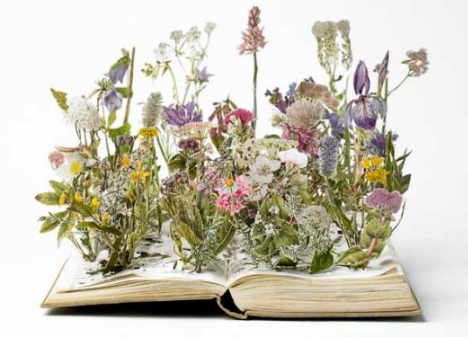
The Book of the Lost (2011) by Su Blackwell
Step One: embrace the question mark
In my first meeting, my supervisor made sure to emphasise that she would be happy for me to start by recording much of my thoughts and research with question marks, rather than with a hasty full-stop. We discussed the benefits of writing and reading in a speculative mode, and talked about the importance of keeping questions open, of slowly unpacking them instead of closing them down.
In an effort to allay the anxiety that can threaten to swallow up precious time working on your PhD, the endless questions that seemed to be lurking around every newly read article, thesis, or book chapter, – it is often important to make a pact with yourself to not to be afraid of the question mark.
In the earliest beginnings of a thesis– before you begin detailed research, before you attempt to definitively map out your argument, before everything – the question mark is your best friend.
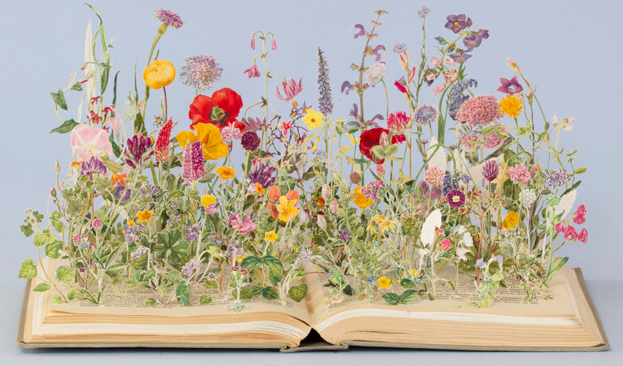
Wildflowers (2014) by Su Blackwell
Step Two: envisage your dream thesis
To get in touch with your ‘dream thesis’ imagine that you are going to the library or browsing its catalogue. What is a book that you wish was there waiting for you, the book you would quite happily, despite its size, or dusty cover want to immerse yourself in completely?
Does it sit in the confines of a particular discipline? Or does it cross into multiple fields?
Does it have a particular set of approaches attached to it?
This exercise does not have to be solely focused on the subject – it can be about the writing style, the layout of the argument, or the integration of varying, perhaps divergent texts.
As for the dreaded methodology – what avenues of research really appeal to your work process? Do you like looking closely at texts and drawing out the intricacies of language? – Do you enjoy seeing an overarching trend shaped from quantitive data? When looking at another scholar’s research – what methodology do you find most appealing/ compelling?
Now is not the time to attempt to answer your thesis – but to ask questions of it.
How then, if we are asking so many questions, do we pin anything down at all?
My personal preference, perhaps as a student looking at natural history, is to ‘tag’ or taxonomise the various threads of your argument, to keep track of them, but let them organically shift without pinning them down.
Now is the time to ask, in detailed particulars rather than in sweeping generalisations, where your interests lie, and how would you metaphorically (or literally) ‘tag’ your research?
Nature in Britain (2012) by Su Blackwell
Step Three: find a community
At this point it can be a good idea to discuss your thoughts with a friend and see if you can learn more about your research this way. Get them to ask you questions that will help you organically explore your intuitive line of argument. – It can be a great idea to buddy up with a fellow PhD student and “swap” brainstorming sessions, half an hour your topic, followed by half an hour on theirs.
Twitter can also offer a warm and welcoming community for academics. Particularly those who cannot regularly make it up to campus or to an academic milieu like The British Library. I have found ‘lists’ particularly useful to ‘classify’ Twitter accounts according to my academic interest, or to keep track of groups of students that have attended certain events. – Storify, which, ‘lets you curate social networks to build social stories, bringing together media scattered across the Web into a coherent narrative’, is also a great tool for either following or curating an event.
The collective reassurance and even practical help offered by the Twitter community is sometimes astounding. On numerous occasions when I have been unable to find a source, date, or detail about my research my Twitter followers have come to my aid at the blink of an eye, providing retweets, advice, and detailed insight.
Wildflowers (2006) by Su Blackwell
Step Four: optimise your environment
Writing and researching effectively can be difficult. Sometimes it is all too tempting to think in terms of shortcuts and arbitrary lists. You have to overcome obstacles like mis-managing time, lack of self-belief, procrastination, and everything else in between.
I found writing a list of everything that is preventing you from working, no matter how seemingly trivial, extremely useful.
Include both obstacles that are external, like needing a place to write, and internal, like procrastination or a lack of archive-navigating skills.
Then, write a specific, tangible solution for each obstacle.
Try not to cloak your problems in a nebulous feeling of ‘I can’t do this’ – if you flesh anxieties out and, in effect, make them corporeal, you will have a higher chance of successfully exorcising them from your PhD.
I hope you found this post, in some way, useful. Good luck!
To be kept up to date on new posts from The Cabinet of Curiosity subscribe by WordPress or follow me on Twitter @rosalindmwhite.
The botanical clock, or ‘Watch of Flora’, was a garden plan hypothesised by the eighteenth-century naturalist Carl Linnaeus. This ‘pretty fancy of Linnaeus’ was attempted by several botanical gardens in the early Victorian era, with dubious success.
So what exactly is the ‘Horologe or Watch of Flora,’ and what was it designed for?
Linnaeus observed the strong circadian rhythm or ‘chronobiology’ of forty-six flowers, from the opulent water lily, to the common daisy. He optimistically suggested one could read the time by them ‘as accurately as by a watch’. The hawkweed ox-tongue, for example, opened its petals at 4-5am and supposedly shut them punctually at noon.
Linnaeus’ concept of floral timekeeping picked up on a deep rooted belief in the punctuality of plants – the goat’s beard (or Aruncus dioicus), for example, was said to regulate the ploughboy’s mid-day meal, and was thus locally referred to as ‘Jack-go-to-bed-at-noon’.
Thirty years before Linnaeus’ birth, such a floral clock may have been described by Andrew Marvell, in his poem “The Garden” (1678):
How well the skilful gardener drew
Of flow’rs and herbs this dial new; Where from above the milder sun Does through a fragrant zodiac run; And, as it works, th’ industrious bee Computes its time as well as we. How could such sweet and wholesome hours
Be reckoned but with herbs and flow’rs!
Charlotte Smith’s ‘The Horologe Of The Fields’ provides a later ode to the ‘Watch of Flora’:
In every copse, and shelter’d dell, Unveil’d to the observant eye, Are faithful monitors, who tell How pass the hours and seasons by.
The green robed children of the Spring Will mark the periods as they pass, Mingle with leaves Time’s feather’d wing, And bind with flowers his silent glass. […]
Thus in each flower and simple bell That in our path untrodden lie, Are sweet remembrancers who tell How fast the winged moments fly.
Time will steal on with ceaseless pace, Yet lose we not the fleeting hours, Who still their fairy footsteps trace, As light they dance among the flowers
Smith’s romantic poem belies the often complicated matter of attempting to read the botanical clock and the difficultly of cross referencing between floral synchrony. Botanists frequently observed a flower’s punctuality to vary by as much as two hours. The “clock’s” accuracy was diminished according to the temperature change and seasonal effects that affected a plant’s flowering time.
The flowerbeds that arose from such endeavours were a peculiar hotchpotch of incongruous and often uncultivated plants, including clusters of dandelions (traditionally the plant weeded out of flowerbeds). Thus, despite its practical inaccuracies botanical timekeeping played an unorthodox, but significant, aesthetic role in the botanical fashion of the day.
Linley Sambourne’s cartoon ‘Man is but a Worm’, appearing in Punch in 1882 in depicts the evolution of man; from worm, to ape, to an archetypal top-hatted Victorian gentleman, concluding with an image that had fast become an emblem for evolutionary theory – the bearded Darwin himself. The cartoon ridicules the idea of a relation between the two species, using grotesque caricature to depict Darwin’s theory as nothing more than comical absurdity.
Like Linley Sambourne’s cartoon, Charles Kingsley’s The Water Babies parodies much of the discourse surrounding the origins debate. However, Kingsley does not choose to satirise the theory of natural selection itself, instead Kingsley parodies the reaction Darwin’s ideas provoked. The novel ‘argues against purely physical definitions of humanity’. [2] Kingsley takes a bone of contention in the origins debate, The Great Hippocampus Question (which debated upon the similarities between the anatomy of apes and men) and lampoons the debate as ‘the great hippopotamus debate’, using humour to emphasis the absurdity of reducing humanity to anatomy.
‘You may think that there are other more important differences between you and an ape, such as being able to speak… and knowing right from wrong and saying your prayers; but that is a child’s fancy my dear…if a hippopotamus major is ever discovered in one single ape’s brain nothing will save your great-great-great-great-great-greater-greatest-grandmother from having been an ape too.’
Rather than ridicule the idea of natural selection Kingsley takes the essence of the theory and transforms it into what he terms ‘Fairy Science’. As Anne Chassagnol notes:
‘Darwin’s theory is quite a fairy-like concept concerning as it does metamorphosis…[and] focusing frequently upon fantastical, often miniature animals including, larvae, beetles and butterflies’. [3]
Kingsley adopts these characteristics of science and re-imagines them as tenets of fairy-tale. Tom’s odyssey begins with his metamorphosis: like a butterfly he leaves his old husk behind and devolves into an eft in preparation for his moral evolution.
In On the Origin of Species (1859) Darwin emphasises that the natural world is characterised by a struggle for survival. He urges us to remember that ‘birds which are idly singing around us mostly live on insects and are thus constantly destroying life’ . [4] This struggle for survival is depicted in The Water Babies. The trout ‘gobble the beetles and leeches… [and swim] about with great worms hanging out of their mouths, tugging and kicking to get away’ . The otter despairs how men speared her ‘poor dead husband’ . Even Tom is described as being at the bottom of the food chain; the otter first decreeing that Tom ‘is not worth eating after all’ and then threatening that the salmon will eat him and then they will eat the salmon. This struggle is imperative to Tom’s passage into adulthood. Gradually he moves up the evolutionary ladder no longer fraternising with the gnats, the dragonflies and the sea snails, and instead talking to Ellie and other water babies.
The logical inversion of Darwin’s theory, devolution, is made a concrete possibility in The Water Babies. As Mrs Bedonebyasyoudid asserts ‘if I can turn beasts into men, I can by the same law of circumstance and selection and competition, turn men into beasts’. Tom observes many examples of this throughout his journey: some of the salmon become ill adapted through their atrophy and as a result ‘grow ugly and brown and spotted;’ the Tomtoddies turn into radishes, as their brains are so filled with water due to their preoccupation with ‘The Examiner;’ the Doasyoulikes, a race of idle humans, ‘grow so stupid … [that] they have almost forgotten how to talk… [and] will all be apes very soon’.
Tom himself is described at the beginning of the tale as a ‘little black ape’ , which immediately emphasises his risk of degeneracy. Furthermore, he is described to be quite at home in a chimney; ‘a mole underground’ he is adapting to his uncivilized surroundings, and therefore is presented as being on the wrong evolutionary tract. Kingsley uses Tom as a symbol for Victorian anxieties about the degeneration of the poor, who: unclean; uneducated and faithless seemed symptomatic of social degeneration on a national level. This connection between moral decay and evolutionary decline was unequivocally assumed, as although by the 1830s the term ‘evolution’ was used in its modern sense, prior to this it was ‘a term for individual growth’, which ‘only further helped to forge and explicit connection between the two processes’. [2]
Kingsley responds to the anxiety of degeneration with the concept of recapitulation, an idea which suggested that ‘the development of the individual repeats the development of the human race’. Just as ‘the human foetus passes in the womb through the evolutionary stages of life on earth … the growing child passes through physical and psychological stages of savagery and barbarism’. [5]
In The Water Babies the fairies spirit Tom away from London, where he is at risk of evolving into a double of Mr Grimes; he imagines that when he himself is a master ‘he would bully [his apprentices] and knock them about, just as his master did to him’ . They reduce him to an embryonic size and submerge him in a womb-like water-world, where Tom must ‘re-inhabit nature to achieve his own humanity, [in order to] transcend his origins.’ [2] Mrs Bedonebyasyoudid embodies nature’s absolute justice; she ‘cannot help punishing people when they do wrong … [she] work[s] by machinery … wound up carefully [so that she] cannot help keep going’. She does not interfere, allowing the water babies to learn from their mistakes, and adapt accordingly.
However, her code of conduct does differ from Darwinian selection. The natural education Tom is subject to is not reliant on qualities that nurture survival, but on qualities that nurture Christian virtue. It is not survival of the fittest but survival of the moral. For example, Tom grows prickles not because he has done something contrary to his survival but because he has done something contrary to Christian morality; ‘when his soul grew all prickly with naughty tempers, his body could not help growing prickly too’. The use of the word ‘punish’ throughout the novel (the tommodites are ‘punished’ for worshipping the ‘idol’ examination, the salmon ‘properly punished’ for their slothful nature) magnifies the sense that God uses the seemingly autonomous model of natural selection to enact divine punishment. Kingsley only reconciles religion with science, by making the two entities one and the same; faith in the universal laws of science becomes synonymous with faith in divine presence.
This is made irrefutably clear at the end of the novel when Tom and Ellie learn that all the fairies who have throughout Tom’s journey governed nature’s law are one and the same. This epiphany is met with ‘a clear, white, blazing light’ emblematic of divine presence. To Kingsley ‘evolution must have meaning and purpose, two attributes that Darwin had tried to eliminate from his own theory’. [6] Kingsley separates the evolution of man from the evolution of all other organisms, upholding modern man as a superior being because of his moral choices. The notion of Mrs Bedonebyasyoudid’s ‘downhill as well as uphill road’ is made clear; Tom learns Christian principles, and therefore is no longer at risk of remaining a degenerate ‘little black ape,’ nor a ‘poor little heathen’, instead he journeys upon the ‘uphill road’ becoming a ‘great man of science’.
The Water Babies functions simultaneously as a tale of evolutionary recapitulation and as a religious pilgrimage. Tom’s return to a pre-human morphology allows him to spiritually as well as physically adapt to achieve a redemptive end. Parallel to this, physical evolution and moral evolution are inextricably intertwined, as Kingsley hypothesises ‘your soul makes your body just as a snail makes his shell.’ Kingsley takes the idea of evolution as a grotesque struggle and moralises it, likening each transitional stage of physical advancement with moral improvement, and moral decline with physical deterioration. Faith in the indefinite, a tenet of religious belief becomes a prerequisite for scientific practice –
‘You must not say that this cannot be, or that is contrary to nature. You do not know what nature is or what she can do’.
Overall, the Darwinian subtext present in The Water Babies is paramount to the novel’s moral sentiment, that although ‘some people say that [bad behaviour] … is nature, and only proof that we are all originally descended from beasts of prey’, ‘little boys can help it and must help it’ otherwise ‘by doing only what they liked’ they are at risk of degeneracy and ‘will all be apes very soon’.
References
[1] Kingsley, Charles, The Water Babies, (Oxford: Oxford University Press, 1995).
[2] Straley, Jessica, Of Beasts and Boys: Kingsley, Spencer and the Theory of Recapitulation’, Victorian Studies, Vol. 49, No. 4, (2007) pp. 587-609.
[3] Anne Chassangnol, ‘Darwin in Wonderland: Evolution, Involution and Natural Selection in The Water Babies’, University of Toulouse, France, (2010) p. 1.
[4] Charles Darwin, On the Origin of Species, (Oxford University, 1859) p. 62.
[5] Moore, K.L. and Persaud, T.V.N., The Developing Human; Clinically Oriented Embryology, Fifth Edition, (Philadelphia: 1993), p. 608.
[6] Joseph Green, ‘“THE GREAT FAIRY SCIENCE”: THE MARRIAGE OF NATURAL HISTORY AND FANTASY IN VICTORIAN CHILDREN’S LITERATURE’, (University of Missouri-Columbia, 2009) p. 161.
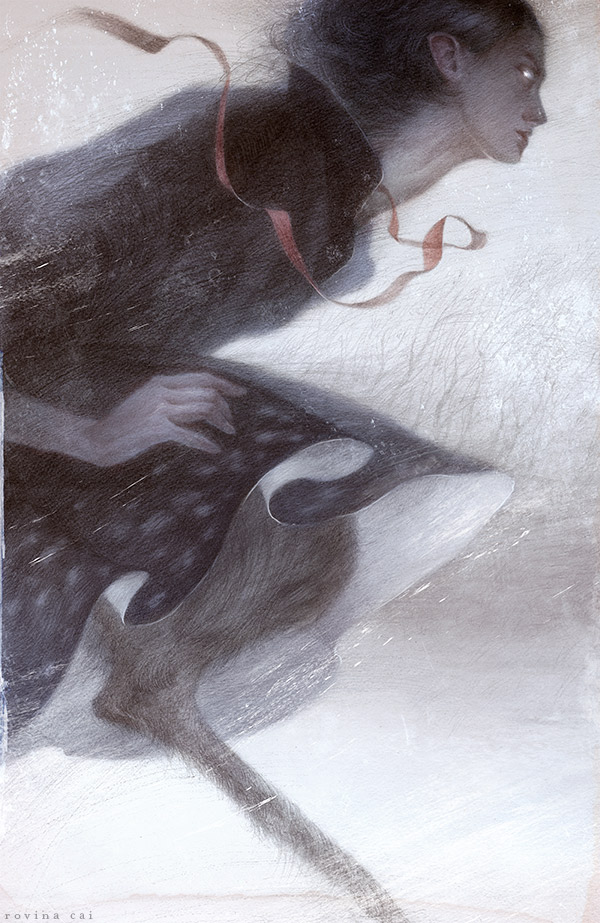
[ illustrations ‘Cold Wind’ & ‘Fake it till you make it’ by Rovina Cai]
As the only Victorian medical student at the time to graduate without having experimented on a single animal, a theosophist, who believed in knowledge of God through spiritual ecstasy, a spiritualist who communed with Anne Boleyn, (her supposed ancestor), and a proponent of animal and women’s rights who fiercely denounced vivisection – Anna Kingsford, traversed all manner of Victorian debates. She is, however, surprisingly absent from academic scholarship.
As a child Anna spent her time in her father’s library, alternately conversing with flowers or with fairies; she was a ‘born seer…seeing apparitions and divining the characters and fortunes of people.’ Her psychic abilities became linked from a young age to her kinship with animals. Deborah Rudacille notes that as a child, Kingsford enjoyed foxhunting, until one day she had a vision of herself as the fox.
Anna Kingsford 16 September 1846 – 22 February 1888
In order to escape unwanted suitors, when she was twenty-one she married her cousin, an Anglican clergyman named Algernon Kingsford, on the condition that she would continue to lead a fully autonomous life. Rereading their early courtship letters later in life she bemusedly notes ‘they are full of declarations that my chief reason for marrying was to be independent and free!’ Shortly after her marriage, after dreaming of a visit from Mary Magdalene, Kingsford converted to Catholicism. Her husband respected her independence and supported her in her choices, as well as in her later conversion to theosophy – on the grounds that it promoted gender equality.
In these years of spiritual conversion, Kingsford became a feminist and vegetarian; in 1872 she bought The Lady’s Own Paper, and took up work as its editor, becoming acquainted with the famous writer, feminist, and anti-vivisectionist Frances Power Cobbe.
In 1873 Anna enrolled for medical study in Paris in order to acquire the scientific knowledge to argue against vivisection and advocate a vegetarian diet. Her final thesis, L’Alimentation Végétale de l’Homme, was on the benefits of vegetarianism, published in English as The Perfect Way in Diet (1881).
‘Grand Show of Prize Vegetarians’ by John Leech Punch (1852)
Kingsford wrote to her husband in 1874:
Things are not going well for me. My chef at the Charité strongly disapproves of women students and took this means of showing it. About a hundred men (no women except myself) went round the wards today, and when we were all assembled before him to have our names written down, he called and named all the students except me, and then closed the book. I stood forward upon this, and said quietly, “Et moi aussi, monsieur.” [And me, Sir.] He turned on me sharply, and cried, “Vous, vous n’êtes ni homme ni femme; je ne veux pas inscrire vôtre nom.” [You, you are neither man nor woman; I don’t want to write your name.] I stood silent in the midst of a dead silence.
In 1877, After listening to one of her instructors, Dr. Claude Bernard, exhorting slowly baking live animals to death in order to study body heat, Anna, flew from her seat, labeled her teacher ‘Murderer!’ and refused to return to the classroom. Sickened by Parisian animal experimentation, (she wrote of ‘trying vainly to shut out the piteous shrieks and cries which floated incessantly towards [her] up the staircase’ at night) Anna arranged for private tuition and refused to dissect a single animal. In an effort to ‘root this curse of torture’, she habitually volunteered herself for dissection so that the doctors would leave the animals alone.
Soon after her exchange with Dr. Claude Bernard, Anna records feeling as though she became ‘a spiritual thunderbolt’ who, with all her might, willed the doctor dead. Soon after this episode, and after fainting from the extent of her fury, Kingsford wrote to Maitland (her confidante and later biographer) of the doctor’s sudden death:
‘Woe be to the torturers! I will make it dangerous, nay, deadly, to be a vivisector. It is the only argument that will affect them. Meanwhile, thank God the head of the gang is dead!’
Spellbound by her extrasensory powers, Kingsford set her sights on Dr. Paul Bert, ‘the most notorious of the vivisecting fraternity’, a doctor known for keeping all who slept by his laboratory awake with the cries of semi-dissected animals. After Dr. Bert died in November 1886 Kingsford wrote again of her triumph:
I have killed Paul Bert, as I killed Claude Bernard; as I will kill Louis Pasteur, and after him the whole tribe of vivisectors – it is a magnificent power to have, and one that transcends all vulgar methods of dealing out justice to tyrants.
Fortunately for Louis Pasteur, Kingsford’s psychic homicide ‘took from [her] nervous force’; after being caught in rainstorm (whilst investigating Pasteur’s laboratory) Kingsford developed pneumonia, and later tuberculosis. She died on February 22, 1888 spending her final days, according to her friend Sir Richard Burton, ‘suffering in mind and soul’ ‘at the sights and sounds connected with Parisian vivisection.’
Maitland, Edward, Anna Kingsford: Her Life, Letters, Diary and Work, 2 Vols. (Whitefish: Kessinger Publishing, 2003)
To be kept up to date on new posts from The Cabinet of Curiosity subscribe by WordPress or follow me on Twitter @rosalindmwhite.
As an addendum to my previous post that celebrated the ‘haptics’ of examining physical materials, I thought I would write a parallel piece exploring what the digital realm has to offer. I wanted to exhibit how digital curiosities can often provide an almost extra-sensory experience that can emotionally propel us through time – in a manner that a ‘physical’ material can not. Therefore, I have (somewhat sporadically) organised these resources by ‘sense’ – in an effort to show how successfully the digital medium can inhabit the full span of bygone sensory experience.
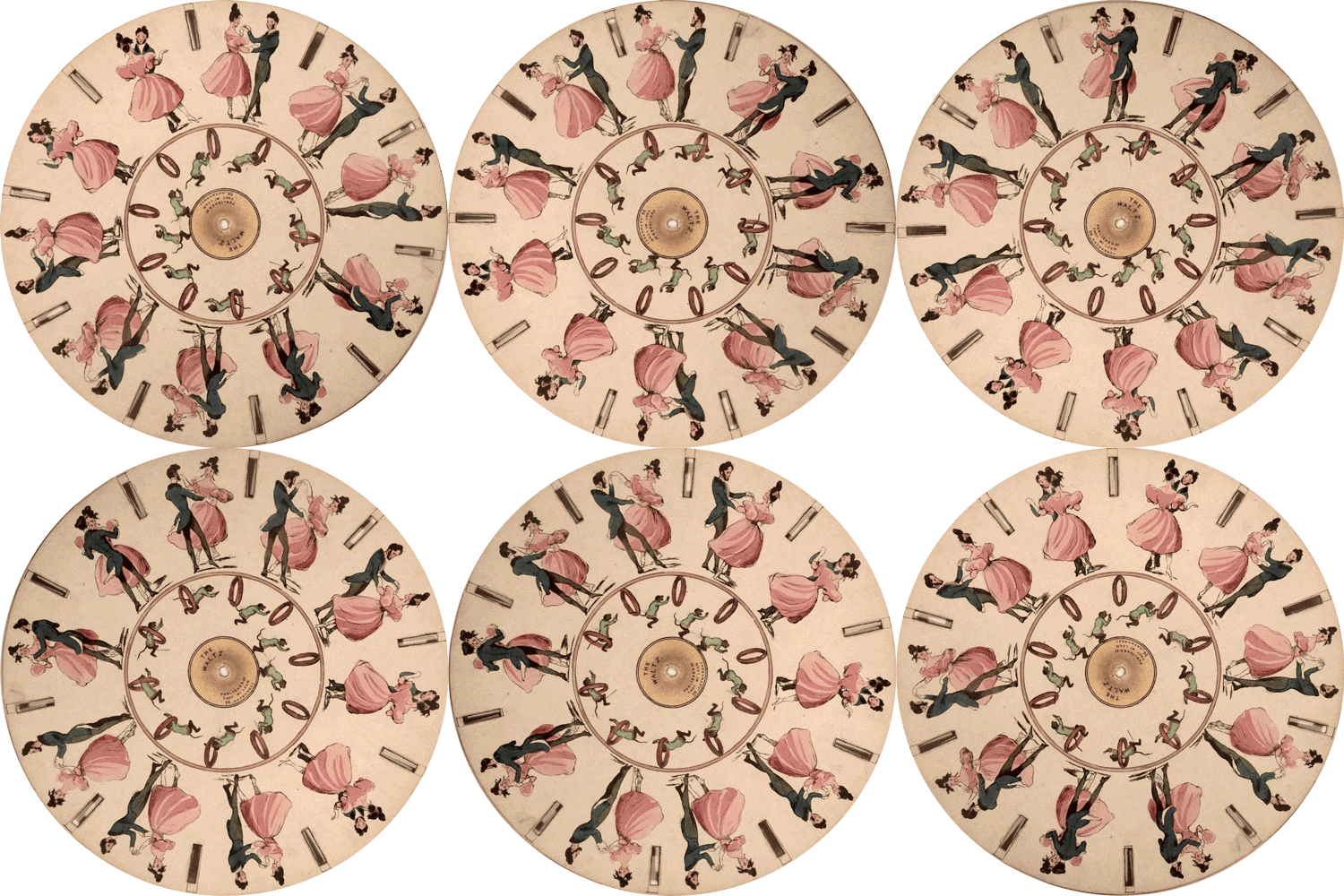
#1 Starting with the visual – The Richard Balzer Collections offers a veritable virtual Wunderkabinett of visual curiosities. This rich collection of visual wonders includes magic lanterns, peepshows, shadows, transparencies, thaumatropes, phenakistascopes and a variety of other optical toys.
#2 The Tate Collective’s Blog provides another celebration of ninteenth-century visual culture. The Blog celebrates digital remixes of famous pieces of art. Check out the ‘1840’s GIF Party‘, ‘All Glitched Up‘ and more.
#3 An example of auditory material is this recording of a machine from 1890s used to make birdsong.
#4 Returning to ‘haptics’ but this time through the computer screen, ‘The Thomas Hardy and Clothing Project’ builds upon student-led research undertaken at Exeter to create a digital research database of references to fashion in Hardy’s writing and biography. The database will also provide links to digital images of clothing worn by Hardy, his friends and relatives and contribute to the Thomas Hardy: Fashion, Fact and Fiction exhibition.
#5 – For olfactory curiosities until the advent of smell-o-vision (an invention that would surely have captivated the Victorians!) see Mimi Matthew’s brilliant ‘A Victorian Lady’s Guide to Perfume’ for a comprehensive touchstone on the olfactory vernacular of the nineteenth-century.
#6 Moving away from the foundations of human experience, into other facets of existence like the spatial, The Dicken’s Society is looking for a team of scholars to become a part of an exciting project that will geographically map the lifespan of Dickens’ works.
#7 Mapping Emotions in Victorian London offers another example of harnessing digital technology for ‘literary geography.’
#8 The ‘Our Mutual Friend Tweets’ experiment, (run by Birkbeck University) a collaborative project in which participants re-enacted the voices of Dickensian characters on Twitter – does a brilliant job of recreating the immediacy of Victorian print culture. See Emma Curry’s ‘Doing the Novel in Different Voices: Reflections on a Dickensian Twitter Experiment‘ for further insight into the project.
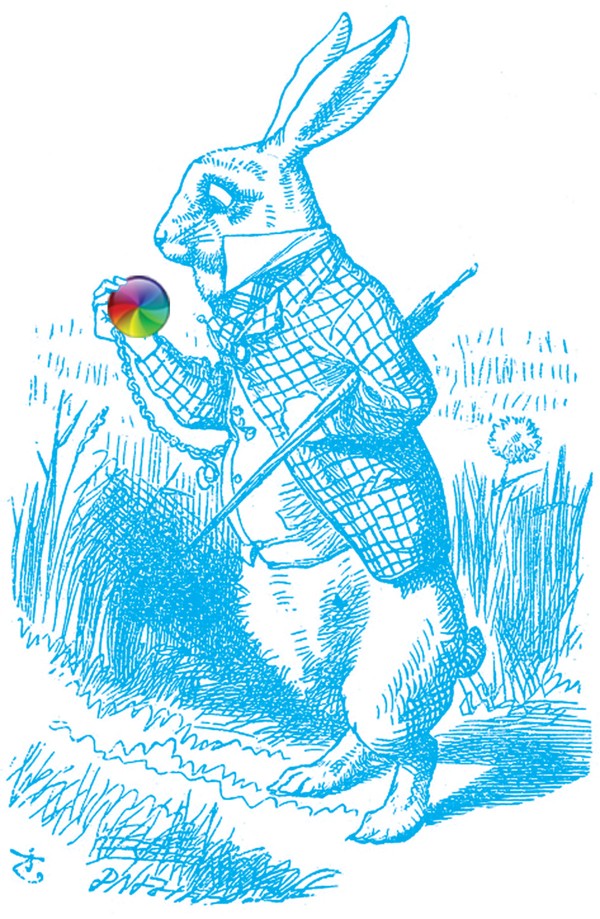
#9 Finally, Evan Kindley’s article ‘Down the Rabbit Hole: The rise, and rise, of literary annotation’ provides a Carrollian travel-guide to crowd-sourced annotation technology such as ‘Genius’. Which seek to create ‘living documents’ out of classic texts, a virtual surrogate of the annotated library book – but with far more detailed annotations.
[Images from Evan Kindley’s Down The Rabbit Hole]
To be kept up to date on new posts from The Cabinet of Curiosity subscribe by WordPress or follow me on Twitter @rosalindmwhite.





 The Book of the Lost (2011) by Su Blackwell