In The Entomologist’s Dream (1909) by Edmund Dulac an entomologist – in a state of near collapse – bears witness to an ominous kaleidoscope of butterflies that envelop his bedroom in a mantle of blue chaos. The insect-collector’s beloved specimens have escaped: struggling from their skewers and shattering their glass-fronted prisons. (It is left up to viewer to determine whether they seek freedom or vengeance.)
The work is an illustration for Le Papillon Rouge (the red butterfly) by Gerard d’Houville, a tragic love story published in L ‘Illustration, Numero de Noel 1909 the French news and art magazine. (In the tale an entomologist plunders his collection, in a state of moonlit delirium, incensed with his failure to capture a blood red butterfly for his lady love.)
A sense of anxiety pervades the practice of entomology – the use of chloroform, killing jars and other lethal devices leaving many naturalists with a sense of guilt.
The killing jar was an ordinary glass preserving can, with a small lump of cyanide of potassium, covered by a thin layer of plaster. An entomologist was instructed to arrange the insect, once dead, in ‘a natural position’. Killing jars habitually resulted in a slow death for the imprisoned insect – it was difficult to settle upon a formula that would result in death swiftly without damaging the insect’s fragile carcass. In the midst of searching for such a ‘sweet spot’ an entomologist was often faced with specimens that were prone to spontaneous resurrection.
Much of the literature in the late 1840s ruminated upon the question of entomological suffering. Naturalists made use of insects to contemplate hierarchies of pain: paying special attention to cases of insect decapitation. One naturalist, for example, was shocked to see that a dragonfly he had just pinned through the thorax still clutched a struggling fly in its forelegs – and proceeded to eat it.
Similarly, George Henry Lewes affirmed that ‘an insect pinned to the table will continue to eat and a headless fly or worm will writhe and twist if touched.’
Imagining the horror of a man eating under such circumstances, many entomologists of the age (gladly) concluded that an insect was not capable of experiencing emotional trauma as we do. (Though they might ‘learn’ to avoid stimulus associated with sustained tissue damage.)
If we classify pain as an emotional response (a conscious experience) -does the question of insect pain hinge upon the concept of insect emotion? How on earth could we determine if an insect’s experience is intertwined with ‘anthropomorphic’ factors like mood, personality, disposition, or motivation?
(Hit me up with any other examples you have of ‘entomological anxiety’.)
To be kept up to date on new posts from The Cabinet of Curiosity subscribe by WordPress or follow me on Twitter @rosalindmwhite.
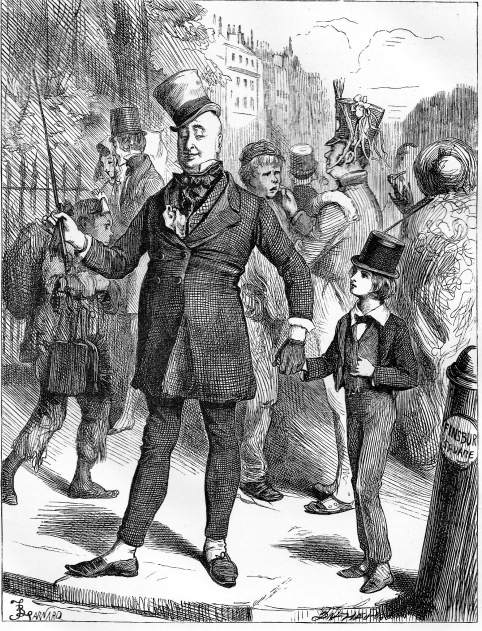
Welcome poverty!..Welcome misery, welcome houselessness, welcome hunger, rags, tempest, and beggary! Mutual confidence will sustain us to the end! – Mr. Micawber
Wilkins Micawber from Charles Dickens’ David Copperfield (1854) is known for his resourcefullness, optimism and adaptability.
“His clothes were shabby but he had an imposing shirt-collar on . . . And a quizzing-glass hung outside his coat – for ornament, I afterwards found, as he very seldom looked through it and couldn’t see anything when he did.
Welcome poverty!..Welcome misery, welcome houselessness, welcome hunger, rags, tempest, and beggary! Mutual confidence will sustain us to the end! – Mr. Micawber
Wilkins Micawber from Charles Dickens’ David Copperfield (1854) is known for his resourcefullness, optimism and adaptability.
“His clothes were shabby but he had an imposing shirt-collar on . . . And a quizzing-glass hung outside his coat – for ornament, I afterwards found, as he very seldom looked through it and couldn’t see anything when he did.
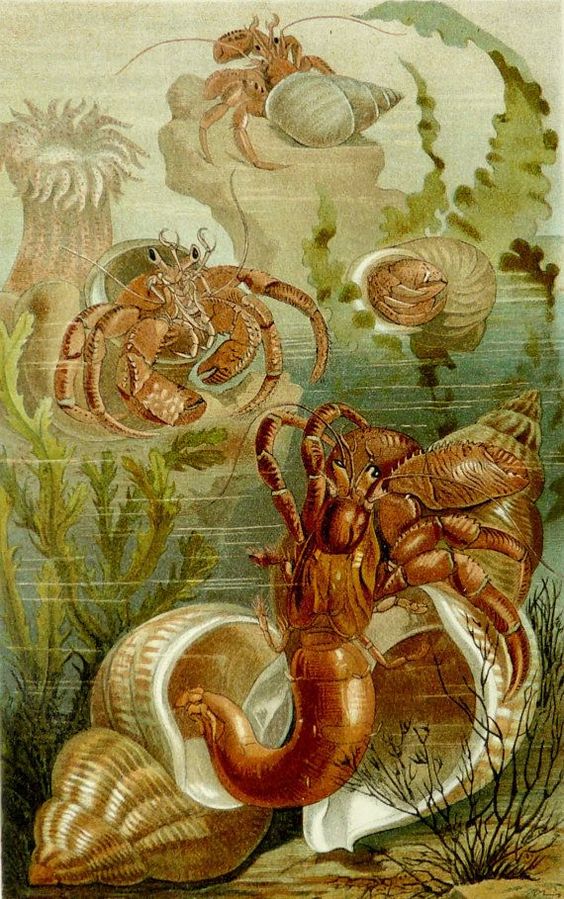
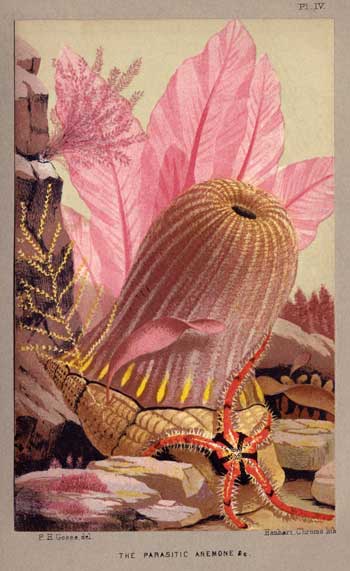
The noted naturalist, and populariser of the aquarium, Philip Henry Gosse extended Micawber’s sense of reckless buoyancy to the character of the hermit crab in his domestic aquarium.
The Bernhard crab or hermit crab, much like Mr Micawber is in the habit of frequently changing his residence. As the hermit crab grows it finds a new shell to live in. they often make use of the discarded shells of other animals.
Here is Gosse’s amusing anecdote:
This Bernhard Crab in the front, so leisurely pushing away the sand before him with his broad, flat claws, quietly enjoys the meal he finds, undisturbed by fears of a failing supply. There is less of enterprise than complacency in his character, and I call him Micawber, for he is always expecting “something to turn up.”
Twice since March has he changed his coat, and thrown off his tight boots and gloves for new ones. The disrobing seemed to give him little trouble, though he sat dozing at the door of his cell some hours after, as though fatigued by the unusual effort.
Dickens himself makes metaphorical use of the hermit crab in Our Mutual Friend (1864) in reference to John Rokesmith, a character who sheds his old life and takes on a new identity.
‘The natural curiosity which forms the sole ornament of my professional museum,’ he resumes, ‘hereupon desires his Secretary–an individual of the hermit-crab or oyster species, and whose name, I think, is Chokesmith–but it doesn’t in the least matter–say Artichoke–to put himself in communication with Lizzie Hexam.’
___
See Philip Henry Gosse, The Aquarium: an unveiling of the wonders of the deep sea (1854).
Throughout the nineteenth-century the mania for seashells steadily swelled; they featured on Christmas cards, and adorned countless keepsakes, jewellery, and furniture. The Gradgrind nursery in Charles Dickens’ Hard Times is equipped with a “little conchological cabinet, a little metallurgical cabinet, and a little mineralogical cabinet”, whilst, inspired by works of natural history, men and women scoured the seashore for conchological specimens. Conchology, unlike other branches of natural history such as zoology or mineralogy was easily accessible to everyone, and did not require specialist equipment. It also had the added bonus of including inanimate specimens that were not subject to disease or decay.
The Conchologist / G. Spratt del. ; Printed by G. E. Madeley ; Pubd by C. Tilt, Fleet Street.
George Spratt’s composite caricature of ‘The Conchologist’ offers a personification of the craze – a woman, fashioned from shells of marine life, is depicted scanning the sea-side for her kin: her basket is filled with sprigs of seaweed and various tide pool treasures. Her rather ineffectual sun-bonnet looks to be crafted from the soft-bodied bell of a jellyfish, while a quasi-vulval cowry shell, disturbingly enlarged, makes up the lower half of her body.
The Shell Grotto in Margate, is perhaps the most impressive example of conchological worship. In 1835 an architectural love letter to the humble shell was uncovered by a man and his son attempting to dig a duck pond. The son, falling from a hole in the ground, recovered from his tumble to find a chamber ‘papered’ with an exquisite tapestry of shells. The chamber was connected to a labyrinthian passage similarly shrouded with cockles, whelks, mussels and oyster shells forming intricate mosaics. We still do not know how, or why the grotto came to be nor who is responsible for its creation.
Victorian women made use of their collection in various handicraft projects. Many put together imitation bouquets: using various miniature shells to create the desired flower.
Soon enough collectors, having exhausted the beaches of Britain, took to harvesting more impressive shells from overseas. An army of merchants, catering for the increasing demand, set up shop in London.
The name of the global oil company “Shell” is, oddly enough, a reminder of the victorian love of conchology.
In 1833 one Marcus Samuel opened such a shop selling shells, curios, and other trinkets to natural history enthusiasts. By 1851 Marcus was described in the census as a ‘shell merchant’ and was listed as proprietor of ‘The Shell Shop’ in Houndsditch. He later formed the ‘Shell Transport and Trading Company.’ In 1882 his son (Marcus Junior) while travelling in the Caspian Sea, saw a potential for exporting oil from the region. He commissioned the world’s first purpose-built oil tanker and named the tanker the Murex, Latin for a type of snail shell, as a nod to the company’s beginnings. The first logo (1901) was a mussel shell, but by 1904 it was replaced with a scallop shell.
An essay towards a natural history of serpents :
London :Printed for the author, sold by John Gray ...,1742.
http://biodiversitylibrary.org/page/38946403
I stumbled upon these plates from a gorgeous book entitled An Essay Towards a Natural History of Serpents (1742) and had to share them on the blog. I love it when the boundaries of science and folklore begin to blur. The book is available via the Biodiversity Heritage Library.
Fellow muggleborns should pay close attention to pages 78 and 79 which may be of use should a certain chamber be opened once more. The pages bear more than a passing resemblance to a passage found by one Hermione Granger on a fateful day in 1993.
An abridged excerpt is as follows …
The Basilisk or Cockatrice, is a Serpent of the Draconick Line: in shape [it] resembles a Cock, the Tail excepted. Authors differ about its Extraction; the Egyptians say, it springs from the Egg of the Bird Ibis; and others, from the Eggs of a Cock: other conjectures about its descent, being as ridiculous, I forbear to mention them. It is gross in Body, of fiery Eyes, and sharp Head, on which it wears a Creft, like a Cock’s Comb. It has the Honour to be known by the latins as the Little King of Serpents. … Tradition adds, that its eyes and breath are killing.
Several dreadful things are attributed to its venomous qualities. The Venom of the Basilisk is said to be so exalted, that … it will kill the person that makes use of it.
The reason why this Serpent is dubbed King is not because it is larger in bulk, or because it wears a Crown, … But ’tis most probable, that the royal title is given to this Serpent, because of its majestic pace, which seems to be attended with an Air of Grandeur and Authority. It does not, like other Serpents, creep on the Earth … but moving about, in a sort of an erect Posture, it looks like a Creature of another Species, therefore [other serpents] conclude ’tis an Enemy.
The fairy was often thought of as a mode of rebellion against the exactitude of science and technology.
This is exemplified in Turner’s Queen Mab’s Cave (1846) which is hazily wrought with a nebulous glow that appears to purposefully cloud the eye with a literal and metaphorical opacity. As the rocks, water and dappled light optically coalesce the fairies appear to be indeterminately in and out of both the water and our world. A contemporary reviewer attests to this reading noting Turner ‘admits of more than a usual employment of the vague, illusive, and fanciful; [he]… produce[s] a daylight dream … not painted but apparently flung upon the canvas in kaleidoscopic confusion.’
Queen Mab’s Cave exhibited 1846 Joseph Mallord William Turner 1775-1851
In 1917 two girls, Elsie Wright and Francis Griffiths, were said to have photographed fairies at the bottom of their garden. The Cottingley Fairies, as they became known, became the locus for the tension between ‘men of science’ and those who wished to retreat into the fairy realm.
Many eminent members of society including Arthur Conan Doyle viewed these images as authentic evidence: seen through clairvoyant eyes that could become clouded as the two girls approached adulthood, ‘the processes of puberty [proving] often fatal to psychic power.’ Proof of the existence of fairies, he believed, would ‘jolt the material 20th-century mind out of its heavy ruts in the mud, and make it admit that there is a glamour and mystery to life.”
In the 1980s Elsie and Frances admitted that the photographs were faked, Elsie had copied illustrations from a popular children’s book, Princess Mary’s Gift Book, published in 1914, They said they had then cut out the cardboard figures added wings, and supported them with hatpins. But Frances maintained that the fifth and final photograph was genuine.
This final photo is described by Arthur Conan Doyle as follows:
“Seated on the upper left hand edge with wing well displayed is an undraped fairy apparently considering whether it is time to get up. An earlier riser of more mature age is seen on the right possessing abundant hair and wonderful wings. Her slightly denser body can be glimpsed within her fairy dress.”
Fairies and Their Sun-Bath, the fifth and last photograph of the Cottingley Fairies.
Veiled by a grass, the concealed translucent fairy-folk optically mystifiy the eye. This effect is likely produced by a method of double exposure. William Mumbler’s deceptive double exposures of the dead in the 1860s used film already exposed with an image (usually of a doll or photo of the deceased) to trick customers into believing the spectral image residing in the photo was the spirit of their beloved. – The last Cottingley Fairies photograph is likely to have been taken using a similar process.
Today the photographs are thought of as the product of imaginative play. As Elsie Wright has said
If people wish to believe in fairies, there is no harm done. And if people wish to think of us as a couple of practical jokers, or two solemn faced Yorkshire comedians that’s alright too. But the word liar is a rough word for a true or untrue Fairy story.
However, a recent reappraisal of two photographs sheds a different light on this curious case.
The Secret of the Cottingley Fairies, (2017) by F.R. Maher presents an ingenious theory backed up by meticulous research. The photographs, that form the foundation of Maher’s theory have been known to folklorists and fans of the Cottingley Case for some time. I myself had come across the photos on Pinterest, that great nightmare of cyclical untethered images, and assumed they were copycat works.
F. R. Maher is the first to suggest that these photographs (taken in 1918) may not be copies, but may, in fact, have provided the inspiration for the famous hoax.
The second of the five photographs, showing Elsie with a winged gnome in comparison with Dorothy Inman’s photograph.
One of the photographs taken by Dorothy Inman in 1918, is held in the same collection as the Cottingley fairy material where it is labelled ‘Mrs Inman‟s Fake Photograph.’ Little else is known about this photo. In 1918, The Sphere, printed the second photograph of a young girl surrounded by fairies. Beneath the photo ‘A Fantastic Invasion of A Modern Garden’ the caption reads ‘An attempt to picture the Little Folk with which a child’s imagination will people even the most prosaic London garden, and the little girl who loved them.’As Maher notes, ‘the picture made no attempt to pass these figures off as real fairies’.
A Fantastic Invasion of A Modern Garden (April 1918) The Sphere.
Maher is the first to query the timeline of these photographs. As the story goes, the ‘original’ Cottingley photos were taken in 1917 and then ‘forgotten’ for over two years until Polly Wright, mother of Elsie took these photos to the Theosophical Society. Maher questions this chronology: suggesting that Arthur Wright, Elsie’s father and a keen amateur photographer, may have simply copied The Sphere photograph.
Maher’s theory rests on the simple fact that the Cottingley fairy photographs materialised into the wider world a year afterThe Sphere publication. Further evidence for Maher’s theory, such the curious lack of ageing Francis displays between 1917 and 1920, can be found in her book as well as on her blog post.
Maher’s ‘new’ evidence, and more tellingly its previous availability to researchers of the Cottingley myth, suggests that we have been rather too preoccupied with debating the fairies veracity, so much so, we have failed to interrogate their place in history.
The fact that we have managed to collectively ignore something hidden in plain sight – and as historians obsessed over the binary question of whether two young girls did or did not see glimpses of fairyland, suggests that we, like poor Arthur Conan Doyle, were all too eager to be taken in by the tale.
How likely is it that one of the many emminent men, determined to find verifiable proof of fairies, would have not retained cuttings or memories of fairies in the press prior to 1920?
Is it not more probable that men like Gardner and Doyle may have actively repressed all memory of these previous images? – To go out of their way to give-wings to the possibility that fairies might not only exist, but could be arrested beneath a photographic plate.
___
The Secret of the Cottingley Fairies by F.R. Maher is available to buy on Amazon. An interview with F.R. Maher on her discovery is available in the August 2017 issue of The Fortean Times.
See also:
Doyle, A., 1922, The Coming of Fairies. London: Hoddon.
Smith, Paul (1997), “The Cottingley Fairies: The End of a Legend”, in Narváez, Peter, The Good People: New Fairylore Essays, The University Press of Kentucky, pp. 371–405.
I at least have so much to do in unravelling certain human lots, and seeing how they were woven and interwoven, that all the light I can command must be concentrated on this particular web, and not dispersed over that tempting range of relevancies called the universe. (2.15.1)
In an academic world where we are accustomed to reading multiple works in tandem, where we have to juggle disparate eras, genres, and styles, the opportunity to spend an entire week alone with a single novel is as rare as it is rewarding. This year, for the first time in 36 years, the organisers of Dickens Universe chose to illuminate a single work outside of Dickens’ oeuvre. The spotlight was torn from Charles Dickens and refocused onto his contemporary, George Eliot: zooming in on her meticulous study of provincial life, the once infamous Middlemarch. The chosen text provided us with a sample frame teeming with microscopic particulars and idiosyncratic details – revealing a work that through its focused myopia became known for its expansive influence.
The keynote papers each morning provided us with a centre of illumination with which to interpret Middlemarch: our thoughts and discussions arranging themselves, like the scratches of Eliot’s pier glass, in a series of concentric circles around each speaker’s provocative thesis. The cumulative effect of this was that each of us emerged at the conference’s close with a Venn diagram of overlapping interpretations of the novel that orbited around a constellation of different arguments.
My own thoughts centred around the concept of Middlemarch as text that, as Ruth Livesey put it, ‘flickers between particularity and universalism.’ Alongside Ruth’s talk on the middleness of Middlemarch, Summer Star’s examination of the significance of multitasking in Middlemarch as well as Helen Michie’s paper detailing the value of mid-page lexical forays helped me to foster new ways of thinking about my own work. Helen Michie’s paper, alighting on words such as ‘pilulous’ and ‘privacies,’ demonstrated how to refocus a text through the prism of a single word. – A methodology that yields surprisingly nuanced results and which, I hope, will inform my own research practice.
As Eliot Universe progressed it began to feel as though we had developed our own Middlemarch-esque microcosm, within the web-like redwood forest of Santa Cruz. As cohorts dining and dorming together we embraced a curious pseudo-provinciality. We adopted the same preoccupations: from how to pronounce various character’s names, to the oft heard question – is George Eliot funny (yes!). We shared a sense of collective disorientation, (‘are you lost too?’), and embarked on countless mutual quests (whether to find the Wi-Fi signal, bus stop, or a way to get into the cafeteria early.) Daily afternoon teas, ‘Post-Prandial Potations’, and graduate parties soon resembled Middlemarch’s whispering gallery, so a-buzz was the Eliot Universe hive-mind. Each of these informal events afforded us with the opportunity for countless fruitful discussions, as well as a healthy dose of gossip. Whilst the various workshops encouraged us to pool our collective tips, resources and teaching horror stories.
At times, Dickens Universe feels rather like an exercise in placing academia under the microscope. The occupation can be observed in all its sprawling intensity – as the week progresses, and stories of past and present ‘universes’ are shared between meals, there is a sense that any barriers between the professor and the student have been broken down. It is hard to articulate the nature with which Dickens Universe manages to dispel the hierarchal nature of academia – where other conferences have not. So, I will do as Eliot might, and provide a small anecdote, from which the whole can be expanded. – A quote from renowned Victorianist George Levine, spoken on the last day of Eliot Universe – ‘If you want to get the Ladislaw backstory straight, I recommend Schmoop.”
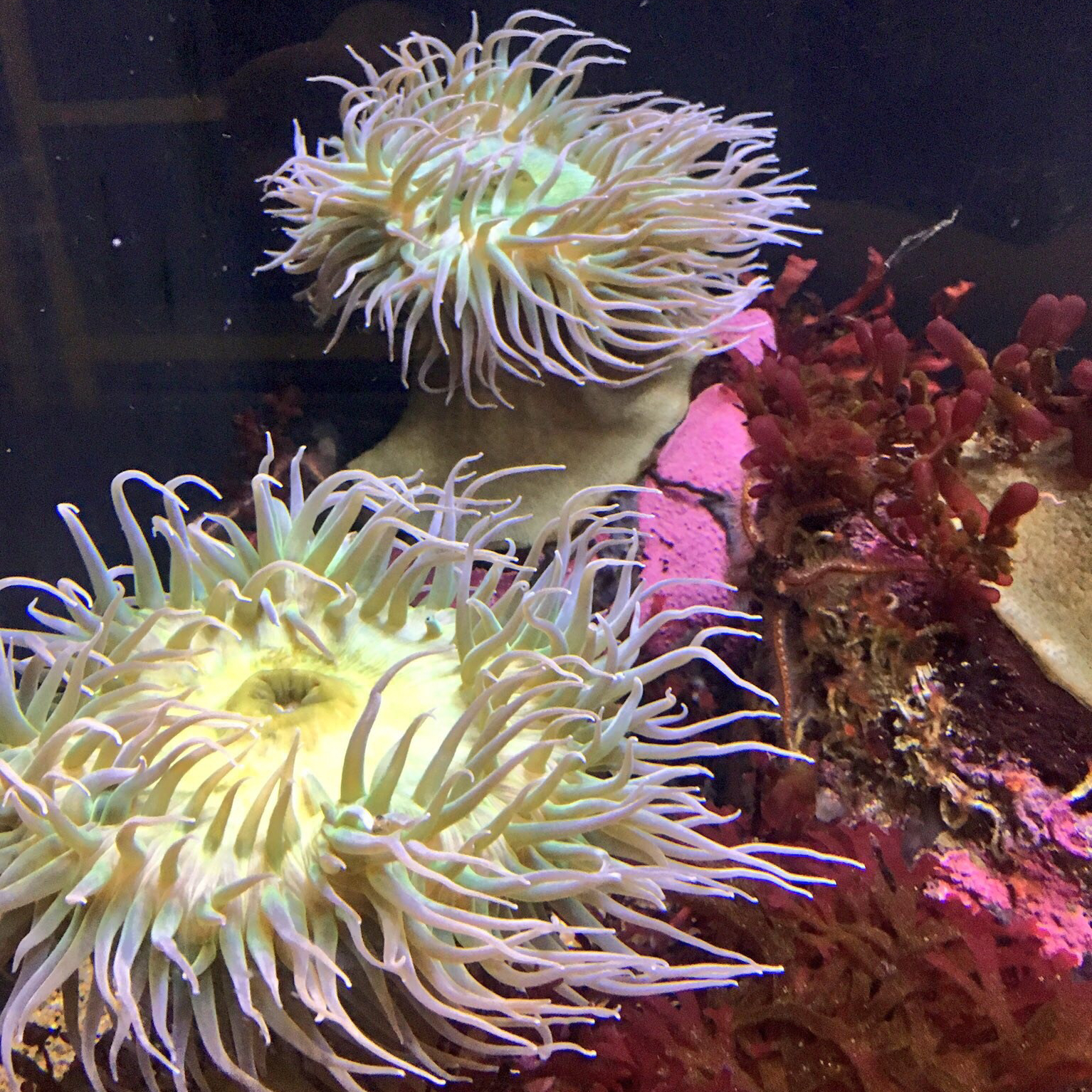
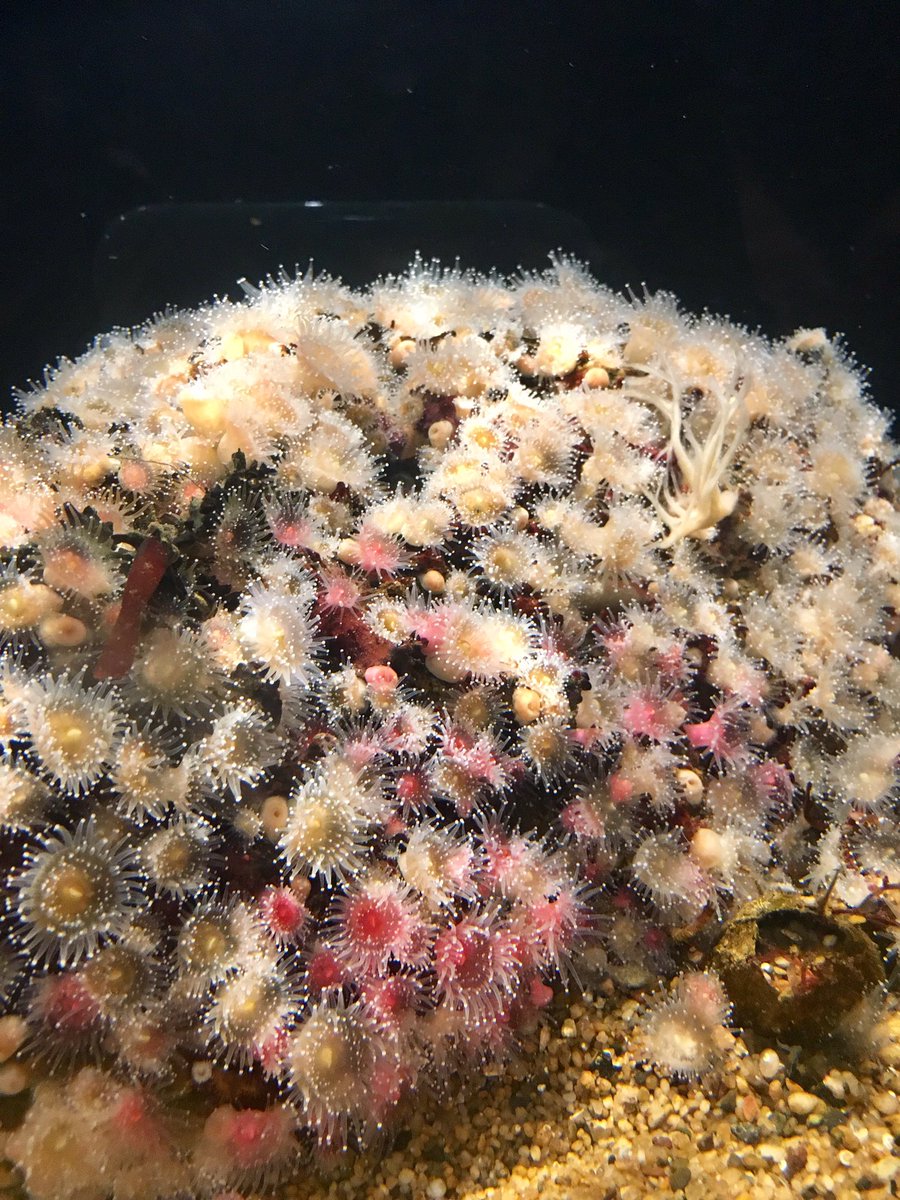
If you find yourself, much like Eliot’s Lydgate, struggling to escape the hampering threadlike pressure of small social conditions, less the Universe swallow you whole. Then it is important to remember that it is quite impossible to do everything, and take some time to yourself and enjoy Santa Cruz. I myself did as Eliot would and ran away to explore the wonders of the shore at the aquarium – enjoying the opportunity to hold a starfish, stroke a sea anemone, and let time dilate within an undulating jellyfish’s watery whirl.
Dickens Universe, at its core, encourages us to emerge from the Californian redwoods and see the world beyond our own institutions, allowing us to learn from students and staff across the globe. So that we begin to perceive the larger web of scholarship, our own place in it, and how incalculably diffusive it has the potential to be.
They say that beauty is everywhere, often hidden in plain sight.
In the case of the lost art of fore-edge painting this idea can be taken quite literally.
A fore-edge painting is a scene painstakingly rendered on the edges of a book; the pages are fanned and clamped as the artist works and then gilded with gold leaf when the book is closed. This creates a sense of ephemeral beauty: as the painting magically surfaces and then dissolves before ones eyes. The artists who crafted these priceless works of art would have been intimately involved with the specialised process of book-binding.
The university of Iowa, recently discovered secret fore-edge paintings on a selection of unassuming books on the Seasons by Robert Mudie.
Summer by Robert Mudie / Special Collections at the University of Iowa.
The text block would have to be held very tightly and it was necessary for the artist to use as dry a brush as possible – to prevent the water-colour spoiling the pages of the book. Water colour was preferred to other paints as it had the added benefit of being absorbed into book leaves without sticking the pages together, or crumbling over time.
The earliest secret fore-edge paintings were floral designs and biblical scenes. However, This popularity of this technique gained in currency in the late 18th century, in a shop owned by Edwards of Halifax.
Fore-edge painting by ‘Edwards of Halifax’ of Wilton House, ca. 1812, on one volume of a 1797 edition of Shakespeare’s plays.
However, the majority of fore-edge paintings date to the late 19th and early 20th century and have been carried out on books originally published in the early 19th century.
Some choice examples follow.
The Modern History of Hindustan, by Thomas Maurice, 1802, with a series of Hindu temples on the bank of a river and minarets of a Mohamedan mosque in the distance.
Latin and Italian poems of Milton translated into English verse, 1808 with a painting of the inn at Edmonton.
Characteristics of women, moral, political, and historical, v.2 1833, by Anna Jameson.
Lyrics of the Heart: With Other Poems, by Alaric Watts, 1851. & the Poetical Works of Robert Browning with Portraits. London: Ballantyne, Hanson & Co. 1899.
Princeton copy of an 1877 reprint of Alice in Wonderland (London: Macmillan and Co.)
For further research into the art of fore-edge painting see Jeff Weber’s Annotated Dictionary of Fore-Edge Painting Artists & Binders (Los Angeles, 2010)
Thank you for reading and please contact me if you come across any (contemporary) examples of victorian fore-edge painting using natural history books.
What is curiosity? Does it change according to the ebbs and flows of time? While today we might associate it with an involuntary odyssey down a Wikipedia rabbit-hole, in which the infinite regress of clicking just one. more. link. is all too tantalising, the Victorians were far more likely to sate their curiosity by studying a literal rabbit-hole.
However, just as our curiosity encounters a certain lack of control as we proceed to surf the web ad infinitum the Victorian’s similarly associated curiosity with disorder. The phrase ‘down the rabbit hole’ functioned both as a metaphor for an entry into the unknown, and a disorienting or mentally deranging experience. Alice transforms from an active protagonist who finds Wonderland ‘curiouser and curiouser’ into an object of curiosity herself whether as a curious flower that can move around and has ‘untidy’ petals or as giant with a neck like a ‘Serpent.’ Curiosity is both a force wrought by humans, and a supposedly inanimate object that somehow exudes curiosity.
Barbara Benedict in Curiosity: A Cultural History of Early Modern Inquiry (2002) discusses the ‘fluid exchange between agency and objectivity, curiosity and curiousness’. She sees curiosity as ‘the mark of a threatening ambition, an ambition that takes the form of a perceptible violation of species and categories: an ontological transgression that is registered empirically. To Benedict, ‘curiosity is seeing your way out of your place. It is looking beyond’.
Alice experiences exist betwixt and between these conflicting categories; she is treated alternately as one who is innocent or experienced, as miniature or gigantic, as a replica or an ‘original’ or as an subject and an object.
Curiosity is not only inseparable from visual experience, but also inextricable with the idea of transgressing binaries or crossing boundaries.
The Victorians equally loved beauty in its natural form and beauty artificially shaped by human hands; they would often sit side by side in one museum or curiosity cabinet. Cabinets of curiosity would serve scientific advancement, functioning as physical representations of knowledge, but they were also ultimately works of art.
Likewise, many collections are now effectively specimens of anthropology, that function primarily as vectors into the psyche of the past, rather than sole specimens of natural history.
This clash of conflicting curiosity that seems to reverberate disparate and often paradoxical interests is a hallmark of the Victorian era. Isobel Armstrong in Victorian Glassworlds (2008) highlights ‘the optical shock and exhaustion of the eye [which] produced an intense disorientation that undermined ordering principles: a surreal heterogeneity juxtaposed erotic and mundane objects.’ One can imagine this was most apparent at The Great Exhibition of 1851. The building, containing nearly one million square feet of glass, and dubbed ‘The Crystal Palace’ by the editor of Punch, and a ‘magical fairyland’ by Queen Victoria. Among the many reactions to the panoply of the Exhibition were complaints about the overwhelming, and conflicting kaleidoscope of visual stimulus.
Wallpaper illustrating the Crystal Palace. About 1853-5 ( from The V&A)
The Crystal Palace reminds us of one more important aspect of curiosity, its association with glass. A curious glance in the Victorian era was almost always mediated through glass: whether via a microscope; magnifying glass; vivarium; conservatory; window; camera or picture frame. Glass, as an agent of curiosity that sharpens the eye and focuses the senses held far more metaphorical weight to the culture at large than it does today – even though we too often express or satisfy or curiosity through the glass of a computer or television screen.
The Victorians, like us, were not only storytellers of the natural environment. The cabinet of curiosity was regarded not only as a microcosm of the natural world but also as a memory theatre that captured the dreams and emotions of its collector like that of a ‘pensieve’ in Harry Potter. Equally, Victorian wonders like the diorama (a miniature or life-size scene in which figures, taxidermy, and other objects are arranged in a naturalistic setting) allowed people to experience the ecosystem of not only of another country but of another time. So extensive was the reach of Victorian curiosity that we can imagine the interplanetary dioramas the Victorian’s would have expected of the future. Let us hope we do not disappoint them.
An eager student of both the arts and the sciences Beatrix Potter’s childhood was equally enchanted by the discovery of a fairy grotto or a hibernating hedgehog. She drew her own versions of countless fairytales including Cinderella, SleepingBeauty, and Alice’sAdventuresinWonderland and discovered to the world of fairy ‘under the tyranny of [her] cross old nurse’, Anne Mackenzie, who introduced her to ‘witches, fairies and the creed of the terrible John Calvin’. Though the ‘set of fairy tales in thin volumes’ that she dreamt of writing did not come to pass, Potter’s love of combing the countryside for fungi and fairies alike can still be detected in much of her work.
One of her early sketches depicts Cinderella’s iconic pumpkin carriage driven by a pair of smartly dressed mice, each of whom are painstakingly attaching a harness to a fleet of chubby bunny rabbits. The rabbits idly blink their eyes and lick their paws as though quite unaware of the job at hand and liable to forgo their newfound duty under the influence of a ill-placed lettuce patch.
Potter uses a similar technique in her retelling of the little old woman who lived in a shoe – who is, of course, recast as a mouse.
You know the old woman
who lived in a shoe?
And had so many children
She didn’t know what to do?
I think if she lived in
a little shoe-house-
That little old woman was
surely a mouse!
John Everett Millais, the Pre-Raphaelite painter famed for art that entwined the mythic and the natural at a microscopic level (see detail of Ophelia above) was impressed by Beatrix’s drawings as a child, stating, ‘plenty of people can draw but you and my son Johnny have observation.’ Beatrix herself disclosed how her love of detail began in childhood recalling that she could ‘remember quite plainly from the age of one and two years old; not only the facts, like learning to walk, but places and sentiments – the way things impressed a very young child.’
In a letter to Bertha Mahoney Miller, Potter further articulated her desire to make for herself ‘a fairy land amongst the wild flowers, the animals, fungi, mosses, woods and streams, all the thousand objects of the countryside’ and knit together ‘that pleasant unchanging world of realism and romance, which in our northern clime is stiffened by hard weather, a tough ancestry and the strength that comes from the hills’.
Beatrix’s manifesto to unite realism and romance is most explicitly attempted in a little known story named The Fairy Caravan. First published in 1929, it is one of Potter’s later books. And was, by Beatrix’s own admission, never intended to be published at all:
Through many changing seasons these tales have walked and talked with me. They were not meant for printing; I have left them in the homely idiom of our old north country speech. I send them on the insistence of friends beyond the sea.
The story came to her as she walked alone in her beloved Lake District.
In a soft muddy spot on the old drove road I had found a multitude of un-shod footprints, much too small for horses foot marks, much too round for deer or sheep. I wondered were they foot marks of a troupe of fairy riders, riding down old King Gait into Hurd Wood and Hallilands – away into Fairyland and the blue distance of the hills. … The finding of those little fairy foot steps on the old drove road first made me aware of the fairy caravan.
Beatrix’s love of the minute is woven into the narrative of The Fairy Caravan. In the story a miniature travelling circus, drawn by a pony and a highland terrier performs for the animals they pass on their travels, the magic fern seed woven in their hair shielding them from the eyes of humans.
Beatrix’s frequent visits to the Natural History Museum to study the insects demonstrates her ability to reap both a fantastical and factual harvest from nature. Her meticulously detailed microscopic studies, wrought with a dry brush as fine as a cat’s whisker, detail the minute beauty of the most fragile of specimens and convey her wish to see the phantasmagoric realm of fairyland and the realistic wonder of natural history in one vision.
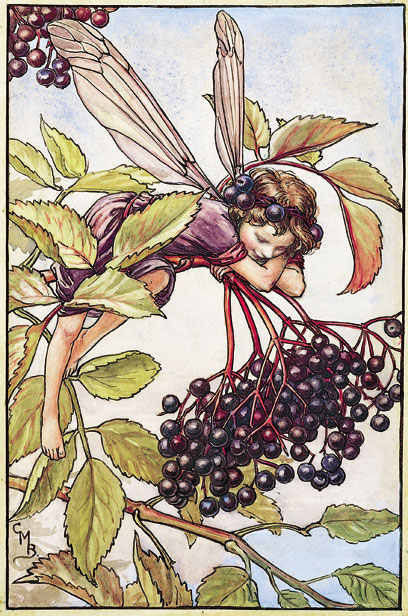
The artist Cicely Mary Barker, best known for her Flower Fairies series has also been likened to Beatrix Potter in the botanical accuracy of the plants and flowers amidst which the fairies dwell. the Victoria and Albert Museum has set up a gorgeous virtual gallery comparing their work. As the V&A notes ‘both were strongly influenced by what Potter described as the Pre-Raphaelites’ ‘niggling but absolutely genuine admiration for copying natural details’.
In 1842, Charles Darwin relocated to the English countryside where he would spend the next seventeen years working on his magnum opus, The Origin of Species.
There he adopted a surprisingly relaxed routine. The following schedule, provided by Francis Darwin, summarises a typical day in his father’s life.
7 a.m. Rose and took a short walk, followed by breakfast.
8a.m. Worked in his study; he considered this his best working time.
9:30 a.m. Went to drawing-room and read his letters, followed by reading aloud of family letters.
10:30 a.m Return to study, the end of his working day.
12 noon Walk, starting with visit to greenhouse, then round the sandwalk, the number of times depending on his health, usually alone or with a dog.
12:45 p.m. Lunch with whole family, which was his main meal of the day.
3 p.m. Rested in his bedroom on the sofa and smoked a cigarette, listened to a novel or other light literature read by ED [Emma Darwin, his wife].
4 p.m. Walk around sandwalk followed by clearing up matters of the day
6 p.m. Rested again in bedroom with ED reading aloud.
7.30 p.m. Light high tea while the family dined. In late years never stayed in the dining room with the men, but retired to the drawing-room with the ladies.
10 p.m. Left the drawing-room and usually in bed by 10:30, but slept badly.
Darwin’s strategy is one of crafted self-possession. He prioritises domestic comfort, time with the family, rambles in the country, and immersing oneself in the sensory world over hard-lined intellectual endurance. His emotional discipline is built on positive rather than negative reinforcement.
Moreover, it likely that this approach was adopted in an effort to maintain both his mental and physical health. As Scott Stossel notes in My Age of Anxiety: Fear, Hope, Dread, and the Search for Peace of Mind Darwin’s wellbeing was psychosomatically wed to his work.
Observers going back to Aristotle have noted that nervous dyspepsia and intellectual accomplishment often go hand in hand. Sigmund Freud’s trip to the United States in 1909, which introduced psychoanalysis to this country, was marred (as he would later frequently complain) by his nervous stomach and bouts of diarrhea. Many of the letters between William and Henry James, first-class neurotics both, consist mainly of the exchange of various remedies for their stomach trouble.
But for debilitating nervous stomach complaints, nothing compares to that which afflicted poor Charles Darwin, who spent decades of his life prostrated by his upset stomach.
However this modus operandi not only safeguarded Darwin’s health but also fostered a deep emotional connection with his research.
The personal intimacy intertwined with Darwin’s ‘entangled bank’ resonates within the lucid flow and appreciative tone of his argument.
It is interesting to contemplate an entangled bank, clothed with many plants of many kinds, with birds singing on the bushes, with various insects flitting about, and with worms crawling through the damp earth, and to reflect that these elaborately constructed forms, so different from each other, and dependent on each other in so complex a manner.
There is grandeur in this view of life, with its several powers, having been originally breathed into a few forms or into one; and that, whilst this planet has gone cycling on according to the fixed law of gravity, from so simple a beginning endless forms most beautiful and most wonderful have been, and are being, evolved.
Darwin resists an algorythmic, automatic, or breakneck approach; the symbiotic pleasurehe takes in both his writing and research is tied with his ability to take a moment, breathe, and witness the world in a wider dimension.
This consciousness of place, evolving from a sharpening of vision, and a slowing down of time is a method that can be applied to both natural history and to writing.
If your writing is made up of non-stop, frantic, action with no breathing space at all, then – instead of accelerating your work – you can just create a confusing muddle of disparate ideas.
In a letter to H.W Bates in 1861 Darwin provides a plan for dredging your thoughts out of this primordial soup. Lamenting the sting of labouring ‘very hard and slowly at every sentence’, he admits he sometimes finds style ‘a great difficulty’. His advice to fellow floundering writers is as follows:
I find it a very good plan, when I cannot get a difficult discussion to please me, to fancy that some one comes into the room, & asks me what I am doing; & then try at once & explain to the imaginary person what it is all about.— I have done this for one paragraph to myself several times; & sometimes to Mrs. Darwin, till I see how the subject ought to go.— It is, I think, good to read one’s manuscript aloud.
He also suggests that a writer should power through their piece briskly in order to construct a kind of skeleton argument; noting ‘it is good I think to dash “in medias res”, and work in later any descriptions of country or any historical details which may be necessary.’
Darwin, unsurprisingly, encourages writers to work with (rather than against) the natural selection process. Adam Gopnik in Angels and Ages: A Short Book about Darwin, Lincoln, and Modern Life explores Darwin’s strategy for adapting his argument to different environments. Short of growing gills, or developing the ability to camouflage, Gopnik describes Darwin’s power to create ‘a book that is one long provocation in the guise of being none.’ Gopnik notes that the habit of “sympathetic summary,” what philosophers now call the “principle of charity,” is essential to all the sciences and traces the the heart of Darwin’s rhetorical power with his ability to preemptively defend his ideas.
A counterargument to your own should first be summarized in its strongest form, with holes caulked as they appear, and minor inconsistencies or infelicities of phrasing looked past. Then, and only then, should a critique begin. This is charitable by name, selfishly constructive in intent: only by putting the best case forward can the refutation be definitive. The idea is to leave the least possible escape space for the “but you didn’t understand…” move. Wiggle room is reduced to a minimum.
All of what remain today as the chief objections to his theory are introduced by Darwin himself, fairly and accurately, and in a spirit of almost panicked anxiety — and then rejected not by bullying insistence but by specific example, drawn from the reservoir of his minute experience of life. This is where we get it all wrong if we think that Wallace might have made evolution as well as Darwin; he could have written the words, but he could not have answered the objections. He might have offered a theory of natural selection, but he could never (as he knew) have written On the Origin of Species. For The Origin is not only a statement of a thesis; it is a book of answers to questions that no one had yet asked, and of examples answering those still faceless opponents.
Darwin rhetoric not only predicates an opposing argument but inhabits it with all the fidelity and spirit of one who truly holds such an intellectual position. The survival of his thesis is won on the field of intellectual empathy, within the privacy of his own work, rather than through an indelicate fight to the death played out in the public arena.
Thus, Darwin teaches us that, in an effort to make sure that your work does not go the way of the dodo – and become usurped by an argument better suited to the wider intellectual climate – it is worthwhile to adapt your methodology and anticipate arguments in order to survive.
In the spirit of this philosophy, I think it is important to remember that such advice is worthless if you do not possess the tenacity to actually write the damn thing – intellectual stagnation, masquerading as perfectionism, is an all too common affliction of writers and researcher’s alike – Darwin himself after all did take over two decades to produce Origin, in equal parts due to academic ambivalence and an eight year sojourn to study barnacles.
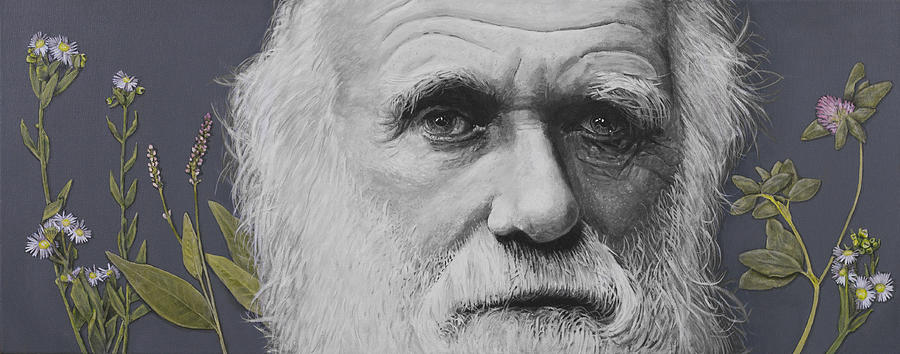
Sandlewalk Wood by Simon Kregar (2012)
Scott Stossel, My Age of Anxiety: Fear, Hope, Dread, and the Search for Peace of Mind (London William Heinemann, 2014)
Charles Darwin On the Origin of Species, (Oxford Classics, 2008)


















 he takes in both his writing and research is tied with his ability to take a moment, breathe, and witness the world in a wider dimension.